BlogCase Studies
How an iGaming Founder Unified Product, Marketing, Compliance, and Support

Konstantin BuzzResearch Lead
5 min read
Gamegist is an iGaming operator without in-house development: its business model is built around leasing and operating gaming platforms from specialized vendors.
The founder, Marco, now 52, has spent more than two decades in gaming and iGaming. Today he leads a fully remote team of around 60 people across Europe, Latin America, and Asia. Roughly 80% of the team is marketing—performance, affiliates, and creative—reflecting how much the business depends on fast user acquisition and retention.
In late summer 2025, Marco made a strategic decision to move the company onto BridgeApp. Within a few months, BridgeApp effectively became the operating system for the entire team.
The Challenge and the Solution
Before BridgeApp: fragmented workflows in a very fast business
Before BridgeApp, day-to-day work was scattered across multiple tools:
- Slack for internal communication with the core team.
- Jira for task tracking (and Asana before 2021).
- Telegram groups with the outsourced development team that owned and maintained the gaming platform.
- Separate Telegram chats with payment providers (the company also accepts crypto, so they work with a long tail of complex payment bridges).
- Affiliate managers using email, various messengers, and LinkedIn to liaise with and coordinate activities among affiliates, partner programs, and traffic vendors.
Each tool did its job, but together they often created a sense of chaos:
- Coordination between marketing, the external product team, internal engineers, risk, and support was difficult—especially when affiliates were involved.
- A few serious mistakes and even a regulator fine happened because important follow-ups were “lost” in chat context.
- Several critical updates were delayed, including in the most sensitive area: customer payments.
As Marco puts it:
“If you lose speed, you lose the race. If you lose trust, you lose all next races. We couldn’t afford either.”
He started looking for a single environment that could:
- bring internal and external communication into one place;
- provide a real-time view of key KPIs;
- help automate risk monitoring, approvals, and support.
Moving to BridgeApp: one platform for all teams and partners
In late summer 2025, the company began migrating to BridgeApp and, over the next few months, turned it into a single environment for communication, processes, data, and AI.
“BridgeApp had to prove itself quickly—and it did.”
What They Built on BridgeApp
1. A unified communication hub for internal and external teams
Instead of Slack plus dozens of Telegram chats plus email, the company now has a single comms landing inside BridgeApp:
- all critical conversations—with the internal team, external developers, payment providers, and affiliate partners—were moved into BridgeApp traded chats and topic-based channels cover product, marketing, risk, payments, and VIP players;
- external teams received access only to the specific channels where they needed to participate, private channels connect the team with external developers and payment providers;
- for a few affiliates who insisted on staying in Telegram, the team set up “bridges to BridgeApp”: messages are typed in Telegram, but appear for the core team in dedicated channels on the app;
- dedicated project channels handle new games and campaigns.
For the team, this means fewer lost messages, clearer ownership, and far less dependency on personal messengers for critical work.
2. Task Tracker instead of Jira boards, reminders, and Telegram pings
All product and technical workflows have been moved from Jira into BridgeApp’s Task Tracker and then refined. Separate boards now cover product and engineering sprints, marketing, and risk, with a shared overview of all workflows and statuses.
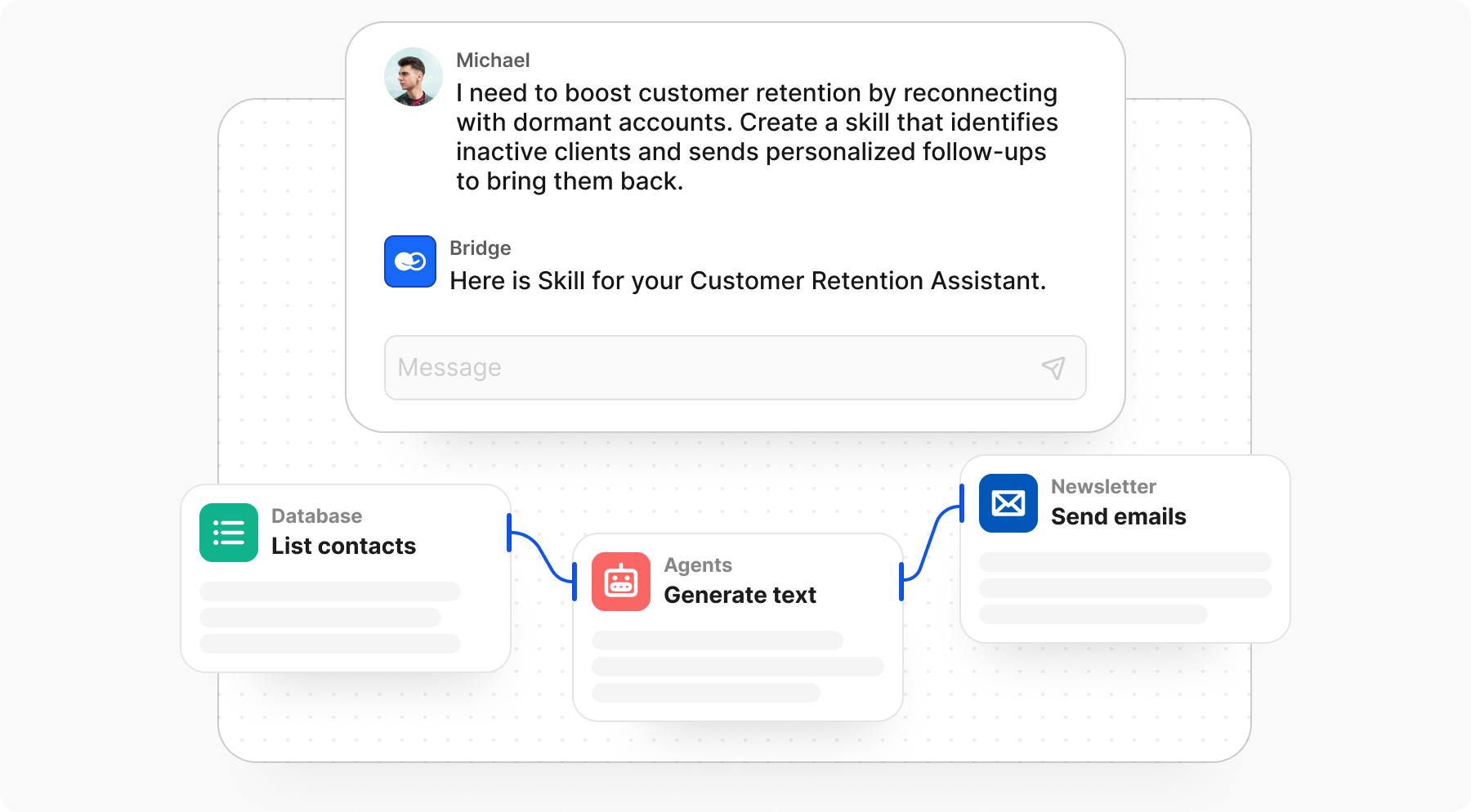
Because tasks and discussions now live in the same workspace, the team can ask AI agents for help directly from task cards—and, conversely, escalate incidents from chat to task in a single click. They can also scroll through the full decision and change history for each task.
3. KPI dashboards for the founder and leadership team
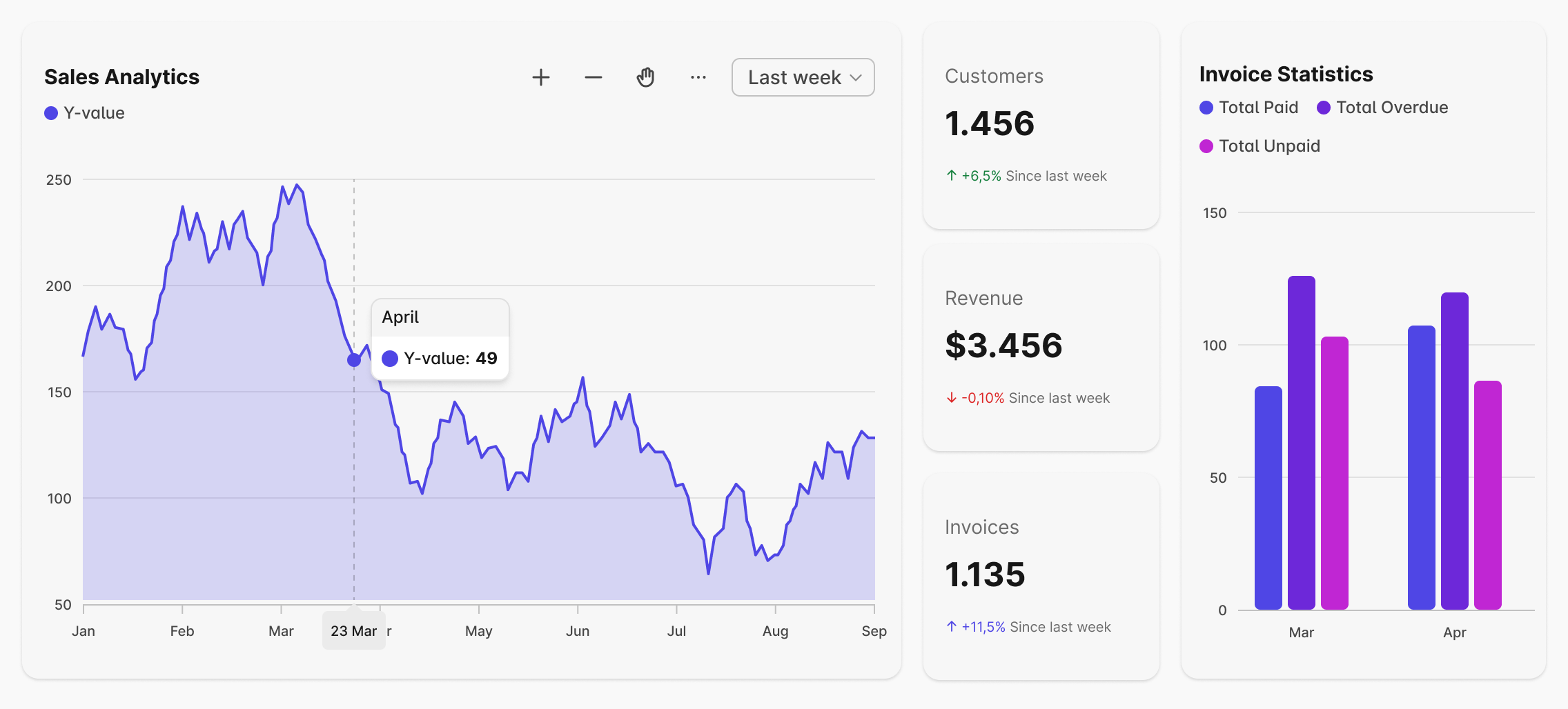
Through integrations with the gaming platform and payment systems, aggregated data is now piped into BridgeApp Databases:
- GGR and NGR by game and market;
- deposits and withdrawals;
- core retention and conversion metrics;
- key operational metrics such as payout processing speed.
On top of this, the team built several dashboards:
- a Performance Dashboard—a “cockpit view” for Marco with core KPIs;
- a Marketing Dashboard showing campaign and market performance;
- a Risk Dashboard surfacing suspicious activity and regulatory flags.
Managers now starts and ends the day in BridgeApp instead of jumping between four or five systems. They have a single “screen of truth” instead of a patchwork of exports and screenshots.
4. Risk team: triggers and automation in shared channels
For the risk function, the team configured a set of AI-automations on top of BridgeApp:
- triggers for key risk events (unusual betting patterns, frequent withdrawal attempts, KYC/AML flags);
- automatic task creation in the Task Tracker with links to the relevant player, provider, or campaign;
- notifications in dedicated channels (Risk, Compliance, Payments) so the right people see incidents at the same time.
This cut the team’s dependence on the vendor’s clunky internal service and on manual forwarding, and made it much harder to miss a critical signal. Marco had already learned that lesson the hard way—once bitten, twice shy.
5. AI-powered first- and second-line support
Inside BridgeApp, the team built a two-level AI support structure.
AI assistants were given the full context of brand rules, payout and winnings policies, bonus rules, and common player question scenarios. They now take over the first line—formulating routine answers and handling a large portion of requests autonomously.
When they cannot resolve a case, they escalate it to second-line specialists along with a prepared summary of the situation. Second-line support relies on AI-driven analysis of per-player dashboards and full activity histories, including the latest transactions.
The same bots are exposed in Telegram and WhatsApp, so players and affiliates can reach out through familiar channels, while the team still sees and manages all requests from inside BridgeApp.
6. AI agent for affiliate channels
Separately, the team launched a “betting analyst” AI agent in Telegram:
• the agent tracks which top games are live or upcoming, and what major wins or upsets happened;
• produces draft insights and analytical notes on possible next bets;
• hands those drafts to a human-run channel for refinement, with tone and creativity controlled by marketing and boundaries set by risk and compliance;
• the final picks are then pushed into several affiliate channels.
This setup helps boost affiliate engagement and bring additional traffic to the product.
7. Expenses, payouts, and budgeting inside BridgeApp
All expense and payout approvals were moved into BridgeApp:
- requests for marketing budgets and affiliate payouts are submitted as standardized tasks;
- approvals are transparent—everyone can see who signed off and when;
- over time, this builds a structured expense base that feeds an AI budgeting assistant.
The AI assistant helps the team:
- generate quick spend reports;
- compare budget vs. actuals;
- draft budgets for the next month or campaign.
For Marco, this adds a layer of visibility and fairness around money flows—critical in a business where trust and speed go hand in hand.
Success with BridgeApp
While the company has not yet run a full formal measurement, the impact is already clear to the team:
- Less context switching.
Instead of Slack, Jira, a dozen Telegram chats, and email, top management and key teams now start and end their day in BridgeApp. - Faster approvals and decisions.
Budget requests, risk incidents, and product tasks are easier to see, act on, and discuss—one click away from both the conversation and the task. - Support offloaded from repetition.
AI-powered first- and second-line support absorbs recurring questions, leaving human operators to handle complex cases. - More manageable risk.
The risk team works with triggers and structured tasks, not fragments of chat history. - Better affiliate integration.
Instead of affiliates living in separate chats and black-box tools, conversations, referrals, traffic, and transaction data are brought into the same workspace where product, risk, marketing, and finance work—so campaigns stay aligned, explainable, and easy to audit. - Simpler control for leadership.
The founder and C-level team have a single “truth screen” for core metrics—as well as a Copilot-like assistant that walks them through the most important items, including budget approvals.
Today, the company runs on BridgeApp’s cloud deployment. Given licensing requirements and growing volumes, the team plans to migrate BridgeApp to its own servers by spring 2026, keeping all existing workflows, dashboards, and agents intact.
For a founder running a high-velocity, high-pressure business in a heavily regulated industry, that is a natural next step:
“Don’t bet on luck; build your dream and let luck catch up.” — Marco says.