BlogHow-To Guides
How to Automate Employee Onboarding in 2026

Konstantin BuzzResearch Lead
5 min read

Bringing someone on board isn’t just pulling them from the murky waters of job sites or poaching them from a competitor. That part’s easy compared with proper onboarding. The real work is helping them become a true, valuable member of the crew. The transition from offer to fully integrated teammate is rarely trivial.
We’ve all lived the bad version, from either side. A newcomer shows up and spends weeks figuring out how everything works. Many teams underestimate how many recent hires are still lost—across docs, access, processes, equipment, and responsibilities. The cost is hard to price, but the signal is clear: training and social integration aren’t “nice to have.” They’re the difference between a well-paid warm body and a teammate who more than earns their salary.
That’s why larger organizations treat onboarding as its own discipline, with clear timelines and owners. Today, with agentic AI— artificial intelligence, capable of planning and executing actions—we can automate the grind.
Getting even one new hire sprint-ready takes a village. In most companies, six to nine roles work together to make it happen:
- New hire — the protagonist of the whole story.
- Hiring manager — sets expectations, goals, and early wins.
- HR (People/Recruiting) — paperwork, personal data, start date, policies.
- IT / service desk — accounts, devices, permissions, support.
- Security — least-privilege access, required training, audits.
- Finance — licenses, budgets, payroll details, benefits.
- Office/operations — badge, workspace, logistics, stationery.
- Legal/compliance — country and industry requirements.
- (Often) a buddy/mentor — the first line of help in week one.
The buddy’s purpose is to ease the transition: answering questions, walking the halls—virtual or real—introducing teammates and leads, and preventing silent drift. Increasingly, we can offload much of that coordination to smart assistants that monitor the process, nudge at the right time, and handle the repetitive steps so people can focus on what humans do best.
The 2026 tool stack for automated onboarding (by category)
- HR suites (ATS/HRIS). Applicant tracking and HR systems handle offers, e-signatures, pre-boarding packets, and day-one checklists. They centralize employee data and benefits, and use role-based templates to kick off onboarding tasks (including equipment-request steps) from offer to the first week. (e.g., BambooHR, Rippling).
- Identity and access (lifecycle/JML). Identity platforms automate joiner–mover–leaver events: create, update, and deactivate accounts, trigger changes from HR/IT systems, and grant/revoke access on time with a centralized audit trail (e.g., Okta Lifecycle). Role/attribute rules keep provisioning consistent, and unused licenses can be recuperated on offboarding.
- IT service and knowledge. Service desks automate employee onboarding by turning access requests, device hand-offs, and FAQs into templated onboarding flows tracked as tickets, with AI bots and an internal knowledge base providing consistent answers (e.g., Zendesk). This keeps exceptions visible and accountable and gives newcomers a clear, auditable path through day-one tasks.
- Workflow automation (iPaaS). Integration platforms stitch HR, IT, facilities, and finance into event-driven flows—creating HRIS profiles, provisioning identity and apps, opening IT tickets, scheduling orientation, and routing approvals in chat (e.g., Workato, Boomi). Think of it as the plumbing that listens for key events and moves data and actions across systems end-to-end.
- Execution & collaboration layer. Collaboration apps make the human side move faster. Bridge operates as the execution workspace: it runs fully integrated onboarding workflows, requests approvals at risky steps, writes changes back to systems of record. All that with smart AI agents, including Onboarding Buddy. Slack centralizes day-one comms in channels, pins key docs, and uses Workflow Builder to automate welcomes, intros, FAQs, and reminders.
How the AI onboarding works
Pre-boarding (from signed offer to the day before start).
Once the offer is signed, the buddy kicks off preboarding—the work from offer to day one—so the essentials are ready when the newcomer arrives. By day one it ensures that:
- All documents are signed, personal details are collected, payroll/tax forms are in, and the start date is locked.
- Equipment is requested, devices are imaged with the role’s software, a workspace or shipment is scheduled, and any building access is arranged.
- Core accounts are created, with baseline permissions ready.
- A manager is assigned and first tasks are queued, orientation sessions are on the calendar, and welcome communications are sent.
The buddy doesn’t just “check” these items—it maintains checklists, gathers confirmations from the new hire, and surfaces a simple dashboard for the hiring manager.
Day 0/1 (first day)
The buddy gets the newcomer plugged in fast—whether onsite or remote:
- Access check. Email, calendar, and primary apps confirmed; multi-factor authentication (MFA) turned on for secure sign-ins.
- Setup & sanity test. A quick “does it all work?” pass. If something breaks, the buddy creates the right support ticket—or guides the newcomer to file it correctly.
- Team map. Who’s who, who owns what, how to reach them, plus a short tour of the main workspace and key contacts.
- Business/product snapshot. Key metrics, goals, how the system fits together—and yes, the mission and motivation bear repeating.
- Security basics. How to avoid data leaks, bite-size training videos, and timely nudges on do’s and don’ts—standard day-one onboarding fare.
Day one should feel like total support. The buddy handles orchestration so people handle the welcome.
Week 1.
The buddy plugs the newcomer into the right repos and datasets, lines up the first tickets, and decodes the cadence—recurring meetings, stand-ups, handoffs, the whole drumbeat. It’s a week of small wins by design: first pull request merged, first dashboard query shipped, first support ticket closed. Around those outcomes sits the scaffolding—tight assignments, mentor check-ins, and required training—all of which keep momentum smooth without turning week one into a slog.
First 30/60/90 days.
Across the first one to three months, the buddy keeps the plan visible and the cadence predictable. Goals become measurable—objectives, milestones, owners, all written down and revisited on schedule. Access grows with scope, not before: as responsibilities expand, the buddy proposes new permissions, and higher-risk grants still pass a human check. Progress is visible rather than assumed; early results are logged, review loops are booked, and both the newcomer and the manager can see where things stand—and what’s next. Eventually the nudges stop; the buddy tips its hat and slips away. Apprenticeship complete.
The offboarding buddy (a separate agent)
Exits deserve the same discipline as entries, so there’s a dedicated offboarding buddy. It revokes accounts and tokens, confirms devices are returned, transfers document and repo ownership, settles outstanding expenses, and closes the loop on payroll and benefits. It also collects final signatures and logs the whole trail for audit. In short: clean handover, no dangling access, no orphaned assets.
Common onboarding headaches (and how an AI buddy fixes them)
Onboarding often breaks for very human reasons—mixed signals, off days, plain forgetfulness, a newcomer too modest to ask or reluctant to bend etiquette—and sometimes simple “not my job” gaps. A lead’s missed coffee or a bad morning in finance can stall a newcomer for days. The buddy can’t fix feelings, but it buffers them with structure and timing.
The buddy keeps expectations realistic. It knows what’s premature to ask of a newcomer and, on request, reminds the manager. It helps set a clear day/week/30/60/90 plan, then tracks follow-through. It’s the first stop for “how to,” “where to check,” and “who owns this,” so the new employee isn’t wandering through channels and coffee corners asking around. That cuts the noise—and the shortcut advice that sends people sideways.
No more “can you add me?” pings. Accounts and baseline permissions are ready before day one; the buddy grants them at the right moment and explains what each access does. It absorbs repetitive questions so admins don’t have to. Routine training and instructions don’t slip. Higher-risk permissions stay locked until training is done, and the buddy keeps security top-of-mind.
The buddy checks that required software licenses exist—and that unnecessary ones don’t—then alerts the owner so fewer “zombies” drain the budget. It also helps request gear—from stationery to laptops—in the right format, with the right approvals.
Last but not least, it helps ensure compliance that doesn’t drift. It chases missing consents and country-specific forms, making sure personal data is handled the way local rules require.
In a nutshell, the buddy replaces manual checklists and sprawling email threads with clear triggers and receipts: it starts from real events, issues role-based access packages (prebuilt groups, apps, licenses), compares “should be” vs “is,” flags gaps, and proposes fixes; tracks deadlines and pings the right person before things slip. It also keeps an audit trail (who granted what, when, and why) and escalates risky steps or unusual patterns to managers for a fast, human decision.
Is automated onboarding outcome measurable?
Is automated onboarding measurable?
We decided to test ourselves. We pulled a month of team chat and ticket logs and asked a simple question: does automation move the needle? Two hires, same role, same company—only the onboarding method changed.
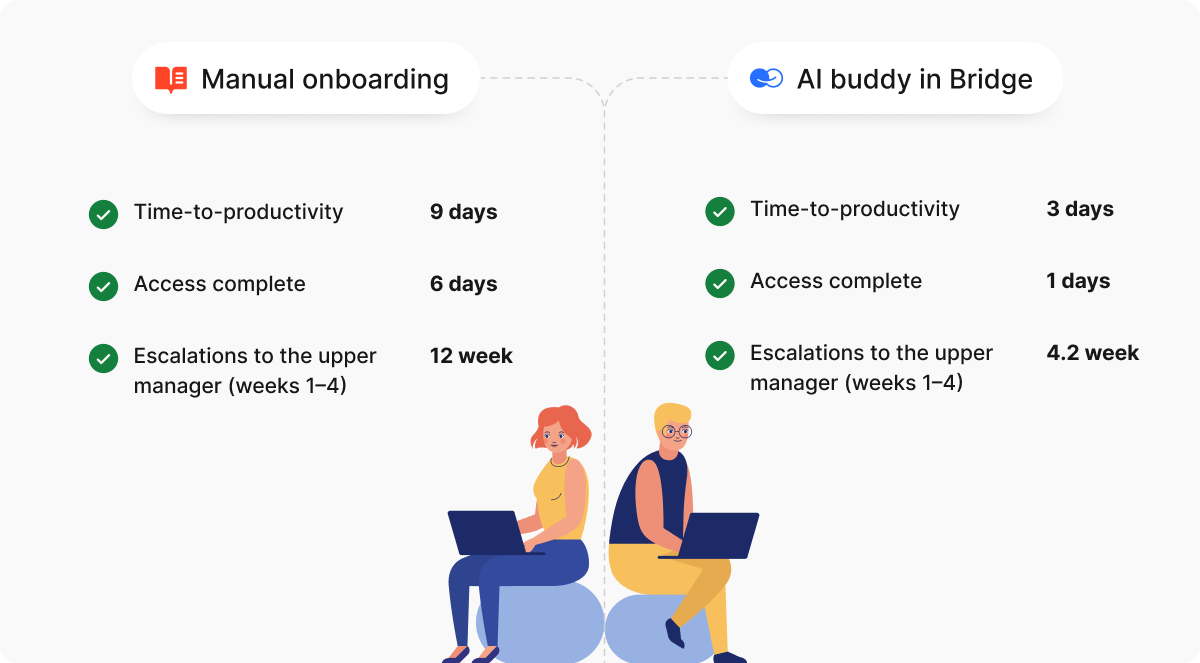
Same team, same role, different runbook. The outcomes speak for themselves.
BridgeApp and automated onboarding
BridgeApp is where a team’s work actually lives. It pulls tasks, data, and conversations into one place, cutting app-switching and duplicate work—the biggest sinkholes in early ramp. The built-in Knowledge Hub serves people and AI agents: everyday playbooks sit alongside legally sensitive policies and industry rules, so guidance and governance share one shelf. Role-specific agents work like teammates and are built in a no-code editor by combining behavior (prompts), inputs (variables), knowledge (docs/data), and skills.
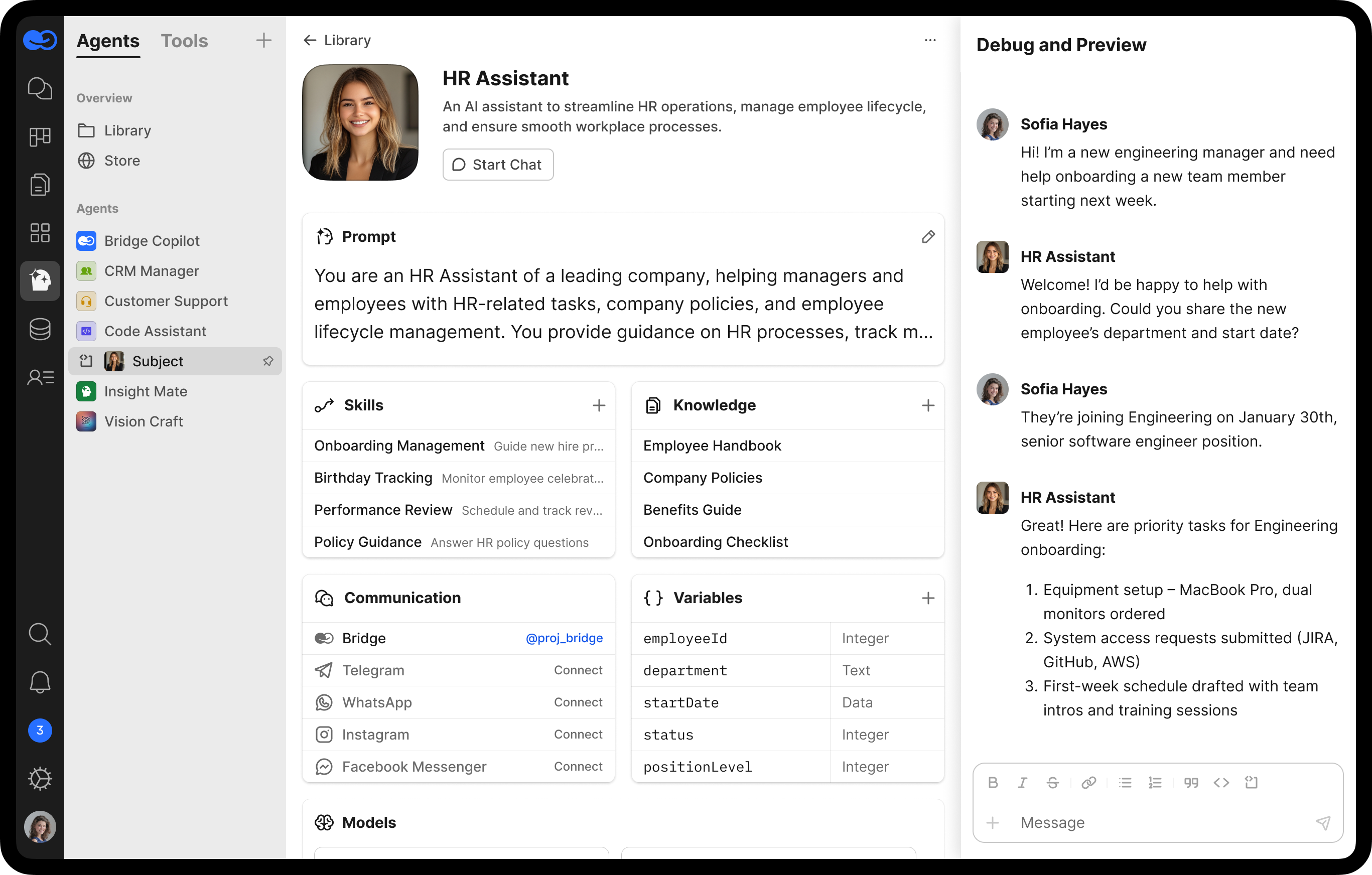
One of those agents is the onboarding buddy. Beyond running the flow, it performs should-be checks, surfaces bottlenecks, and turns progress into clear reports instead of guesswork. During setup, you explicitly declare sources of truth and ownership: who holds a person’s data and role, who approves exceptions, who speaks for the team. New hires get a mentor who’s constantly available and helps keep important steps from slipping. The hiring manager stays in the loop and can also talk to the buddy directly. Some decisions remain human—costly licenses, admin rights, access to personal data—and BridgeApp makes those moments obvious, auditable, and quick to resolve.
In the end, that’s the point: automate the toil, highlight the moments that should get attention, and keep the whole story consistent. Let conversations stay front and center, let agents handle the busywork, and give newcomers a clear lane to contribute from day one.
Try BridgeApp smart digital workspace for modern teams with its onboarding buddy (and many more AI agents).