BlogIndustry Insights
Digital Sovereignty in 2026: International Data Flows after the EU-US Privacy Shield

Konstantin BuzzResearch Lead
5 min read
Big Tech was quick to internalize the "data is the new oil" mantra. But while the industry raced to move every conceivable service to the cloud, it took years for governments and boardrooms to realize the uncomfortable truth: their data security and legal pipelines were held together by little more than duct tape and optimism.
The seismic shift hit on July 16, 2020. In a decision that felt less like a legal ruling and more like a controlled demolition, the Court of Justice of the European Union (CJEU) handed down its verdict in Case C-311/18—immortalized in the tech lexicon as Schrems II.
The court didn't just move the goalposts for international data flows; it uprooted them and threw them into the sea. The CJEU invalidated the Privacy Shield between the EU and the US, severing the primary legal bridge for transatlantic data. It also placed Standard Contractual Clauses (SCCs) under a hi-rez legal microscope, forcing thousands of organizations to realize their entire tech stacks were built on shifting tectonic plates.
The Genesis of the Chaos: Data Protection Commissioner v. Facebook and the Security of Personal Data
The chaos started with Maximillian Schrems, an Austrian law student turned privacy insurgent, targeting Facebook Ireland. The narrative began to unravel in 2013, when Schrems filed a complaint challenging how the Irish subsidiary of the Menlo Park giant funneled the personal data of EU citizens back to the United States. His argument was a surgical strike against the status quo: he contended that US surveillance laws allow American intelligence agencies and other US authorities to vacuum up European data in a way that fundamentally clashes with the core tenets of the General Data Protection Regulation (GDPR) and broader European data protection laws.
The resulting "Schrems I" ruling by the CJEU on October 6, 2015, sent shockwaves through the Valley by instantly vaporizing the Safe Harbor agreement. By 2020, the CJEU doubled down. The court ruled that US law simply cannot offer an "essentially equivalent" level of protection to Europe’s gold-standard privacy regulations. This wasn't just another regulatory headache; it was a "Code Red" for every IT and legal department across the continent. Suddenly, every European firm relying on an American SaaS tool or a US-based cloud service found themselves standing on thin legal ice that was beginning to crack.
The "Hasty Compliance" Era: A Schrems II Summary of the 2020–2025 Fallout
When the Privacy Shield collapsed, European corporations panicked. The immediate, knee-jerk reaction for most was to paper over the cracks with Standard Contractual Clauses (SCCs). But the CJEU had already anticipated this "check-the-box" maneuver. While the court technically upheld SCCs as a valid mechanism, it stripped them of their perceived "automatic" safety. The ruling made it clear: a contract is only as strong as the law of the land where the data lands. If the recipient country allows for overreaching surveillance that overrides private agreements, SCCs alone are no longer enough to ensure adequate protection.
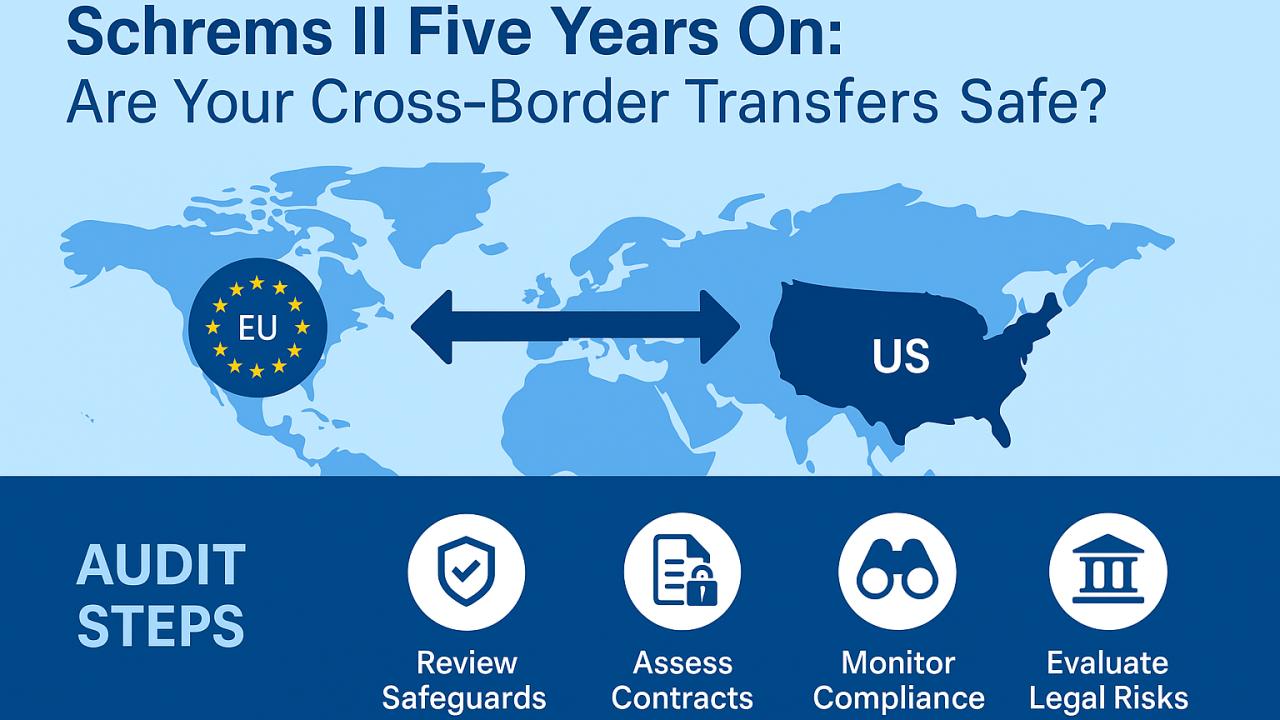
The Court’s message was clear: You cannot simply sign and forget; you must ensure that your chosen transfer mechanism remains valid under EU law and is updated to the latest 2021 SCC modules. This ruling effectively deputized data controllers and data importers into amateur intelligence agencies. Data exporters became legally tethered to mandatory forensic audits of every vendor on a case-by-case basis. Conducted at appropriate intervals, these reviews now include researching local surveillance programs and practices. This ushered the era of the Transfer Impact Assessment (TIA)—a dense, soul-crushing bureaucratic hurdle that required tech leads to prove that a sub-processor in Northern Virginia wasn't a back door for the NSA.
The ensuing half-decade has been defined by this frantic, high-stakes game of regulatory Whac-A-Mole. Businesses have spent millions trying to retroactively engineer legality into operations that were never designed for digital borders. “Well, I guess it’s okay” has ceased to be a viable strategy.
The TIA: Navigating European Data Protection Board Guidelines Turned Data Transfers into an Audit Discipline
Think of a TIA as a mandatory, high-stakes building inspection that must be completed before you move a single byte into a new storage facility. It is no longer enough to trust the landlord's word; you are now legally required to conduct a forensic, component-by-component evaluation of the entire structural integrity under the GDPR.
The core of the TIA is an assessment of risk when "transferring personal data outside the European Economic Area (EEA) to countries lacking an adequacy decision." The scrutiny must prove that third-country data protections are "essentially equivalent" to the EU's gold standard. If the inspection reveals a crack—if the destination country's laws allow for overreaching surveillance—the company is legally mandated to implement 'supplementary measures,’ i.e., additional safeguards to ensure adequate protection. And here the kill switch appears: if an adequate level of protection cannot be guaranteed even with those extra safeguards, the data transfer must be suspended or terminated immediately. In the post-Schrems world, ignorance isn't just bliss—it's a massive liability.
To survive the scrutiny of a European Data Protection Authority (DPA), your strategy must evolve through five critical phases:
- Map the Terrain (Inventory): Identify every cross-border hop and sub-processor.
- Patch the Legal Firmware (Mechanism Check): Update to the latest 2021 SCC modules.
- The Jurisdictional Deep Dive (Local Law Audit): Analyze for backdoors like Section 702 of the Foreign Intelligence Surveillance Act (FISA).
- Build the Digital Moat (Guardrails): Implement strong encryption where keys stay in the EU.
- Document for the Snap Audit (Accountability): Maintain a "black box" paper trail for DPAs.
The Operational Tax: Managing Data Transfers in the Shadow of Schrems II
For the modern enterprise, the fallout of Schrems II has transformed the tech stack into a legal minefield. Every high-profile American vendor in your architecture—Slack or Salesforce, Google or Microsoft 365, Asana or Jira—is no longer just a productivity tool; they are potential compliance liabilities requiring their own forensic audits.
In this new reality, vendor inventory and TIA maintenance have evolved from "one-and-done" procurement checkboxes into a permanent operational burden. This is the new "compliance overhead" — a tax that scales linearly (and painfully) with your cloud infrastructure. As your footprint expands, so does the complexity of your legal defense. In the post-Schrems era, scaling your tech doesn’t just mean more investment in computational power; it means more scrutiny.
The Data Privacy Framework (DPF): A Fragile Peace in the European Union
Attempting to engineer a diplomatic ceasefire, the European Commission adopted the EU-US Data Privacy Framework (DPF, the successor to the failed Privacy Shield Framework) in July 2023, signaling that the digital bridge between the two continents was finally open for business again. Anchored by President Biden’s Executive Order 14086, the DPF introduced the Data Protection Review Court (DPRC)—a specialized judicial body designed to provide Europeans with a real way to enforce data subjects' rights and a binding mechanism to challenge US surveillance. It was a sophisticated attempt to build a legal foundation strong enough to withstand the "Schrems effect," aimed at restoring the flow of data that underpins the modern transatlantic economy.

But in the world of high-stakes privacy litigation, "certainty" is a moving target. Max Schrems and his organization, NOYB, immediately called the Commission’s bluff, labeling the DPF a "copy-paste" of its failed predecessors. They insist that without a fundamental reform of FISA 702, any court created by an executive order is just a decorative facade of an inherently flawed structure.
As of 2026, the quiet is deceptive. In its September 3, 2025 judgment, the General Court confirmed the US offered "adequate" level of protection at the time the DPF was adopted, the victory is purely tactical. An appeal was filed on October 31, 2025 and is currently winding its way through the CJEU. With a further CJEU challenge now pending, we are one judicial heartbeat away from another "hard reboot" of global data flows.
The Financial Reality Check: The $5 Million "Privacy Tax"
This new compliance order is a massive, escalating drain on the balance sheet. By 2026, 38% of global companies are earmarking $5 million or more annually for their privacy programs—a staggering leap from the 14% seen at the start of 2025.
For Small and Medium Enterprises (SMEs), the situation is even more sobering. A baseline compliance setup for a lean startup now commands an "entry fee" starting at €25,000, while for a standard SMB, this figure quickly climbs to €75,000. But that’s just the down payment. To keep the lights on and the regulators at bay, SMEs are looking at an annual burn rate of €40,000 to €100,000 for ongoing audits, sensitive data protection, and outsourced DPO services. In 2026, privacy isn't a feature; it's a high-maintenance engine that requires constant tuning to protect sensitive data and satisfy the competent supervisory authority.
The Wall of Fines: When Data Protection Authorities Turn Warnings Into Bills
The risk of non-compliance has shifted from a theoretical legal ghost story to a brutal, line-item reality. European regulators have traded their warning letters for billion-euro bills. This isn't just about administrative slaps on the wrist; it’s about existential financial trauma. In 2023, Meta set the grim gold standard, getting slapped with a record €1.2 billion fine for funneling Facebook users' personal data to the US without the "essential" safeguards demanded by Schrems II. The trend only accelerated as we hit 2025, when TikTok was hit with a €530 million penalty for failing to wall off EEA user data from unauthorized access in China. The message to tech leaders is clear: the cost of a legal detour is now hundreds of times higher than the cost of the road itself.
That pressure is why the architectural question is no longer separate from the legal one.
BridgeApp: A Sovereign Fix for Data Protection and Cross-Border Compliance
To escape the "Schrems cycle," you have to stop patching the legal leaks and start fixing the plumbing. The only durable solution in 2026 is data localization.

BridgeApp is an AI-native WorkOS designed to be the ultimate sovereign collaboration hub. It unifies messaging, task management, and deep databases into a single "source of truth" where AI agents operate as first-class citizens alongside human teammates. By providing agents with the same context and permissions as employees, BridgeApp replaces the "goldfish memory" of standard chatbots with a synchronized workforce.
Engineered as a "sovereign workspace," BridgeApp addresses the core systemic failure: jurisdictional exposure. It is a mission-critical fix for EU firms currently tethered to US-based SaaS giants.
Why the Architecture Wins: Engineering the Exit Strategy
- On-Premise Ready: By deploying directly onto your own infrastructure, you turn compliance risk into a zero-sum game. You are the architect of your own safe harbor.
- Radically Simplified Compliance: By keeping relevant data and processing within the EEA or on infrastructure you control, you can significantly reduce reliance on SCCs, TIAs, and recurring transfer-risk assessments.
Switching to BridgeApp isn't just a security upgrade—it’s a hedge against legal volatility. It allows you to stop worrying about cross-border data transfers or the next CJEU ruling and start focusing on growth. Make the workspace truly yours with full White Label customization – your brand, your style. From logos to domain, UI elements, and themes – create a workspace that looks and feels like your brand.
The Engineering Edge
BridgeApp is more than a defense; it’s an upgrade for your development lifecycle:
- Lossless Asynchronous Communication: Through deep-nested threads, persistent pins, and @-mentions, the "why" behind every decision is never buried. By integrating discussions directly with task management and code reviews, the rationale behind every line of code remains exactly one click away.
- Agentic DevOps: GitHub and GitLab webhooks turn BridgeApp into a proactive coding partner. The system automatically transforms bug reports and incidents into structured sprint tasks—complete with logs and context—before your team even starts their morning stand-up. It allows your engineers to skip the manual triage and move straight to the fix.
- Context-Aware Intelligence: Your knowledge is no longer a graveyard of old docs. BridgeApp treats your knowledge base as a dynamic, high-context repository. With live databases and documents bi-directionally linked to active tasks, your AI agents operate with a deep understanding of your codebase and business logic.
Deploy BridgeApp on-premise, integrate it with your tech stack, and centralize everything — communication, processes, and AI automation — in one secure hub. Try all advanced features with BridgeApp Enterprise.
Ready to explore BridgeApp? Visit the pricing page, request a demo, start with the free plan, or contact the team about enterprise deployment options.
* BridgeApp provides personalized onboarding tailored to your team's structure and goals. From step-by-step guidance and detailed documentation to interactive training, we make sure your team quickly becomes confident and effective with BridgeApp — no matter your size or complexity. The result: faster adoption, fewer support requests, and a team fully equipped to succeed.