BlogIndustry Insights
The Ultimate Guide to European Alternatives to Big Tech Saas Tools

Konstantin BuzzResearch Lead
12 min read
Credit where it’s due: Europe’s bureaucracy has worked wonders. How many companies born in Europe make the global top 25? Go on – count. It’s a sobering tally for a continent that writes the rules of privacy yet shackles itself with rigid regulation.
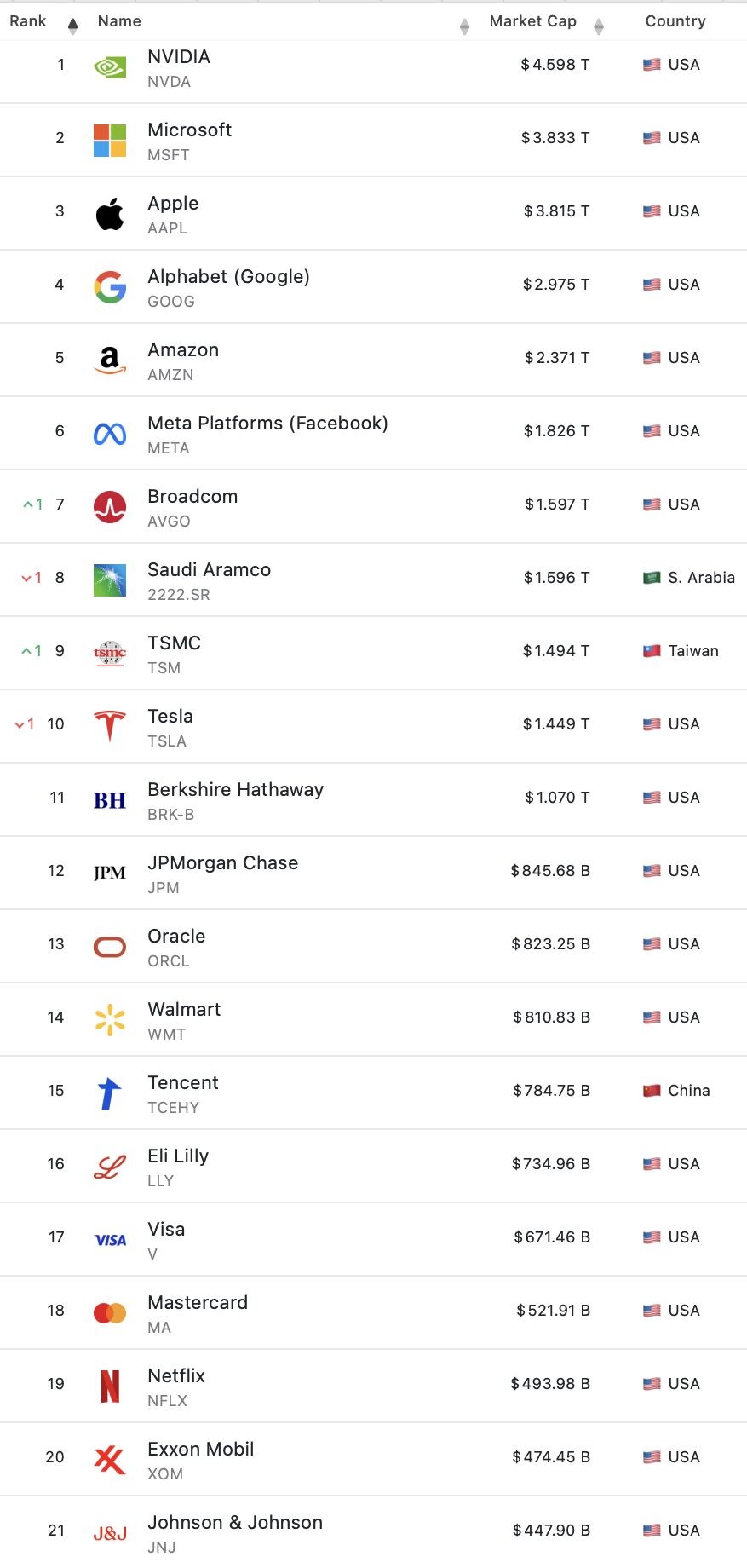
The same story plays out in software: most Europeans still lean on U.S. Big Tech – with one caveat: Germany’s SAP does crack the top twenty.
But what if you’d rather keep your data off U.S. clouds altogether?
The Old World doesn’t shout, but it delivers. It has options.
This guide maps which European tools can actually replace the dominant online services – and which offer EU data residency, on-premises deployments, or end-to-end encryption. When you outgrow a renowned U.S. vendor, which will you choose?
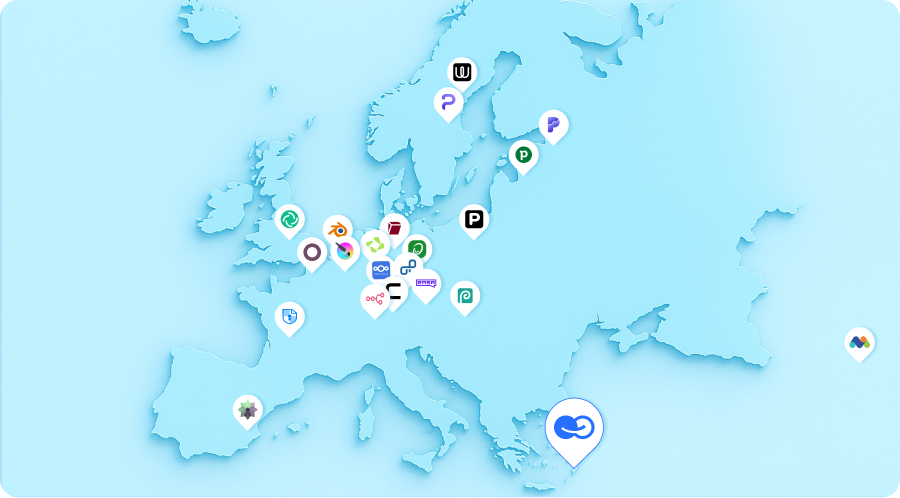
Think of this guide as a trampoline from U.S. corporate SaaS to Old World alternatives. We’ll cover what to pick and what to watch for. We’ve gathered options that are pain-light for pragmatists and compliance-first for auditors and security teams. Let’s chart a course to trade dependency for digital independence – without blowing up your roadmap.
Collaboration / Communication
BridgeApp (Cyprus)
Incorporated in Cyprus as Math & Magic Ltd., with Yana Mareva (CEO) and Rinat Shaikhutdinov (CTO) as BridgeApp’s key executives. The product is positioned as a task-management suite with a knowledge hub and an intuitive workspace for human-AI collaboration. All of that is bundled into something teams can “own for life” and run securely on-premises. AI agents live in the same chats, docs/wikis, and live databases; they can read the knowledge base to answer questions, draft content, and create or oversee tasks. Plus, BridgeApp includes a kanban-style task tracker and audio meetings, so it’s the kind of stack many companies currently stitch together from Slack/Teams, Notion/Google Drive, ClickUp/Jira, and automation tools like n8n.
BridgeApp is designed to be compliant with EU regulations, including GDPR requirements, making it suitable for enterprises, regulated industries, and public sector organizations operating within the European Union.
By enabling sovereign deployment options and strict access controls, BridgeApp helps teams meet security, compliance, and data protection standards without compromising collaboration or AI-driven productivity.
With BridgeApp, Your Team Gets:
- Full Data Ownership: Everything runs securely on your infrastructure.
- Complete Customization: White-label every detail, from branding to user experience.
- AI-Powered Operations: Automate repetitive processes, reporting, onboarding, and more.
- Seamless Integration: Easily connect with all critical tools in your ecosystem.
Things to note: Some advanced features, such as video calls, are being developed in-house and will roll out in upcoming releases (2026).
💶 Pricing:
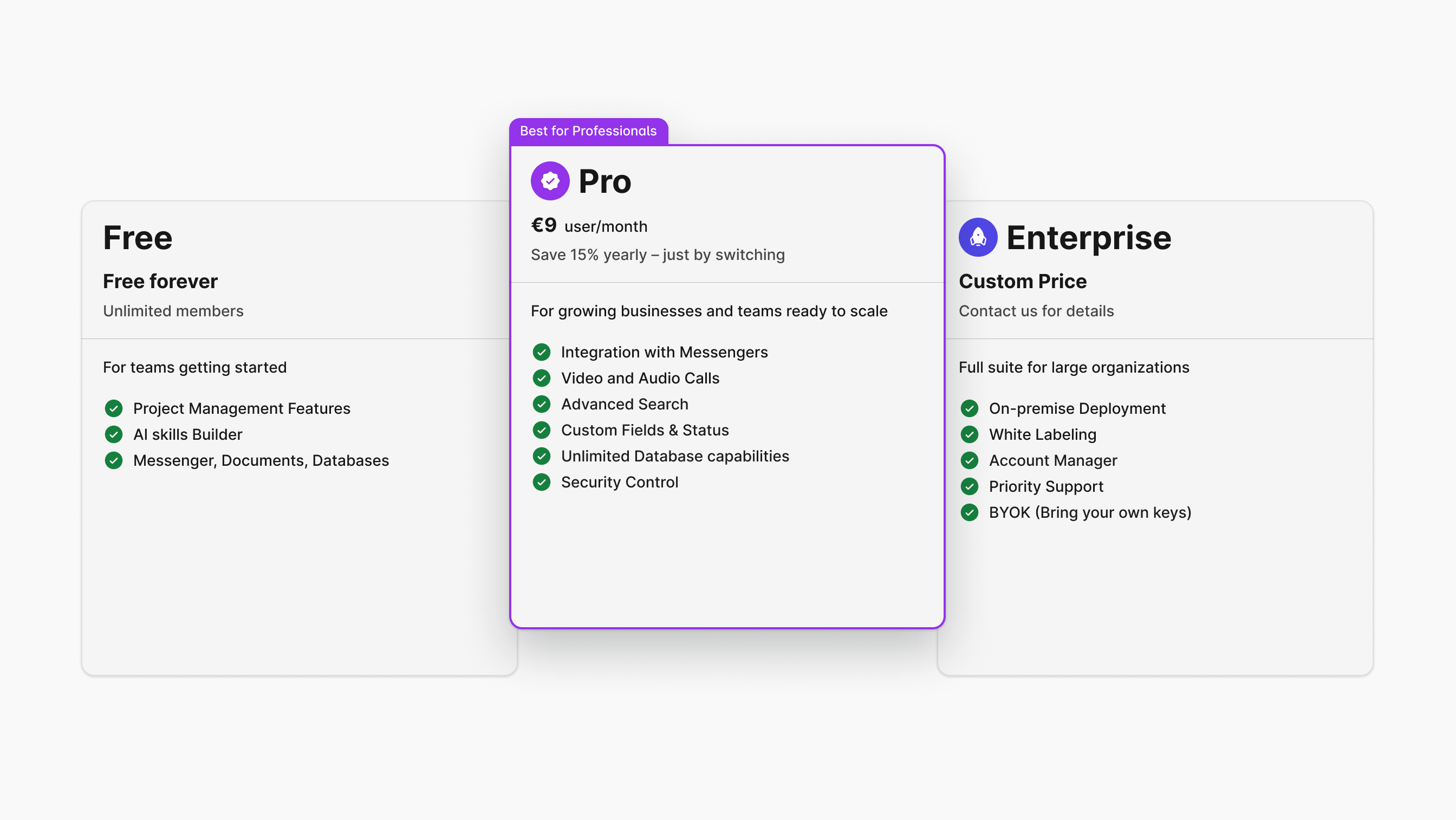
Free plan supports unlimited users and includes all core features. Pro is listed at €9/user/month (or €90/year). Enterprise goes with the on-premises option, white-labeling, an account manager, SLA, and advanced security, with pricing available upon request.
Wire (Switzerland)
A secure team messenger for chats, file sharing, and voice/video – functionally comparable to Slack/Teams – but with end-to-end encryption (E2EE) on by default across messages, calls, and files; self-hosting (on-premises) is available. Wire positions itself as compliant with GDPR/NIS2 and ISO 27001. Headquartered in Zug, Switzerland, it was founded by Jonathan Christensen, Priidu Zilmer, and Alan Duric. In 2020, Wire co-founder and CTO/COO Alan Duric described the platform as built on a security-first approach and a zero-trust framework “without compromising usability.” He also said his aspiration was to enable people to communicate “with the utmost privacy” – one reason Messaging Layer Security (MLS) has been a key project for him and the team.
By default, Wire offers MLS for large, encrypted group chats – designed to scale E2EE to thousands of participants – and it has been generally available since April 24, 2025, for Wire Cloud users and teams. Admin and identity controls (SSO/SCIM) are available for enterprise rollouts, alongside open-source clients and a transparency-first security posture.
🔻 Drawbacks.
Users praise privacy but sometimes flag price/value versus feature depth, as well as occasional cross-platform quirks and feature-parity gaps compared with mass-market SaaS. As always, test against your specific workflows.
💶 Pricing.
A Free plan covers small teams (up to five people) with core collaboration features, multi-platform support, and up to eight devices; the SMB plan is €7.45 per user/month when billed annually (€8.94 monthly) and adds larger video conferences (up to 150), SSO/SCIM, admin controls, and external/guest roles; enterprise and government tiers are custom-priced and include on-premises options and advanced controls.
Matrix / Element (UK)
Matrix is an open standard and protocol for secure, real-time communication (IM/VoIP), built for federation—independent servers (“homeservers”) talk to each other like email, so you’re not locked to one vendor. It underpins multiple government-grade messengers, including France’s Tchap, Germany’s BundesMessenger, and NATO’s NI2CE.
Conceived by Matthew Hodgson and Amandine Le Pape in 2014, as open source, to enable secure connection between teams and organisations built on diverse platforms, a challenge that Hodgson sums up neatly: “End-to-end encrypted platforms have to speak the same language from end to end”. Matrix also has a commercial steward, Element, which has raised ~$48 million by 2021 to accelerate ecosystem development, and completed an additional round for €50 million recently in 2025.
Matrix is federated and self-hosted: you can run your own server, keep data in your jurisdiction, and still interoperate with others. The security model bakes in end-to-end encryption and is used by public-sector deployments for sovereignty and control; the ecosystem spans multiple clients and servers and a large open-source community, with the protocol shaped by the Matrix.org foundation.
🔻 Drawbacks
More ops overhead than centralized SaaS (you’re running a server); mobile UX and stability can vary by client and setup; initial governance/interop choices (federation, E2EE key management) add complexity for newcomers. These themes recur across public case studies and community feedback.
💶 Pricing
Matrix (the protocol) is open and free to implement. Commercial hosting, support, and enterprise tooling are offered by Element (Matrix’s primary commercial backer). If you want sovereignty, you can self-host.
Tuta (Germany)
A privacy-first email, calendar, and contacts suite from Tutao GmbH (HQ: Hanover, Germany). It’s the European alternative to Gmail and Microsoft Outlook/Exchange for teams that want end-to-end encryption by default. Tuta was founded in 2011 by Arne Möhle and Matthias Pfau; the company remains wholly owned by the founders.
Tuta’s origin story is unapologetically about sovereignty and privacy. The team frames its mission as building tools so “anyone, anywhere” can communicate securely – “to fight mass surveillance” and make privacy with zero-knowledge architecture the default. Their manifesto and team page double down on that stance, and in 2024 they rolled out a post-quantum hybrid protocol (TutaCrypt) for future-proof encryption.
Tuta offers full-stack E2EE for mailbox, calendar, and address book; open-source clients with auditable code on GitHub across web, desktop, and mobile; and German-hosted infrastructure in ISO 27001-certified data centers.
🔻 Drawbacks.
You don’t get legacy protocols like IMAP/POP3 (by design, to preserve end-to-end encryption), which can limit compatibility with third-party clients and some migration paths. Reviewers also point to occasional usability quirks compared with mainstream suites.
💶 Pricing & funding.
Personal plans: Free (€0,1 GB), Revolutionary (€3/mo), Legend (€8/mo) when billed yearly. Business plans are listed separately and add admin features, custom domains, and support. Tuta states zero external investors; the company is independent and funded by customers.
Proton (Switzerland)
A Swiss privacy company building a hallmark alternative to the Google stack, with cutting-edge encryption: email, calendar, file storage, VPN, password manager, crypto wallets, and more. All that — designed so Proton itself can’t read your data and even a server breach doesn’t expose readable content. The company is Proton AG, majority-owned by the Geneva-based Proton Foundation, and a founding team led by Andy Yen (PhD Harvard; former CERN physicist). The project collected its initial funding through a 2014 crowdfunding that drew 10,000+ backers and over $500k, and has since stated its mission to “build an internet that puts people before profits.” Today it also cites grants (e.g., EU/EIC) and third-party backers of small amounts, rather than VC rounds.
Proton positions itself as a practical, European answer to Big Tech: privacy by default, no ads, and strong jurisdictional protections (Swiss foundation ownership; ISO 27001 certification). Yen’s public stance is consistent: privacy is a fundamental right, and Proton exists to make private tools usable at scale – “Google, without your data,” as WIRED summarized when Proton broadened beyond Mail to Drive and Calendar.
🔻 Drawbacks.
Some metadata isn’t end-to-end encrypted (e.g., subject lines and addresses), which Proton documents openly. Classic IMAP/SMTP access requires the Proton BridgeApp on desktop; that extra hop can add setup and support friction. In user reviews, teams also mention search limitations on encrypted mail and that certain Proton products (e.g., VPN for Business) can feel quite pricey versus competitors.
💶 Pricing.
Proton offers a Free tier and paid bundles for individuals, families, and businesses. Proton Unlimited with 500 GB of total storage, 3 custom email domains, and unlimited email aliases costs €9.99/month on yearly subscription.
Mailbox.org / Opencloud.eu (Germany)
A German privacy-centric email, office, and cloud suite run by Heinlein Hosting GmbH in Berlin. It’s a European alternative to Gmail/Google Workspace and Microsoft 365 with mail, calendar/contacts, Drive cloud storage, Meet video conferencing, and an online Office. The service launched in 2014 in response to the post-Snowden surveillance climate, building on the JPBerlin roots to offer ad-free, security-first email. As its CEO, Peer Heinlein, stated: “If you demand open source and digital sovereignty without having to sacrifice convenience, then you have to be able to offer answers.”
Under the hood, you get integrated Pretty Good Privacy via Guard (turn it on with a lock icon right in the composer), your own PGP key server (HKPS), optional Mailvelope for client-side keys. In addition, there’s a stack that now includes video meetings and collaborative docs. The provider highlights Germany-based certified hosting, GDPR compliance, and even BSI IT Security Labels reconfirmed recently.
🔻 Drawbacks.
Public reviews often mention modest included storage and limited filtering/rules versus big-box suites; roundups also note there’s no permanent free tier, the service isn’t fully open-source, and dedicated mobile email apps are limited—so test workflows and UX before a full move.
💶 Pricing.
Light — €1/mo: 2 GB mail, 3 aliases, calendar/contacts; Standard – €2.50/mo (or €30/yr): 10 GB mail, 5 GB Drive, Office & Meet, custom domains, family accounts; Premium – €7.50/mo (or €90/yr): 25 GB mail, 50 GB Drive, priority and phone support.
Documents, spreadsheets, collaborative editing
Nextcloud (Germany)
Founded by Frank Karlitschek (ex-ownCloud) and headquartered in Berlin; Nextcloud GmbH builds a self-hosted collaboration stack. It is a modern on-premises alternative to Google Drive/Docs + Microsoft 365 + Zoom/Meet: file sync/share, real-time document editing, chat and video meetings, and groupware across web, desktop, and mobile – running on your servers. Karlitschek describes the mission of Nextcloud as “to provide a collaboration solution that is 100% open source and can be self-hosted by everyone”. Public interviews and founder posts consistently stress customer-funded growth (revenue for support/subscriptions) rather than investors.
Nextcloud includes Talk (chat & video): team chat and video calls integrated with files; calls support end-to-end encryption (E2EE), office editing: choose ONLYOFFICE (strong OOXML compatibility for .docx/.xlsx/.pptx) or Collabora Online (LibreOffice-based) for collaborative editing. The suite can be self-hosted and integrated with SSO for full data control.
🔻 Tool Drawbacks (from users/reviews).
Admins report setup/maintenance complexity, and some users note performance or sync slowdowns – especially with many/large files or heavier app stacks. Mobile client and large meetings can lag behind dedicated SaaS.
💶 Pricing.
The open-source platform is free to self-host; Enterprise subscriptions (support & features) are listed at €67.89 / €99.99 / €195 per user/year (Standard / Premium / Ultimate), typically starting at 100 users.
CryptPad (France)
An end-to-end encrypted, open-source collaboration suite with a geeky minimalist charm, real-time co-editing and link-based sharing. Developed by CryptPad Squad, currently ~7 people, led by David Benqué, with engineering in Paris and Iași, Romania under the roof of XWiki SAS. It’s a privacy-first alternative to Google Docs/Drive and Microsoft 365 for docs, sheets, forms, whiteboards and Kanban boards – plus calendars and team drives – designed to run as a public service at CryptPad.fr or on your own servers.
Started in 2014 as a research project, CryptPad’s pitch is simple: real-time collaboration without exposing readable data to the server (“zero-knowledge” in practice – content is encrypted in the browser before it leaves your device). As XWiki’s founder Ludovic Dubost puts it, they give “an additional layer of cryptographic security on top of the user’s data”. Even server admins can’t read documents, as the server never receives plaintext. He’s also explicit about the funding ethos: “Public money = public code.”
The project sustains itself via subscriptions, donations, and EU/French grants (e.g., multiple NLnet/NGI awards; a €135k NGI Assure grant announced Jan 2025; prior 2022 breakdown showed ~€199k total from grants+subs+donations). No VC rounds disclosed.
🔻 Drawbacks.
You trade some convenience for privacy: fewer deep-office features and integrations than you may be used to; admin effort if you self-host; and like any browser-encrypted app, you must trust the server to deliver unmodified client code (a standard caveat in E2EE web apps noted in CryptPad’s own materials). Performance can dip with very large files or heavy usage. Evaluate against your workflows and threat model.
💶 Pricing.
Plans (hosted by XWiki): tiers from €5 to €100/month for individuals/teams (extra storage 5–50 GB, larger upload limits, priority support). There’s also a free tier with limited storage on the flagship instance. Managed or on-prem support: from ~€1.5k/year for hosted/on-prem assistance (enterprise, nonprofit, education options).
CRM/ERP
Pipedrive (Estonia)
A sales-first CRM built “by salespeople, for salespeople.” It replaces lightweight HubSpot/Salesforce use cases for pipeline tracking, deal management, email sync, automation and reporting in a clean, Kanban-style UI. According to their website they strive to be the “easy and effective CRM for small and medium-sized companies,” to help them focus on selling rather than tooling.
Founded in 2010 in an Estonian garage in Tallinn by a team of five (Timo Rein, Urmas Purde, Ragnar Sass, Martin Henk, and Martin Tajur), the company first moved its headquarters to the Bay Area in the US, and later to New York, while still maintaining offices in Tallinn, Lisbon, London, and Prague. Funding: about $91M raised through 2019; in 2020 Pipedrive took a majority investment from Vista Equity Partners and reached unicorn status, and now boasts a user base of 100,000 companies.
For EU users, it provides a GDPR DPA, SCCs for international transfers, and a published sub-processors white list.
🔻 Drawbacks.
Reviews consistently say Pipedrive shines for sales pipelines, but it’s less deep for broader CRM/marketing suites; some users flag integration setup pains and limited custom analytics.
💶 Pricing & funding.
There’s also no permanent free plan (trial only). New plans were introduced in 2025: Lite, Growth, Premium, Ultimate; example annual pricing shown on the site at $14/$39/$59/$79 per seat (amounts vary by region; add-ons like LeadBooster/Web Visitors/Campaigns).
Odoo (Belgium)
A modular, open-source business suite that can stand in for a large variety of SaaS – Salesforce/HubSpot (CRM), NetSuite/SAP Business One (ERP), QuickBooks/Xero (accounting), Shopify/Woo (e-commerce), Monday/Jira (projects) – all integrated in one stack. Built and still led by Fabien Pinckaers, who started the project as TinyERP (→ OpenERP) before renaming it Odoo in 2014. The founder’s storyline is honest and pragmatic: start lightweight, keep it open, and grow a full suite that small and medium-sized companies can actually deploy without SAP-class overhead. The products are delivered either self-hosted or via Odoo Online/Odoo.sh.
In 2021, Odoo raised $215M from Summit Partners and, in Nov 2024, announced a €500M secondary transaction led by CapitalG/Sequoia, putting valuation at €5B, and making it Belgium's largest “unicorn”.
🔻 Drawbacks.
Real-world reviews repeatedly note that customization and advanced setups need an implementation partner or in-house devs, and costs can climb swiftly as users/modules add up. Some teams cite learning curve/complexity, UI polish gaps sometimes, so if you want ultra-simple, single-purpose tools, Odoo can feel “heavy.”
💶 Pricing is per user with app access; the configurator shows from ~€60/user/month for “all apps” in cloud, with Dedicated hosting at $480/month. There’s also an open source Community Edition – free to self-host, but with fewer features and no official support.
OpenProject (Germany)
An open-source German project-management platform that serves as a substitute for Jira/Monday/Basecamp with classic, agile, or hybrid workflows. Gantt, work packages/boards, time & cost tracking, Rounding it out are wikis, docs, and meetings, covering the rest of the day-to-day collaboration needs. Founded in 2012 by Niels Lindenthal (Berlin), the company is “targeted at organizations that want to impact the world positively,” and strives to be “the leading project management software for data-conscious organizations.”
🔻 Drawbacks.
On self-managed installs users experience setup/maintenance overhead. Some reviewers also note that OpenProject’s UX can feel less polished than mainstream SaaS.
💶 Pricing.
Enterprise Cloud/On-premises: from €5.95–€15.95 per member/month (minimums apply; higher tiers add features/support). The Community (self-managed) plan is free. Free trials exist for both cloud and on-prem.
Taiga (Spain)
Taiga is a free, open-source agile project manager from the Madrid-based studio Kaleidos (spun out as Taiga Agile, LLC in 2014). It replaces Trello/Jira for Scrum/Kanban teams that want a clean backlog: sprint board flow, epics, issues, etc. Co-founder Pablo Ruiz Múzquiz describes its pillars in such a manner: open source first, beautiful design, and “built with Agile in mind”.
Funding-wise, Taiga emphasizes sustainability through open source and its community rather than venture capital. The team often talks about carefully nurturing the community and offering hosted plans to support further development.
🔻 Drawbacks.
Compared with larger suites, reviewers mention fewer enterprise add-ons and that mobile UX polish can vary by use case.
💶 Pricing.
Self-hosted: free (AGPL). Taiga Cloud: free basic tier; paid support tiers: Enthusiast (€5/month), Basic (€20), Premium (€60); Managed instances (SLA, behind your firewall) by quote.
Web Analytics & Marketing
Plausible (Estonia)
A lightweight, privacy-first web analytics tool built by Plausible Insights OÜ (Tartu, Estonia) as a modern alternative to Google Analytics – simple dashboard, cookieless tracking, and data processed on European-owned infrastructure. Co-founded by Uku Täht and Marko Saric, launched in 2019, Plausible is bootstrapped and independent. Their stated mission: “reduce corporate surveillance by making a useful and privacy-friendly analytics tool that doesn’t come from the adtech world.”
You can run Plausible in the cloud (EU-hosted on Hetzner in Germany, ISO 27001 data centers) or self-host the open-source AGPL edition. The tracking script is intentionally dozens of times lighter than those of Google Analytics, which helps performance and carbon footprint. Core workflows cover essentials rather than full adtech-style profiling.
🔻 Drawbacks.
Plausible prioritizes simplicity and privacy over depth: there’s no multi-touch attribution (it uses last-touch only), and it lacks advanced marketing features common in bigger suites (e.g., session replay/heatmaps, complex funnels). Also, unlike GA, it isn’t free.
💶 Pricing.
Traffic-based plans start at $9/month for up to 10k monthly pageviews.
Matomo (New Zealand with EU community)
An open-source, privacy-first web analytics platform (ex-Piwik) that replaces Google Analytics while letting you self-host or use an EU-friendly cloud. Created by Matthieu Aubry (France) with core development under InnoCraft Ltd (HQ in New Zealand) and a large EU-centric community. The mission, in their own words, is to “liberate analytics”, providing openness, privacy, and 100% data ownership.
Matomo covers essentials and enterprise needs: events/goals, funnels, ecommerce, tag manager, consent tools, raw data export, and the option to move between cloud and on-prem without losing ownership. Many teams choose it to meet strict GDPR requirements without ad-tech profiling.
🔻 Drawbacks.
Reviewers note that significant admin effort is required, especially on-premises. If you want multi-touch attribution or very advanced marketing features out-of-the-box, expect add-ons or custom work.
💶 Pricing.
On-premise: core platform is free & open source (GPL); paid extensions/support available. On-cloud pricing scales with traffic. Matomo publishes current plans and explains migrations between cloud and self-hosting.
Piwik PRO (Poland)
An enterprise privacy-first analytics & data activation suite (Analytics + Tag Manager + Consent Manager + Customer Data Platform) built in Wroclaw as a compliant alternative to Big Tech analytics tools. Founded in 2013 by Maciej Zawadziński (now in an advisory role), the company is today headed by CEO Piotr Korzeniowski. Piwik PRO has pursued growth via enterprise customers (passed $11M ARR in 2023) and M&A (merger with Cookie Information in 2023).
Intended for work in regulated sectors (public, finance, healthcare), with HIPAA-ready BAAs, EU data residency options, and onboarding/support for complex rollouts. If you need analytics inside member areas/intranets with strict consent and retention rules, this is where Piwik proves its worth.
🔻 Drawbacks.
Implementation complexity (consent/tagging/governance).
💶 Pricing.
Current public pricing shows Business/Enterprise tiers starting at €366/month (annual billing), with private cloud/on-prem by quote; a Core/free path has existed historically but is being reworked.
Photopea (Czech Republic)
An indie, browser-based photo/graphics editor that feels like Photoshop – opens .PSD, .AI, .XD, even .FIG (Figma!), preserves layers, and runs locally in your browser tab (no installs; files aren’t uploaded unless you ask). First released in 2013, built and maintained by one developer, Ivan Kutskir, who started it at a university in Prague as a side project on computer graphics courses.
Conceived as a practical, lightweight alternative to desktop editors: vector + raster tools, masks, adjustment, plugins, and a tiny script you can load anywhere. Teams use it to collaborate with Adobe-centric partners without buying Adobe, and privacy-conscious users like that edits happen on-device, which earned the project a reputation as “Photoshop without the install.”
🔻 Drawbacks.
Free tier shows ads (pay to remove). Large/complex files will feel slower than native apps on modest hardware; mobile editing is possible but not its sweet spot.
💶 Pricing.
Free (ad-supported). Premium removes ads and expands limits: < $5/mo and €50/year. Team bundles available. Self-hosted edition for organizations runs $500–$2,000/month (annual commitment) with update options.
Blender (Netherlands)
A renowned free open-source 3D suite that replaces chunks of Maya/3ds Max/Cinema 4D: modeling, sculpting, animation, rigging, compositor, video editor, even a path-tracer. Built and stewarded by the Blender Foundation and Blender Institute in Amsterdam; with Ton Roosendaal as a founder and long-time project lead. Funding is community-driven, with occasional industry grants (e.g., $1.2M MegaGrant from Epic Games in 2019).
Blender’s upside: pro-grade tools without license lock-in, a massive plugin/community ecosystem, and production-proven pipelines.
🔻 Drawbacks.
Steeper learning curve than single-purpose tools; studios may need time to adapt pipelines from Autodesk/Adobe ecosystems.
💶 Pricing. Free (GPL). Development is funded by donations/sponsorships, not licenses.
Krita (Netherlands)
A free, open-source digital painting and 2D animation app (Photoshop/Clip Studio alternative for illustrators and concept artists). Developed under the Krita Foundation in Deventer; long-time maintainer: Boudewijn Rempt. The project has been sustained by community donations and periodic crowdfunding (e.g., the Kickstarter campaigns that helped push Krita to pro-ready releases).
Krita’s upside: painter-centric workflow (brush engines, HDR/32-bit, animation), open file formats, and no subscriptions.
🔻 Drawbacks.
Fewer print/DTP features than Photoshop; some third-party plugin gaps; color-management and tablet quirks can depend on OS/drivers.
💶 Pricing.
Free (GPL). Optional donations support development.
AI Agents and Automation
Cognigy (Germany)
Enterprise-grade AI platform focused on contact-center use cases (voice + chat) with deep integrations and deployment control for building agents, copilots, and automation across channels. Deployable on-premises, in private cloud, or vendor cloud. Founded in Düsseldorf (2016) by Philipp Heltewig, Sascha Poggemann, and Benjamin Mayr; raised $100M Series C (June 2024) to scale AI-first customer service.
🔻 Drawbacks.
No public pricing; typical enterprise-only sales motion and total cost of ownership that can be significant—teams should budget carefully and test LLM/voice workloads.
💶 Pricing. No public pricing.
Rasa (Germany)
An open-source conversational AI framework with an enterprise platform on top – used to build chat/voice assistants as a self-hosted alternative to tools like Lex or Watson. Rasa Open Source provides the building blocks; Rasa Pro adds governance, analytics, security/observability and the CALM (LLM-native) approach for enterprise agents – deployable on-prem or in your cloud.
Founded in 2016 by Alex Weidauer and Dr. Alan Nichol in a kitchen in Berlin. As Alex says, “trying to build our own AI assistant and getting frustrated with the tools we had” – so they open-sourced their own. The company successfully attracted three rounds of venture funding (A: 2019, $13M, Accel; B: 2020, $26M (a16z) and C:2024, $30M (StepStone & PayPal Ventures)) and its entities today span Germany, the UK, and the US.
Rasa’s appeal for EU-minded teams: full data control via self-hosting, deep customization of pipelines/channels (Slack, Teams, telephony, etc.), and an enterprise layer focused on reliability at scale rather than black-box SaaS. The open-source repo and docs reflect an active community and production deployments across industries.
🔻 Drawbacks.
Expect a steeper learning curve/ops overhead than turnkey SaaS; reviews often cite complex setup and ML expertise required.
💶 Pricing.
Free Developer Edition (limited conversations, community support). Growth plan starts at an impressive $35k/year; Enterprise by quote.
n8n (Germany)
A global reference in visual automation and AI orchestration built in Berlin by a mastermind & founder Jan Oberhauser. Born in 2019 with the intention to “connect anything to everything,” it ships a source-available core that you can modify, with a growing library of AI nodes and agents for LLM workflows. Think Zapier or Make – plus code when you need it. The founder has framed the ambition as building the “universal automation layer” for AI-driven operations. Significant venture capital funding has been invested in recent years, with the latest Series C round of $180M in October 2025, currently valuing n8n at a staggering ~$2.5 billion.
🔻 Drawbacks.
Self-hosting isn’t “set and forget”: you’re responsible for server/container security, scaling, and updates. Community threads also flag that some AI Agent scenarios can be resource-hungry; benchmark against your workloads.
💶 Pricing.
Cloud: execution-based plans (unlimited users/workflows), billed monthly or annually; pricing starts around $24/month and scales with monthly executions. Self-hosted Community is free (with registration unlocking extras); Enterprise by quote.
Everything we’ve covered is proof that European, Middle Eastern, and global teams can break free from U.S. cloud monopolies. You can replace Big Tech with credible, privacy-forward European tooling.
And we circle back to where we started. Sure, every product is adding AI, but hybrid human-agent collaboration is what actually moves the work forward. Let agents shoulder the grind—triage, summarize, draft, file, remind, route, escalate—so people focus on outcomes. The stack is finally catching up: compose skills visually (n8n-style graphs), shape “personalities” with prompts, plug them into your comms, have them research, organize, and deliver. When agents and humans operate in the same field, that’s hybrid intelligence. Don’t forget to meter the spend like any other budget line.
AI gives us superpowers. Orchestration stretches those powers to the edge of our ambition. But an orchestra still needs a conductor. The good news? That can be you.
Disclosure, better late than never: I use Bridge and advocate for it online. We all need a project-management and team-communication environment that helps us get things done—and, in the EU, we need it to be compliant. Bridge aims to be a European alternative to Slack/Jira/Notion/Monday that delivers digital independence with world-class UX.
Explanation of terms and abbreviations
E2EE (End-to-End Encryption): Only the sender and the intended recipient can read the content; providers/servers/admins don’t have the keys.
On-premises: You run the software on your own servers/infrastructure, rather than on someone’s cloud.
Zero-knowledge / zero-access: The provider’s systems can’t decrypt your stored data.
BSI IT Security Label: A conformity label issued by Germany’s BSI for digital products and services that meet defined security requirements.
Federation (Matrix): Independent servers (“homeservers”) interoperate like email domains.
ML: Machine Learning.
MLS (Messaging Layer Security): A modern group-chat encryption standard designed to scale E2EE to large groups.
GDPR: EU data-protection law governing the processing of personal data.
NIS2: EU directive raising cybersecurity requirements for essential/important entities.
ISO/IEC 27001: International standard for information security management systems (ISMS).
DPA (Data Processing Agreement): Contract terms defining how a processor handles your data for a controller.
SCCs (Standard Contractual Clauses): EU-approved clauses enabling GDPR-compliant transfers of personal data outside the EEA.
HIPAA BAA: A U.S. “Business Associate Agreement” governing the handling of protected health information (PHI) by a service provider on behalf of a covered entity.
SSO (Single Sign-On): One login to access multiple systems.
SCIM: System for Cross-domain Identity Management — an open standard that automates user provisioning across apps.
SLA (Service Level Agreement): Contracted uptime/support commitments.
Open-source: Software with publicly available source code that anyone can inspect/modify.
Multi-touch / last-touch attribution: Credit for a conversion is split across all interactions (multi-touch) or assigned solely to the last interaction (last-touch).
AGPL / GPL: Copyleft open-source licenses (AGPL covers network use; GPL covers distribution).
LLM: Large Language Model (e.g., GPT-style models used by agents/copilots).
IMAP/POP3/SMTP: Email protocols — IMAP/POP3 retrieve mail; SMTP sends mail.
OOXML (Office Open XML): Microsoft Office file formats such as .docx, .xlsx, .pptx.
ARR (Annual Recurring Revenue): Subscription revenue normalized annually.
HKPS: Encrypted protocol for publishing/fetching PGP public keys.