BlogIndustry Insights
AI in Product Development: Meet the AI Operating System That Replaces Your Old Product Stack

Maria ZhuHead of content
12 min read
Take a hard look at your browser tabs right now. You likely have Jira open for tickets, Notion for product requirement documents (PRDs), Slack for chaotic team threads, Zoom for syncs, and Amplitude or BigQuery running in the background. (We hope you use BridgeApp though!)
That is what AI in product development looks like for most teams today: not a better product development process, but five different specialized systems stitched together by manual labor. The real shift is replacing that fragmented stack with a single, intelligent operating system that brings tasks, documentation, communication, and analytics into one workspace.
For product managers, product teams, and technology leaders trying to improve how products move from planning to delivery, this matters because context-switching and tool sprawl slow shipping, waste time, raise costs, and weaken decision traceability. As we navigate 2026, this article examines why fragmented product management stacks are failing, how AI-powered consolidated workspaces like BridgeApp improve collaboration and productivity, where AI adoption in product teams is heading, and what governance practices make the change sustainable. [1]
The tool-fragmentation tax is bigger than most teams think
Knowledge workers now toggle between apps and tools roughly 1,200 times a day, according to research cited by BasicOps, and each meaningful interruption costs about 23 minutes to recover from, based on the landmark UC Irvine research by Gloria Mark. Extrapolated across the economy, Waymaker OS puts the annual cost of that fragmented attention at roughly $450 billion in the US alone — about $270 lost per person, per day.
The average company now runs somewhere between 89 and 112 SaaS applications, and individual employees interact with 10 to 14 different tools daily, per data compiled by Speakwise. For product teams specifically, that fragmentation isn't abstract — it's the tracker, the doc tool, the design file, the analytics dashboard, and the chat thread, each holding a piece of the same decision across the product development lifecycle. Hubstaff's 2026 Global Trends Report found that workers spend just 39% of tracked time in deep focus, while 20% or more of the workday goes to "work about work" — status updates, information searches, and coordination that produces nothing shippable.
It's not just wasted time. Lokalise's 2026 survey of 1,000 knowledge workers found that 79% say their company hasn't taken any real steps to consolidate tools, even as nearly one in five workers switch between platforms more than 100 times in a single day.
The True Cost of Tool Sprawl in 2026
When your tools do not talk to each other, your team spends more time managing software than building it. This division creates friction points across your entire product lifecycle and adds more repetitive tasks involved in keeping plans, specs, and execution aligned.
- Stale PRDs: A decision is made in a chat thread, but the wiki page is never updated. The engineering team ships a feature based on a two-week-old spec.
- Data Silos: Product managers want to check feature adoption, but they have to wait days for a data analyst to run a SQL query.
- Context Bleeding: Finding out why a certain requirement changed requires digging through meeting transcripts, comment history, and direct messages.
Modern product leadership requires a shift from feature-shipping to outcome-based accountability. To achieve this, teams need AI in product development to streamline development, and BridgeApp is built as the system of record for the product development process. [1]
Enter BridgeApp: The AI-Powered Product Workspace and AI Tools
BridgeApp completely replaces Jira, Linear, Notion, Teams, and Slack. It consolidates tasks, docs, chat, and native audio/video calls into a single workspace.
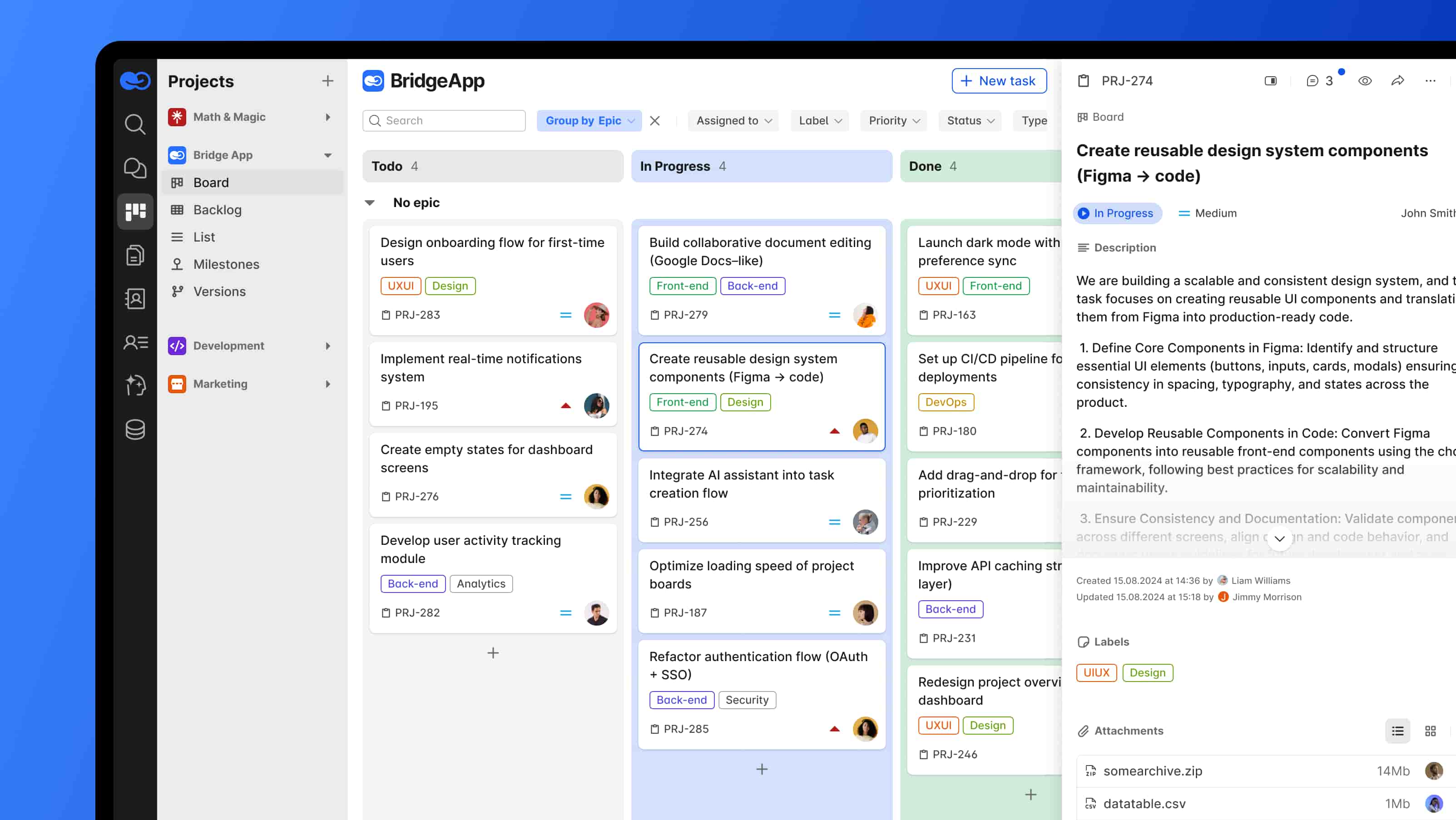
Instead of sitting on top of your existing tools as a superficial integration, BridgeApp replaces the underlying stack and infuses it with a specialized intelligence layer.
1. Living Specs, Not Static Documents
In BridgeApp, documentation is dynamic. When your team debates a feature scope inside a chat channel or a native video call, BridgeApp’s AI contextually updates the relevant wiki page and auto-drafts tasks. It actively flags drift between what is explicitly documented and what is actually moving through the sprint backlog.
2. Democratized Product Analytics via MCP
You do not need to leave your workspace to query data. Through the Model Context Protocol (MCP), BridgeApp connects directly to your analytics stack—including Amplitude, Mixpanel, PostHog, BigQuery, and Snowflake.
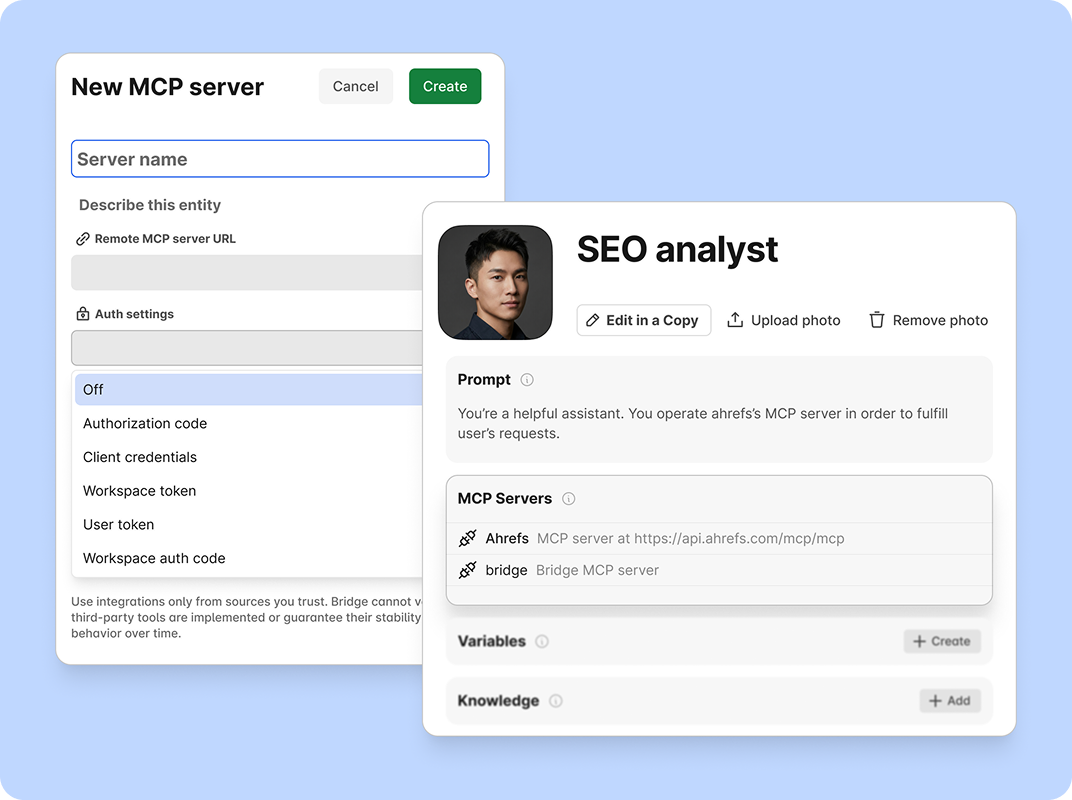
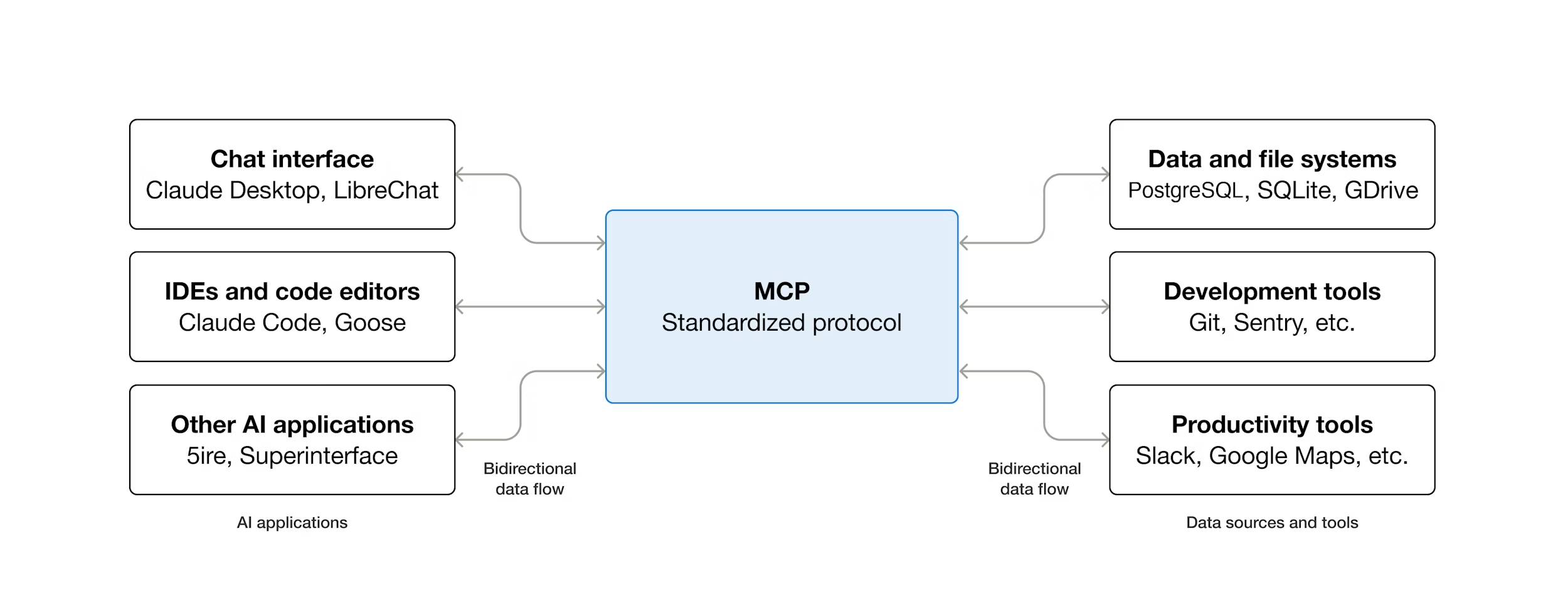
- Anyone on the team can ask in plain English: "What is the conversion rate on our new onboarding flow?"
- The system pulls definitions from a shared knowledge base and returns a generated chart right inside the discussion thread.
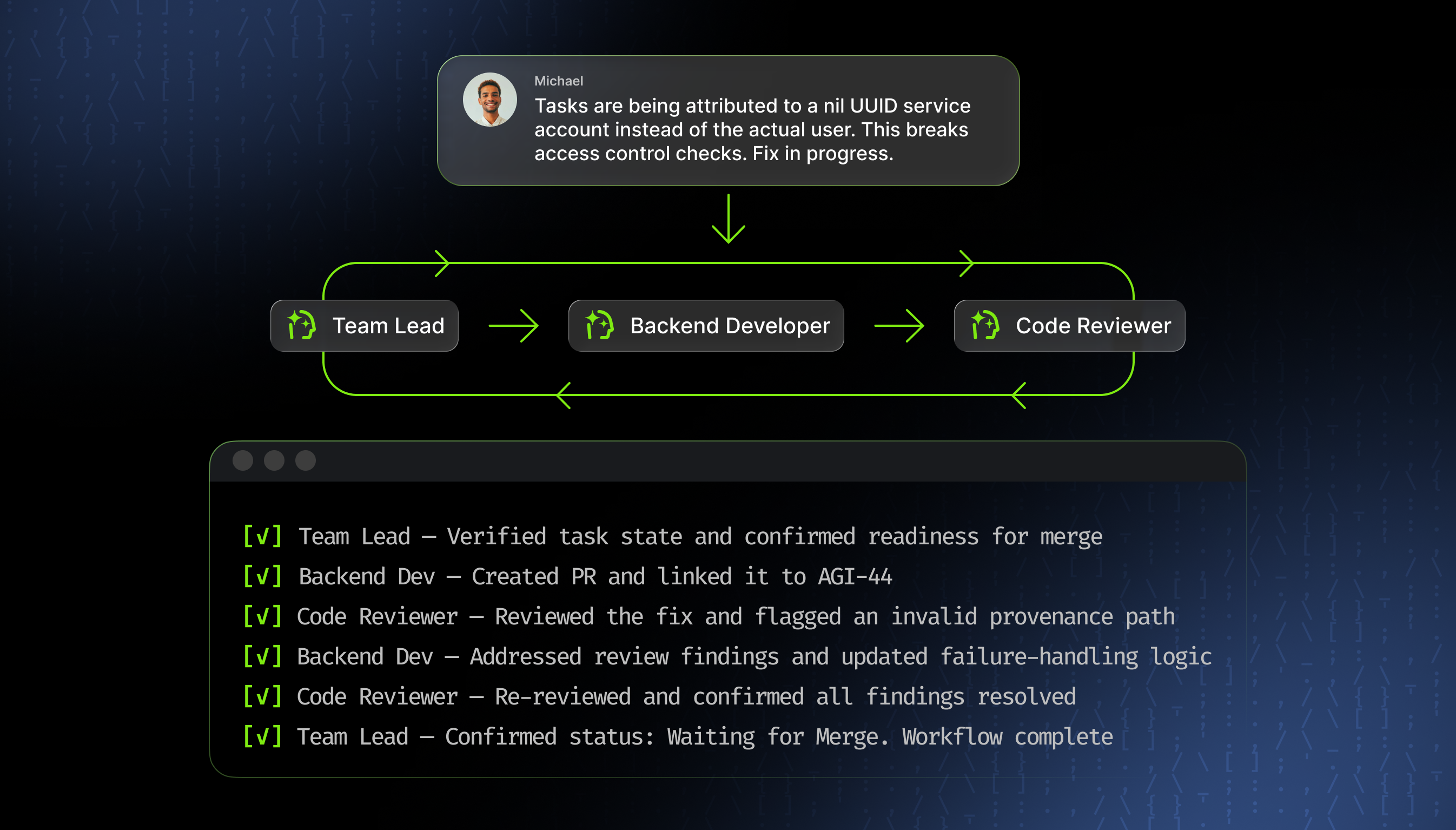
3. Autonomous Agents Tailored for Product Lifecycles
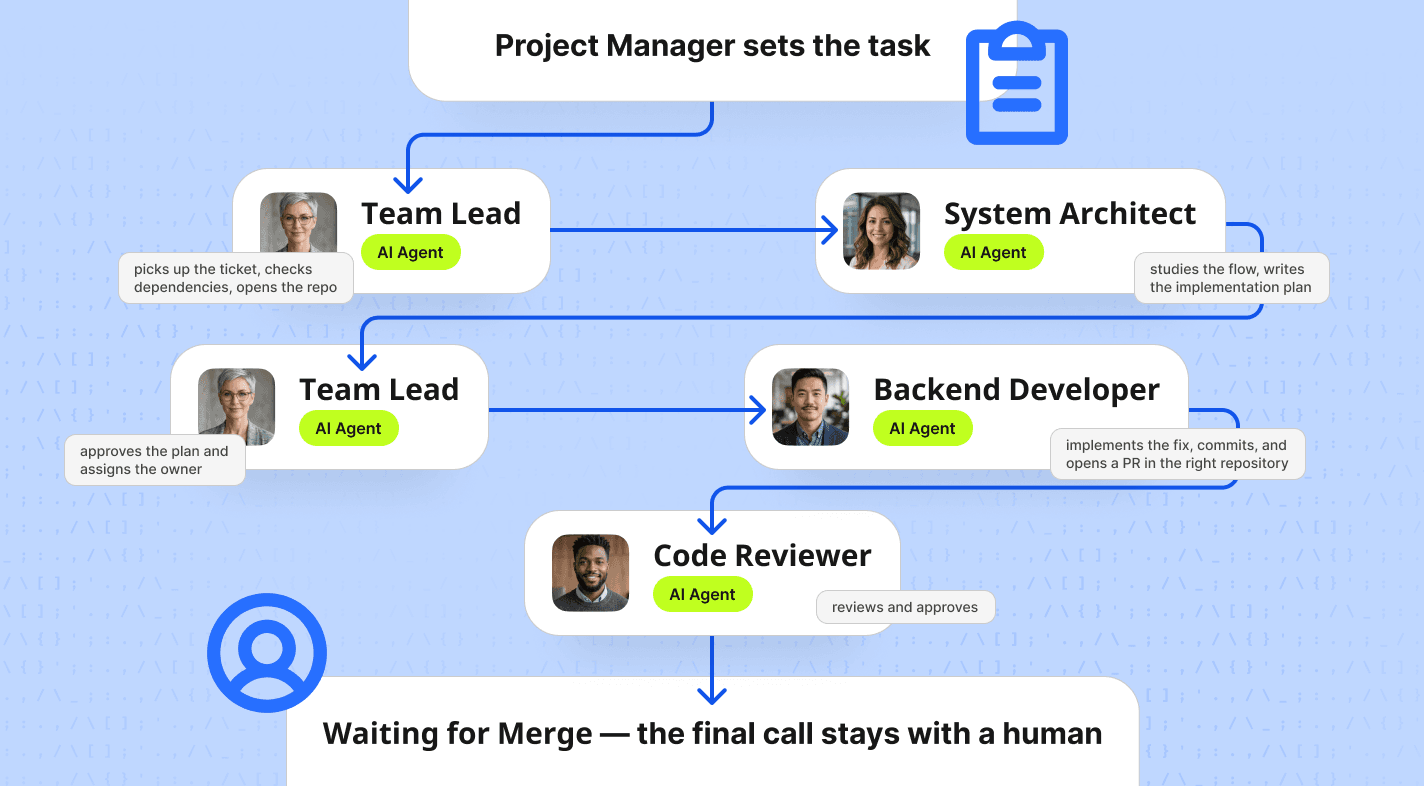
Generic AI models do not understand the day-to-day realities of product development. BridgeApp deploys specialized agents designed for specific workflows:
- Triage Agents: Intercept bug reports and user feedback from app stores or in-app widgets. They automatically attach system logs and generate structured tasks.
- Requirements Agents: Convert user discovery interviews and internal roadmap debates into precise product requirements.
- Research Agents: Scrape market data to maintain live, continuous competitive intelligence right inside your workspace dashboard.
Measured Velocity: What the Data Says
Teams migrating to unified, AI-native architectures are seeing clear operational improvements:
| Metric | Legacy "Franken-Stack" | BridgeApp Workspace |
| Shipping Velocity | Delayed by documentation syncs | 50% Faster time-to-market |
| Tooling Costs | Paying for 5+ separate licenses | 40% Budget savings |
| Documentation Accuracy | 60%+ of wikis left outdated | Zero stale PRDs |
| Visibility | Siloed in private channels | 100% Traceable decisions |
Frequently Asked Questions
Does BridgeApp totally replace our data platform?
No. BridgeApp replaces your operational stack (trackers, docs, communication). It securely hooks into your existing data platforms (like Snowflake or Amplitude) using MCP so you can access insights instantly without changing your underlying data pipeline.
How long does team onboarding take?
Most product teams are fully migrated and active within a single day. Built-in AI onboarding agents safely ingest your historical Jira tickets and Notion pages to make the transition seamless.
Can humans override the automated tasks and documentation?
Absolutely. BridgeApp operates on a human-in-the-loop philosophy. The AI handles data synthesis, draft generation, and routine triaging, leaving final strategic judgment entirely to your product managers and engineers. [1, 2]
AI adoption in product management has already passed the tipping point
While the tooling problem festers, AI adoption inside product teams has moved faster than almost anywhere else in the org chart. Productboard's 2026 State of AI in Product Management report, built on a survey of 379 product professionals at enterprise companies, found that 100% of surveyed teams are now using AI tools in some form, with 96% describing that use as consistent and nearly half calling it "deeply embedded" in their daily workflow. For comparison, general generative AI adoption across the US workforce sits closer to 39%. That pace makes it clear this is no longer just an emerging technology trend but an operational shift that demands technical expertise and sharper decision-making.
But the same report surfaces the gap that matters most for anyone evaluating tools right now: governance hasn't caught up with usage. Teams with centralized governance over their AI tools see meaningfully deeper, more reliable adoption than teams without it — and the stakes of skipping that step aren't hypothetical. IBM's 2025 Cost of a Data Breach Report, cited in the same research, found that 97% of companies that experienced an AI-related data breach lacked proper access controls, with breaches averaging $4.46 million. In practice, that means securing the ai model itself, along with the surrounding data pipelines, and accounting for data quality and bias challenges when deploying ai technologies.
This lines up with the broader picture from Vention's AI Maturity Benchmark: agentic AI adoption is accelerating fast, with nearly three in four companies planning to deploy it within two years, up from 23% today — but only about 20% of organizations report having a mature governance framework in place to manage it. Without that foundation, speed is hard to sustain, and any early competitive edge is usually short-lived.
Best practices product teams are converging on for the product development process in 2026
Pulling from what the research and the field are both pointing toward for adoption of ai in product development, a few practices separate teams getting real value from AI from teams collecting tool sprawl:
Consolidate around a source of truth before adding another tool. Hubstaff's research calls this a "digital spine" — a small set of tools that are unambiguously where decisions live, rather than one more app competing for the same job specs, docs, and trackers that already do badly together. That also makes it easier to evaluate AI platforms with a data-driven approach tied to business outcomes, whether the use case is product workflows or adjacent operations like supply chains.
Build governance in before scaling agents, not after. The teams Productboard surveyed with centralized AI governance saw deeper adoption and fewer of the access-control failures behind costly breaches. Retrofitting governance onto an agent sprawl already in production is, by every account, harder than starting with it, especially if you need to protect the AI model and support better decision-making as the technology matures.
Treat documentation as a byproduct of work, not a separate task. The 39%-deep-focus problem and the "work about work" tax both trace back to the same root cause: specs, tickets, and decisions living in different places that someone then has to manually reconcile. The fix isn't a better wiki — it's removing the reconciliation step entirely so teams can spend more time on creative tasks, keep human input where it matters, and move faster on product innovation shaped by market demand.
Let AI answer the questions that don't need a person. Retention by cohort, conversion on a flow, drop-off on a feature — these are exactly the repeatable, well-defined questions that eat analyst time without needing analyst judgment. Reserve human attention for the ambiguous calls, especially when goals like customer satisfaction are in play; emerging technology adoption also requires technical expertise, not just deployment intent.
Where this leaves product teams choosing tools in 2026
The data points in one direction: the problem isn't a lack of AI, it's fragmented AI bolted onto an already fragmented stack. Teams are adopting AI faster than any function in the business, but most are doing it inside the same five-tools-that-don't-talk-to-each-other setup that was already costing them 1,200 app switches and $450 billion a day before AI entered the picture.
This is exactly the gap BridgeApp is built to close for product teams — one workspace where tasks, docs, chat, and calls live natively instead of across five disconnected apps, with agents that generate and maintain specs from real team discussions, connect out to your analytics stack via MCP so anyone can ask a data question in plain language, and centrally governed access so scaling AI agents doesn't mean scaling risk. For ai product development, the best results usually come from choosing platforms based on integration fit and measurable business outcomes across the product lifecycle.