BlogCase Studies
Developer Productivity: Metrics, Measurement, and AI-powered Improvement

Maria ZhuHead of content
17 min read

Developer productivity is the engine behind every successful software company. Yet most engineering teams still struggle to define it, let alone measure or improve it. In 2026, with AI coding agents embedded in nearly every engineering workflow, the question has shifted from "how fast can we ship?" to "are we building the right things, and how do we know?"
This guide breaks down what developer productivity actually means today, which metrics help engineering leaders make better decisions, which ones actively harm teams, and how AI-powered tools are changing the game.
Key Takeaways
- Developer productivity is about turning engineering effort into business value, not just increasing lines of code or speeding up output.
- Modern frameworks like DORA, SPACE, and Developer Experience Index give engineering leaders better ways of measuring developer productivity than raw activity metrics.
- AI coding assistants and autonomous agents (like Magic Coder by BridgeApp) are shifting the bottleneck from typing code to prioritization, architecture, and code review.
- The most reliable developer productivity metrics combine delivery performance, quality, developer experience, and business impact.
- BridgeApp helps teams improve developer productivity by automating large parts of the software development process while keeping humans in control of plans, reviews, and merges.
What is developer productivity in 2026?
For decades, the software industry treated developer productivity as a counting exercise. Lines of code shipped. Commits pushed. Hours logged. These numbers were easy to collect and easier to misinterpret. They rewarded volume over value, and the gap between what got measured and what actually mattered kept growing.
That gap is now closing. Developer productivity measures efficiency and effectiveness in software development - but the definition has matured. In 2026, it means the ability of software development teams to deliver high-quality, maintainable features that drive business value within a given amount of time and investment. It is not about individual speed. Developer productivity involves human experience, team culture, tools, and system architecture, all working together.
Productivity is a system property. It depends on toolchains (IDEs, CI/CD pipelines), processes (planning, reviews, retrospectives), collaborative practices (code review, pair programming, mentorship), and organizational environment (autonomy, psychological safety, domain knowledge). No single person or tool determines it.
The 2026 context makes this especially clear. AI coding assistants and agents are now mainstream. According to a JetBrains Developer Ecosystem Survey covering over 15,000 professional developers, 90% use AI coding agents at work at least weekly and 68% use them daily. This level of adoption has shifted the baseline: AI-assisted coding is no longer fringe, and what counts as "productive" has changed alongside it.
The goal of improving developer productivity is to increase throughput of valuable features, reduce failure rates, and shorten feedback loops - without burning out teams. This applies across roles: backend, frontend, SRE, QA, platform engineers. Measuring productivity must account for this diversity, including work that produces no direct code - architecture decisions, incident response, mentoring, and refactoring.
Why measuring developer productivity is hard (and why lines of code fail)
For most of software engineering's history, measuring productivity meant tracking output. Lines of code. Commit counts. Hours online. Story points completed per sprint. These input metrics dominated because they were easy to capture and appeared objective.
They are also deeply misleading. Measuring productivity solely by output can create misleading incentives. A developer who writes 2,000 lines of verbose code looks more "productive" than one who solves the same problem in 200 lines of clean, optimized logic. Worse, developers often face interruptions from unnecessary meetings and urgent fixes, and naive metrics don't account for this friction. Cognitive load from complexity and poor documentation can slow down delivery far more than a lack of raw typing speed.
Consider a concrete example: a 20-line configuration change that eliminates a major outage risk is vastly more valuable than a 2,000-line UI refactor that looks impressive but yields little business impact. The small change doesn't shift any traditional metrics, but it preserves business continuity. Simple output metrics miss this entirely.
Then there's "thinking time." Deep debugging, incident postmortems, architecture decisions - these tasks may take days, produce little visible output, and yet deliver outsized value through avoided downtime and future productivity improvements. High-severity issues can drain developers' mental energy and lead to burnout, and that invisible cost never shows up in a dashboard tracking commits.
Collaboration compounds the problem. Mentoring, pair programming, reviewing code, responding to incidents - these are critical contributions that classic metrics ignore or even penalize. If a senior engineer spends a week reviewing architecture proposals from other team members, their individual metrics look terrible. The team, however, is stronger for it.
This brings us to Goodhart's law: once a metric becomes a target, it ceases to be a good measure. Tying bonuses to lines of code or story points leads to artificial inflation of estimates, ballooning codebases, and teams optimizing for the metric rather than the outcome.
Core developer productivity frameworks: DORA, SPACE, and beyond
Most engineering leaders have moved past ad-hoc metrics. Instead, structured frameworks provide a shared vocabulary and a more reliable picture of team performance.
DORA metrics - from the DevOps Research and Assessment program - focus on software delivery performance and include four key metrics:
- Deployment frequency: how often changes reach production
- Lead time for changes: time from commit to production deployment
- Change failure rate: percentage of deployments causing failures
- Failed deployment recovery time (mean time to restore): how fast the team recovers from failures
DORA metrics give a clear view of delivery pipeline health. According to the 2026 Software Engineering Productivity Benchmark Report, only about 22% of surveyed organizations are elite or high performers across all four DORA metrics. There's significant room for improvement across the industry.
SPACE framework measures satisfaction, performance, activity, communication, and efficiency. The SPACE framework emphasizes that productivity is multidimensional - it captures human factors (developer satisfaction, flow, well-being) alongside delivery speed. Measuring software delivery requires focusing on team-level outcomes and system efficiency, and SPACE provides the broader lens to do that.
These two frameworks complement each other well. DORA tells you how fast and reliably you ship. SPACE tells you whether your people are thriving while doing it.
Beyond these, the DX Core 4 framework combines DORA, SPACE, and DevEx metrics into a unified view. Companies using the DX Core 4 framework saw 3-12% increases in efficiency. And the Developer Experience Index (DXI) has emerged as a high-leverage measure: each one-point improvement in Developer Experience Index saves 13 minutes weekly per developer. At scale, that compounds into meaningful capacity gains.
Effective productivity measurement combines multiple signals including developer satisfaction and delivery outcomes. No single framework captures everything.
From metrics to meaning: linking development work to business value
Raw metrics only matter if they connect to outcomes the business cares about. Deployment frequency is a useful signal, but what leaders actually want to know is whether engineering effort translates into revenue, risk reduction, or customer satisfaction.
Business value in concrete terms includes:
- Revenue impact: features that drive conversion, retention, or expansion
- Cost reduction: automation that removes manual toil or infrastructure waste
- Risk mitigation: security patches, compliance work, reliability improvements
- Customer satisfaction: performance improvements, UX fixes, feature requests delivered
Engineering leaders can link features and epics to business outcomes by tagging work items with value categories and then measuring lead time and throughput per category. If your team spent Q2 improving checkout latency by 200ms and saw a measurable conversion lift, that's a productivity story worth telling in quarterly planning and board reporting.
Measuring productivity only at the activity level - pull requests merged, story points completed - can optimize for "busyness" instead of business impact. The most productive teams are the ones where feature development aligns directly with what moves the needle for the company.
Which developer productivity metrics actually help engineering leaders?
Here are the core metrics that tend to give real signal when tracked at team or system level:
- DORA metrics: deployment frequency, lead time, change failure rate, and recovery time remain the backbone of delivery performance measurement.
- Flow time / focus time: uninterrupted blocks of 2+ hours per developer per week. 46% of developers spend 20 hours or less on uninterrupted tasks weekly - a signal that context switching is eroding capacity across the industry.
- Allocation of effort: percentage of engineering capacity spent on roadmap features versus unplanned work (incidents, support, ad-hoc tasks). This reveals how much throughput is frustrated by interruptions.
- Quality metrics: defect rates, incident frequency, escaped bugs after release, and code review effectiveness (time to review, review cycles). Code quality is a system property, not a checkbox.
- Developer satisfaction and DXI: surveys covering perceived friction, tooling pain, cognitive load, and well-being. Each one-point improvement in the Developer Experience Index saves 13 minutes weekly, and teams that track developer satisfaction consistently outperform those that don't in retention and long-term productivity.
- PR throughput: diffs per engineer or PRs merged can be useful at team level for spotting bottlenecks - but never for individual performance reviews.
These experience metrics, combined with delivery and quality signals, give engineering leaders a composite picture that neither input nor output metrics provide alone.
Metrics to avoid: lines of code, story points, and surveillance
Some metrics do more harm than good when misused.
- Lines of code and commit counts incentivize verbose coding, unnecessary abstractions, or micro-commits that clutter history. They reward volume, not value. Output measurement based on code volume tells you almost nothing about software quality.
- Story points and velocity were designed for sprint planning at the team level. Using them to compare individual performance or teams across domains distorts estimation and planning. They become a target rather than a signal.
- Time-tracking and keystroke monitoring erode trust, increase stress, and ultimately reduce the kind of deep work that drives real productivity. Developers tend to optimize for looking busy rather than solving hard problems.
- PRs per engineer and tickets closed per week easily become vanity metrics if detached from quality and business impact. A developer closing 20 low-priority tickets per week may contribute less than one who ships a single high-impact change.
Goodhart's law applies to all of these: once individual metrics become targets tied to compensation or performance reviews, the behavior they're supposed to measure shifts in unhealthy directions. The better practice is to socialize metrics with teams and let them co-design how data will be interpreted.
How AI and autonomous agents are reshaping developer productivity
Between 2023 and 2026, AI coding assistants went from novelty to standard toolkit. GitHub Copilot, Claude Code (which reached ~39% global adoption by mid-2026), and similar tools are now embedded in daily workflows. AI tools can increase developer productivity by automating routine tasks - boilerplate generation, code search, repetitive refactoring, and scaffolding.
The numbers are real but nuanced. AI tools can increase developer productivity by 16%, and teams using AI coding assistants report significant productivity gains, particularly on greenfield tasks where time savings of 30-40% are common. But for complex or legacy systems, savings drop to 10-15%. AI can increase coding velocity but may reduce code maintainability if generated code isn't reviewed carefully. AI-generated code may create maintenance challenges for developers who inherit it without understanding the underlying logic.
Traditional metrics like lines of code become even less meaningful in AI-augmented environments, since AI often reduces total code written while increasing functional output. According to GitLab's AI Accountability Report, 78% of surveyed organizations say developers are writing and committing code faster since adopting AI tools - but 92% report governance challenges around AI-generated code.
This is where autonomous multi-agent systems enter the picture. Tools like Magic Coder by BridgeApp can plan, implement, test, and open pull requests under human supervision. These agents take tickets from "Todo" to "Waiting for Merge" while humans own planning approval and production merges. The bottleneck shifts from typing code to prioritization, architecture, and code review - the high-leverage work that software engineers do best.
How to measure developer productivity in AI-augmented teams
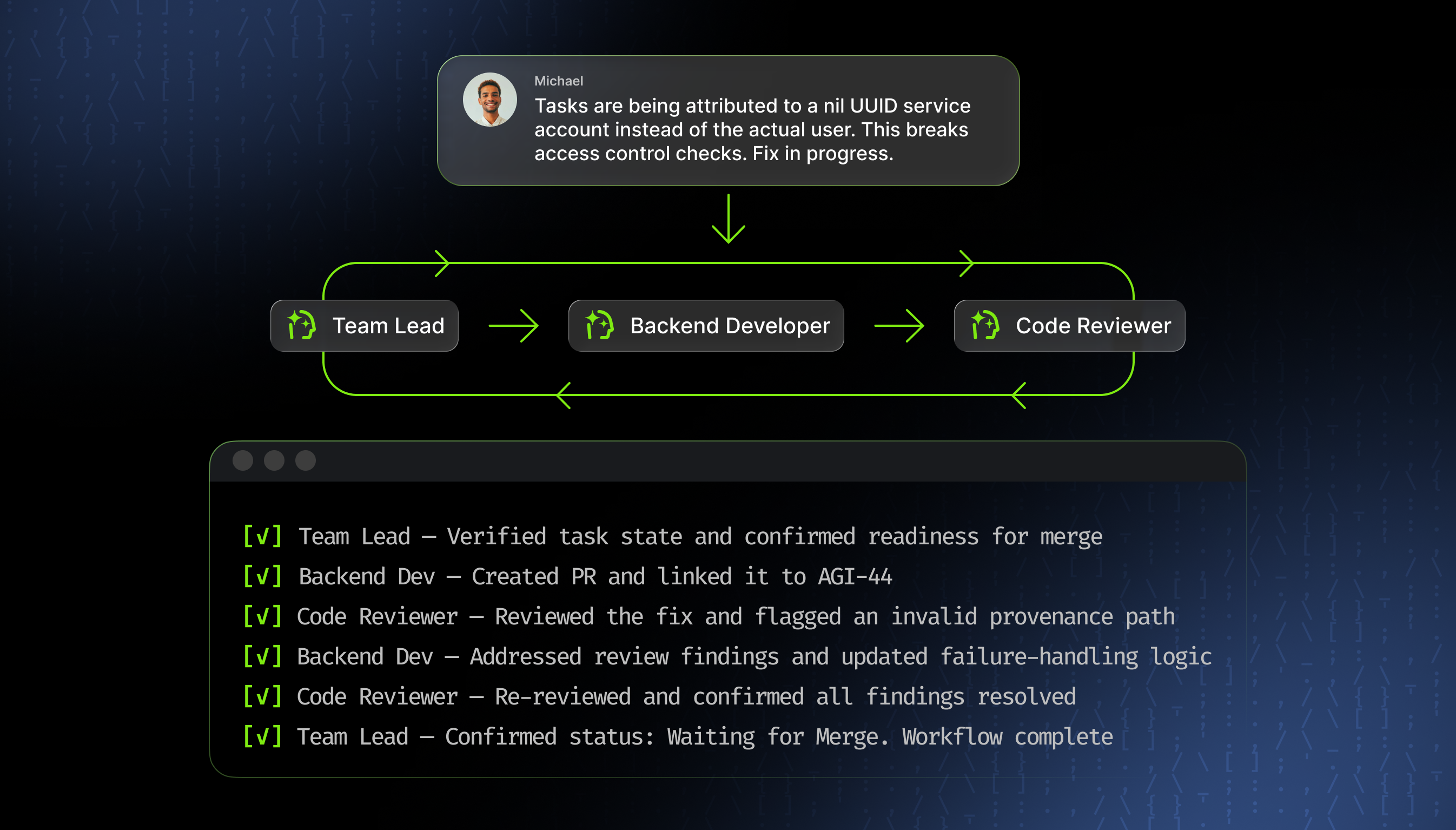
Engineering leaders now need to measure both human productivity and AI-augmented system performance. Here's a practical measurement checklist:
- Continue tracking DORA metrics before and after AI adoption. Look for changes in lead time and deployment frequency as leading indicators of system-level impact.
- Measure AI utilization: percentage of tasks where AI tools are used, PRs containing AI-generated code, and developer sentiment about AI tools. 60% is the active usage rate of AI tools in leading organizations - if your team is well below that, adoption barriers may be worth investigating.
- Monitor quality closely: change failure rate, defect density, and incident counts must be watched when introducing AI-generated code. AI tools can increase coding speed but may reduce code quality if review practices don't keep pace.
- Track flow time and cognitive load: if AI reduces manual toil but increases debugging of opaque code, that should show up in experience surveys. Qualitative feedback from developers helps identify friction points in workflows that dashboards miss.
- Extend DXI surveys with AI-specific questions: ease of use, trust in suggestions, perceived impact on deep work.
- Evaluate total cost of ownership: licenses, compute credits, training time, and infrastructure costs weighed against business outcomes - faster feature delivery, fewer incidents, better customer metrics.
Practical steps to improve developer productivity (beyond metrics)
Once you can measure productivity reasonably, here's what to change:
Reduce context switching. Context switching is a common constraint affecting developer productivity. Limit concurrent projects per developer and protect 2-4 hour focus blocks on calendars. Fast feedback loops keep developers in a state of flow - every interruption resets that clock. 46% of developers spend 20 hours or less weekly on uninterrupted tasks, which means most teams have room to improve here.
Invest in platform engineering. Development environments should be standardized and automated for efficiency. Golden paths, templates, and CI/CD pipelines reduce cognitive load and repetitive configuration work. High-quality developer tools reduce wait times and manual toil. Tooling and environment quality significantly impact developer productivity.
Stabilize priorities. Clear priorities and stable roadmaps ensure that allocation of effort aligns with the most valuable development work. When teams constantly shift between new features and fire drills, throughput drops and morale follows.
Improve code reviews. Smaller pull requests, clear review SLAs, and standardized guidelines eliminate idle time. Effective developer productivity is about improving focus and shortening feedback loops, and code reviews are often the longest feedback loop in the inner development cycle.
Invest in learning and documentation. Documentation enhances effective collaboration and knowledge sharing among developers. Internal tech talks, mentorship programs, and regular refactoring time keep the codebase maintainable and reduce technical debt. Automated testing reduces manual QA cycles and catches bugs early, freeing up dev time for higher-value work.
Protect culture. Psychological safety and a supportive culture boost developer morale and retention. Improving developer productivity requires removing friction, automating repetitive tasks, and providing suitable tools - but none of that matters if the work environment drives people out.
Any intervention should be evaluated against both developer experience and business outcomes, not just short-term throughput.
BridgeApp: a modern approach to improving developer productivity
This section introduces a concrete solution that operationalizes many of the concepts discussed above.
BridgeApp is a platform where development work is coordinated across Projects (tasks), Documents (plans), and AI agents. It provides engineering leaders and team leads with a single orchestration layer for building software - from planning through deployment.
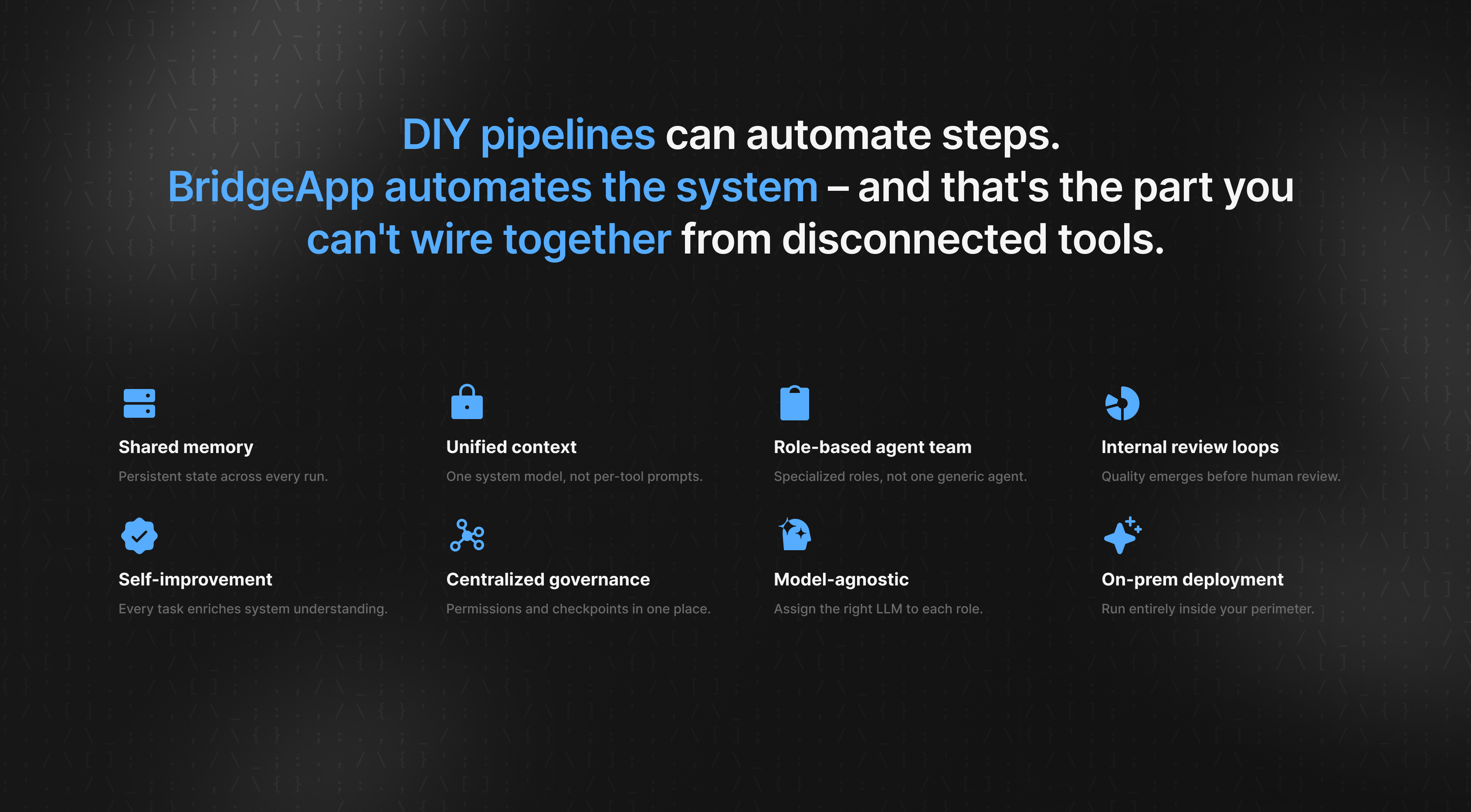
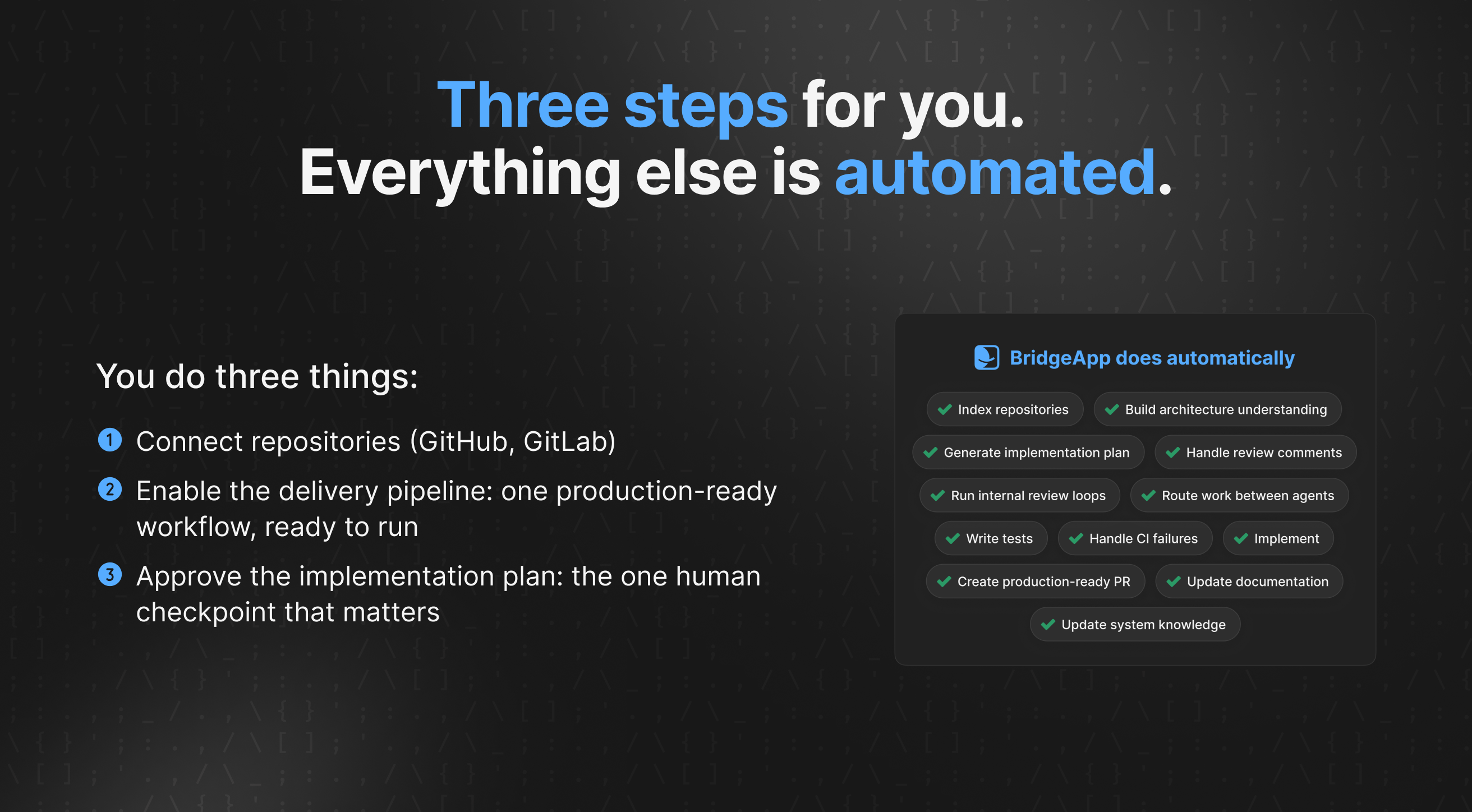
Magic Coder by BridgeApp is an architecture-aware coding assistant built around multi-agent workflows. Its agent roster includes a Team Lead (triage and orchestration), System Architect (plan authoring), Backend and UI Developer agents (implementation), Code Reviewer, and QA agent. These agents work together through a defined state machine:
Todo → Planning → Plan Review → Execution → Local Code Review → Waiting for Merge → (Done - not automated)
Two review loops enforce quality: Plan Review (System Architect and Team Lead) and Local Code Review (Code Reviewer and Developer). Critically, agents never advance a task to Done - humans review the plan, the system reviews the implementation, and humans own the final merge.
This maps directly to productivity metrics:
- Fewer wrong-file changes thanks to codebase intelligence (COD-05) - the agent analyzes existing architecture and reuses components rather than generating code in isolation
- Higher PR throughput per engineer through orchestrated automation that eliminates idle handoff time
- Reduced context switching because tasks, plans, documentation, and code execution live in one workspace
BridgeApp runs agent work in secure, observable flows. Every execution is auditable and queryable, so engineering leaders can measure impact on DORA metrics, code quality, and business outcomes without losing governance. For teams building an MVP, this can compress initial development significantly - reusing template stacks, standard auth, and component libraries instead of starting from scratch.
Designing a developer productivity scorecard for your organization
A lightweight scorecard can be implemented in 1-2 quarters without overhauling existing tools. Organize it around four dimensions:
| Dimension | Metrics | Review Cadence |
|---|---|---|
| Speed | Lead time for changes, deployment frequency, PR cycle time | Monthly |
| Quality | Change failure rate, defect density, escaped bugs, failed deployment recovery time | Monthly |
| Developer Experience | DXI score, focus time per week, satisfaction survey results | Quarterly |
| Business Impact | % of work on roadmap initiatives, features tied to revenue/risk/customer metrics | Quarterly |
A fifth lens - AI-specific signals - can be layered on without overcomplicating the scorecard:
- AI utilization rate across tasks and PRs
- AI-related defect rate (bugs traced to AI-generated code)
- ROI of AI tools (cost vs. measured delivery improvements)
- Developer sentiment toward AI adoption
Metrics should be aggregated at team or organization level, never used for ranking individuals. Always discuss results with teams to co-interpret the data. The most productive teams treat their scorecard as a conversation starter, not a report card.
Implementation roadmap: from ad-hoc metrics to continuous improvement
For engineering leaders starting from a fragmented setup, here's a step-by-step approach:
- Inventory current data sources. Map your CI/CD systems, issue trackers, incident tools, and survey platforms. Identify which DORA and quality metrics you can already compute without new tooling.
- Run a baseline survey. Capture developer satisfaction, perceived friction, and current experience with AI tools. This becomes your DXI starting point and identifies where developers spend time on low-value work.
- Define a minimal metric set. Pick 2-3 metrics per dimension (Speed, Quality, Experience, Business Impact) and build a simple dashboard. Avoid the temptation to track everything at once - continuous improvement starts small.
- Target one or two high-impact bottlenecks. Long code review times? Low focus time? High change failure rate? Design targeted interventions: automation tools, process changes, or Magic Coder adoption for orchestrated development flows.
- Re-measure after one or two release cycles. Compare against your baseline. Adjust the metrics themselves if they're not giving useful signal. Treat the measurement system as a product with stakeholders and a roadmap.
BridgeApp fits into this roadmap as both a workspace to orchestrate autonomous development flows and a place to observe AI-augmented software engineering productivity in action - with every agent step logged, queryable, and tied to the task that triggered it.
FAQ: common questions about measuring and improving developer productivity
How should small teams measure developer productivity without heavy tooling?
Use a lightweight mix of DORA-style metrics from your CI/CD system - deployment frequency and lead time are available from most modern pipelines - plus a simple quarterly experience survey (even a 10-question Google Form works). Track focus time through team-level agreements on meeting-free blocks. Keep metrics visible in a shared document and use them in retrospectives, not performance reviews. Small teams don't need a platform; they need a habit.
How do we measure the business impact of development work in non-revenue projects?
Business value extends well beyond revenue. For internal tools, measure reduced incident minutes, support ticket volume, or internal user satisfaction. For compliance or security work, track risk reduction (e.g., vulnerability remediation time). Tag work items with value hypotheses before the project starts - "reduce support tickets by 20%" or "cut onboarding time from 2 weeks to 3 days" - then measure the downstream proxy after shipping. Partner with product, finance, or operations to agree on impact metrics upfront.
Can we use developer productivity metrics in individual performance reviews?
Most individual-level output metrics - lines of code, tickets closed, PRs merged - are misleading and prone to gaming, especially in collaborative, AI-augmented teams. Individual metrics rarely capture mentoring, architecture contributions, or incident leadership. Focus individual reviews on behaviors (technical leadership, reliability, collaboration, knowledge sharing) and outcomes within the person's control. Keep quantitative metrics at team or system level, used for process improvement rather than ranking.
How does BridgeApp handle governance and safety when using autonomous agents?
Magic Coder by BridgeApp runs work in controlled flows with explicit stages, audited tool access via a layered governance resolver, and secure isolated execution environments (microVMs with scoped credentials). Agents can plan, code, test, and open PRs, but humans retain ownership of plan approval and final merge. The pipeline stops at "Waiting for Merge" by design - agents never push to Done. This keeps accountability with the engineering team and helps maintain compliance with internal guidelines and industry regulations.
What's a reasonable timeframe to see impact from a new productivity initiative?
Small process changes - better code review practices, protected focus time, clearer review SLAs - can show measurable impact on lead time and developer satisfaction within 4-8 weeks. Larger initiatives like platform engineering investments or adoption of autonomous agents like Magic Coder typically require 1-3 quarters to stabilize and show clear business outcomes. Set explicit quarterly targets and checkpoints so improvements can be attributed and iterated. Empower developers to provide feedback throughout - the teams closest to the friction are the best source of signal on what's working.