BlogIndustry Insights
Lark Suite Pricing: Discover Flexible Plans for Every Business Need

Konstantin BuzzResearch Lead
7 min read

ByteDance's Lark Suite is built around a model of frictionless onboarding into the professional sphere. Much like the company's flagship TikTok, this collaborative environment is engineered around free access that creates strong engagement — and significant costs down the line. Here, we take a deeper dive into the super-app's 2026 pricing and the true cost of team collaboration for those using the platform.
Known in China as Feishu, Lark Suite is a monolithic collaboration software suite and productivity tools hub representing the "Work OS" ambition. The name Feishu translates to "Flying Book," though it is often colloquially mistaken for "Squirrel" — both fitting metaphors for a task and project management platform.
Born from the R&D labs of retail and entertainment giant ByteDance, Lark was originally conceived to unify chat, tasks, documents, calendars, and video conferencing into a single, seamless pane of glass. If Slack's foundational mission was to "kill email," Lark aimed to eliminate "tab-switching" fatigue. By investing in specialized tools for deskless workers in retail and F&B with heavy-duty automation, Lark became an ecosystem designed to capture every microsecond of employee attention.
Lark positions itself as the architect of the "new normal," engineering a workspace where automated workflows are the standard operating procedure rather than an optional perk. This vision is fueled by a relentless AI integration: ByteDance has leveraged its status as an AI powerhouse to build a specialized intelligence layer tailored specifically for the Lark ecosystem. It invested significantly during its aggressive market expansion, maintaining a large R&D and marketing staff that peaked at 7,000 employees. The fiscal narrative shifted in 2024 when the platform began prioritizing its high-value "key accounts" — retail giants like Mixue Bingcheng, Miniso, and Yadea. These enterprise partnerships provided the high average ticket prices and superior retention rates required to finally steer the unit toward profitability.
In early 2025, Lark effectively lost the U.S. market following the implementation of the "Protecting Americans from Foreign Adversary Controlled Applications Act," which shuttered ByteDance's domestic operations. Yet ByteDance remained financially strong. ByteDance hit a staggering $185–$190 billion in total revenue for 2025, with profits soaring past $50 billion — fueled by e-commerce and a massive pivot to AI. While Lark's ARR of roughly $300–450 million is a rounding error in this empire, it remains a critical strategic asset as a proof-of-concept for an AI-native workspace.
Navigating the Lark Suite Pricing Staircase: A Three-Tier Monetization Model
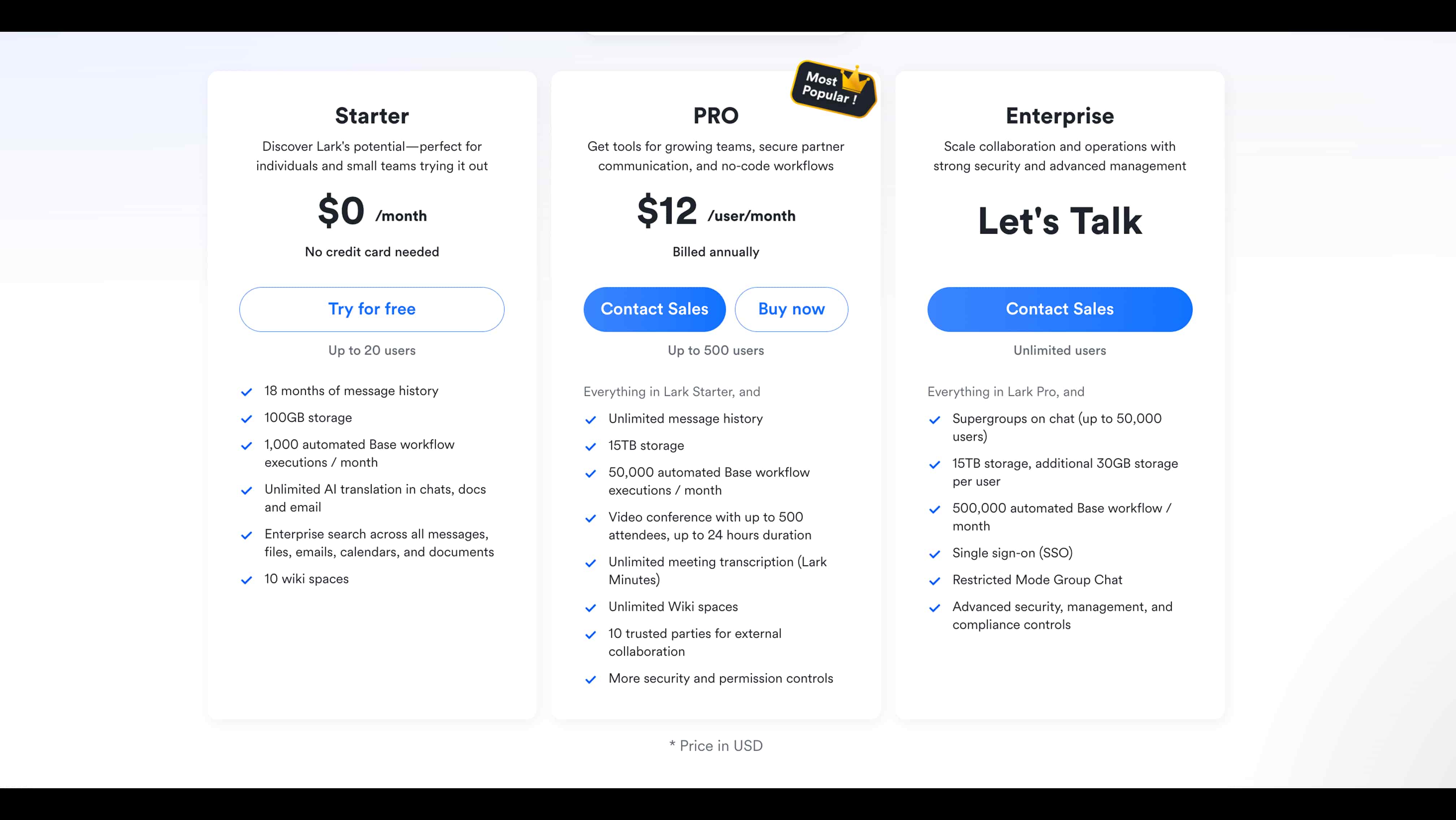
Lark's 2026 pricing follows the classic SaaS ladder, with notable emphasis on the breadth of free features for small businesses.
The Starter Tier: Free Plan as a Strategic Entry Point
The Free Starter Plan remains one of the most competitive offers for small teams in the industry. It supports up to 20 users for free, providing nearly the entire toolkit. This sticky onboarding approach means teams often move their entire workflow into Lark Docs and Lark Base before they've ever seen an invoice.
The Pro Tier: When Scale Demands Control
At approximately $12 per user/month when billed annually, or $14.40 per user/month when billed monthly, the Pro Plan is where real ARPU growth begins for the company. This tier unlocks the storage and video limits (up to 500 participants) necessary for a scaling operation, turning Lark from a startup experiment into permanent infrastructure. Crucially, this tier introduces enterprise-grade security essentials, including advanced security permissions, data encryption, and granular access management to protect sensitive project data.
The Enterprise Tier: The Bespoke Power Play
The Enterprise plan remains a "black box" of negotiated pricing. Official rates are undisclosed, but leaks from the Southeast Asian market suggest SME Enterprise rates around $55 per user/month. For large businesses, this tier adds significant cultural and operational fluidity, such as real-time automatic translation for cross-border communication and a modular library of "mini-apps" that replicate the thriving mini-app culture of the Chinese market within a corporate framework. It also offers security enhancements such as single sign-on (SSO), secure document labels, group chat restrictions, customizable watermarks, and activity auditing.
It is also worth noting that in some localities, a "Lark Premium" tier has sporadically been unveiled. It is priced at $9.99 per user/month, offering a midpoint for SMEs that need GDPR/SOC 2 compliance without the unlimited sprawl of a full Enterprise contract.
The "Iceberg" Economics: Where the Costs Actually Hide
The sticker price of a seat is just the starting point. For large teams, total cost of ownership only becomes visible after full migration, when usage-based friction and hidden cost traps begin to compound.
- Lark Base & the Automation Ceiling: the Pro plan limits teams to 5,000 automated executions. Crossing this threshold requires a leap to the Enterprise tier (500k runs) or purchasing "top-up" packs, such as $599 for 50,000 runs.
- The "Media Tax": Lark's 100GB Starter storage is generous until it isn't. In an era of recorded 4K huddles and heavy document versioning, teams often find that buying more storage within Lark is significantly more expensive than using a decoupled private cloud.
- The AI Compute Economy: AI isn't a feature; it's a metered utility. Similar to Asana's AI Studio, Lark's "AI AnyWhere" assistants consume tokens that can quickly become a significant, non-standard line item on the monthly bill.
- The Meegle Add-on: For teams requiring heavy-duty project management, the Meegle Premium module adds an additional $12 per user/month, pushing the total cost per seat well beyond the "Pro" headline price.
Pros and Cons of Lark Suite at a Glance
Pros: massive free-tier utility; seamless integration of chat and docs; built-in tools for deskless workers; video conferencing for up to 500 participants.
Cons: no on-premises version; vendor lock-in risk for institutional memory; complex paywalled basics for AI and automation.
The Verdict: Who is Lark For?
Lark Suite is the ultimate bet on the "Everything App." It is a compelling setup for companies that want to consolidate their digital environment into ByteDance's infrastructure, so they don't have to switch tabs. But, as we've seen with the "SaaS 1.0" giants, the all-in-one dream often turns into a reality shaped by feature paywalls, seat-step taxes, and aggressive ARPU optimisation.
By 2026, the true cost of enterprise software is more than just a line item on your invoice; it is the operational friction your team absorbs while navigating its workflows. When the knowledge and institutional memory is locked behind a paywall, the "free" entry point of a super-app can quickly become a significant long-term commitment.
Lark Suite is the go-to choice for non-technical small and medium businesses, retail teams, and agencies that want to "buy the entire back office" in one transaction. If you can absorb the feature complexity and the lack of on-premise control, the all-in-one convenience is formidable.
Before committing to the Lark ecosystem, organizations must ask: do we need a "Swiss Army knife" or a "scalpel"? BridgeApp offers a precision alternative for engineering teams and product-centered organizations that value flow. Unlike Lark, BridgeApp provides a context-native, agent-first environment where tasks, threads, and execution remain tightly linked.
Beyond the SaaS Staircase: Why BridgeApp Fits the Logic of 2026
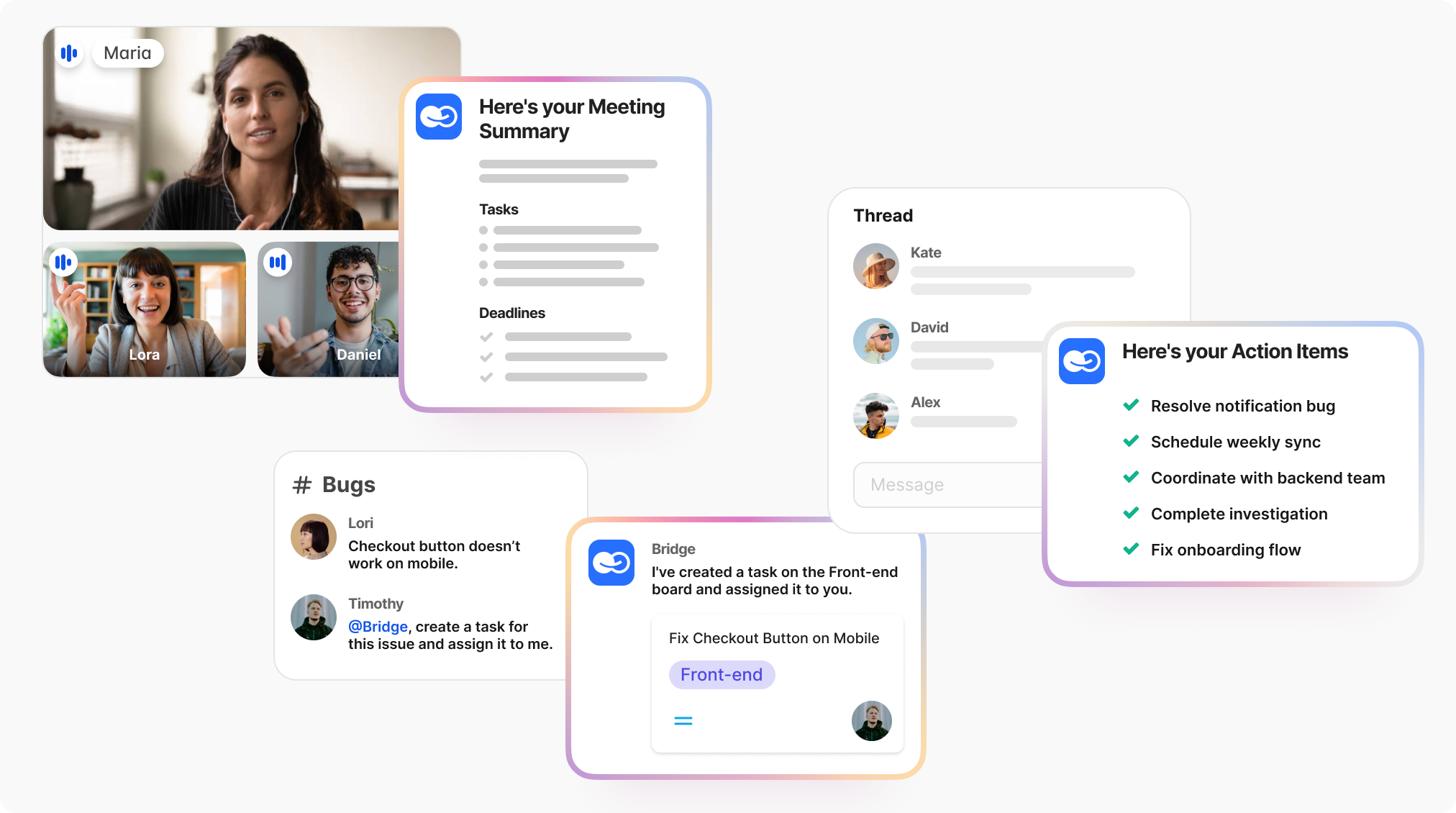
If the core problem in your organization isn't a lack of features, but a loss of context, it is time to exit the traditional SaaS escalation staircase. While Lark builds a closed ecosystem with switching costs, BridgeApp focuses on a context-aware workspace tailored for hybrid human-AI teams that actually ship products. Agents can simply be @-mentioned in threads or in comments on tasks, and they will immediately join in to receive assignments and carry them out.
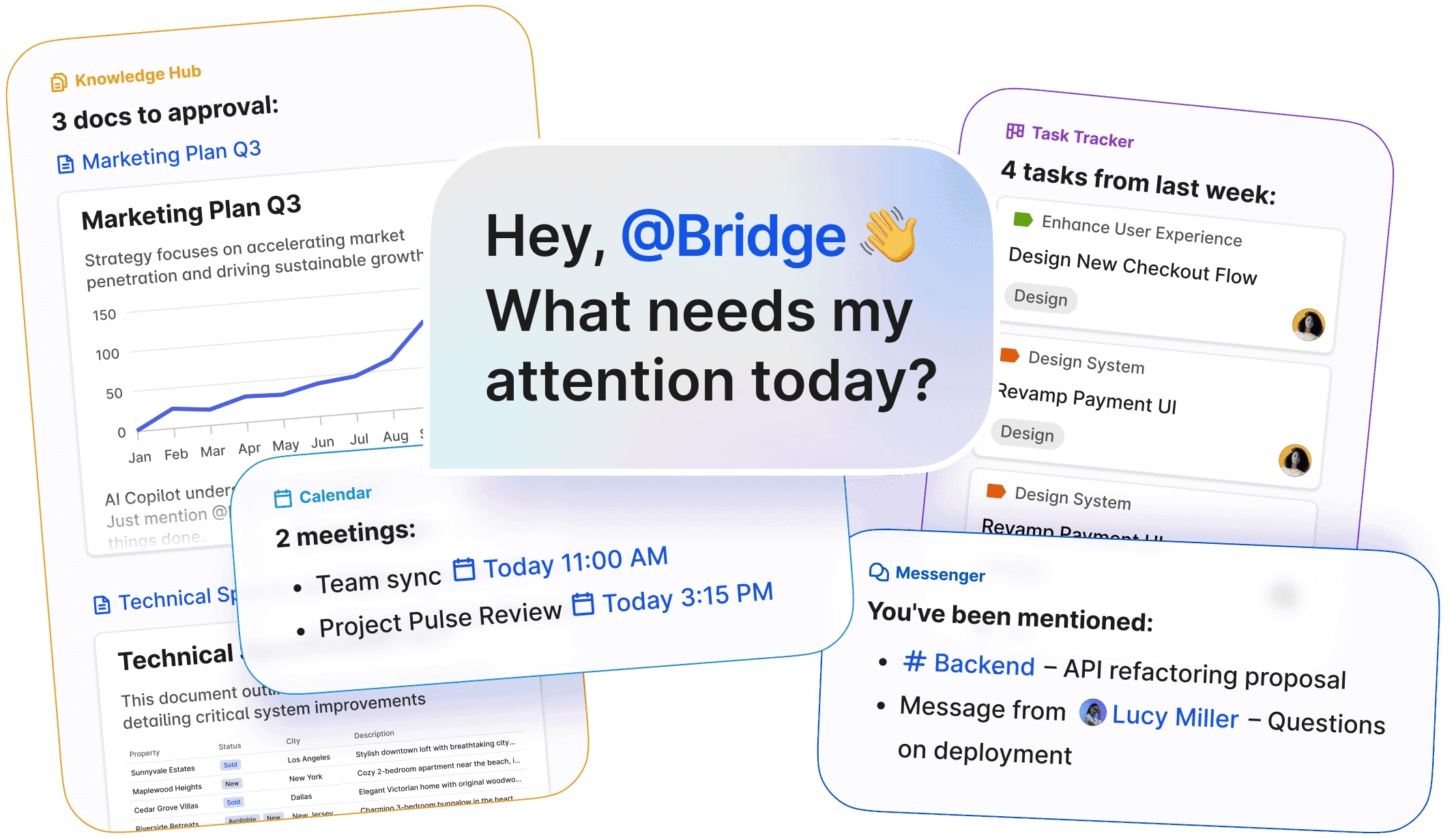
Why BridgeApp is Winning the Hybrid Race:
- Developer-First Context: Unlike Lark's general-purpose chat, BridgeApp provides structured task management and threads that stay permanently tethered to code.
- Data Sovereignty: In a world of increasing U.S.-China tech friction, BridgeApp's on-premise deployment option is a critical fail-safe. You own the infrastructure; the vendor doesn't own your institutional memory.
- Transparent Economics: There is no "Seat-Step Tax" or "Ghost Seat" bundles. BridgeApp disrupts the SaaS staircase with a Pro Plan at €9/user that includes role-based access control, integration with messengers and AI-agent builder without hidden "gates."
- Flow Over Noise: Instead of jumping between a messenger, a document, and a project board, BridgeApp provides a single, context-aware environment where tasks and threads live together.
Is it time for a reboot? The best way to evaluate the difference is to experience it. Spin up a live workflow on BridgeApp and see what happens when you prioritize flow over feature complexity.
[Explore BridgeApp's Pricing] | [Request a Demo] | [Start with a Free Plan] | [Talk to the devs about the Enterprise plan]
FAQ
What are the Lark Suite pricing plans for 2026?
The Lark Suite pricing staircase is designed to match your business needs. In 2026, it includes a generous Free Starter Plan, a Pro Plan at about $12 per user/month (billed annually) for teams with workflow automation needs, and an Enterprise Plan with custom pricing for advanced security and bespoke mini-apps.
What teams can use the Lark free plan?
In 2026, the Free Starter Plan supports up to 20 users at no cost. It includes core features like instant messaging, wiki spaces, and cloud storage up to 100GB. This makes it a natural choice for small businesses with basic team collaboration needs that are just starting their venture and want to consolidate multiple tools into one platform.
What does the Pro Plan include?
The Pro Plan is designed for growing teams that need more file storage, larger video meetings, and more advanced tools than the free plan provides.
What are the main advantages of the Enterprise Plan?
The Enterprise Plan adds enterprise-grade security features such as advanced multi-level login management, data encryption, Single Sign-On (SSO), and document sensitivity classification. It also supports streamlined communication through multi-language collaboration and real-time automatic translation, along with white-labeling options and custom Work Mini Apps.
Can Lark replace tools like Microsoft Teams or Google Workspace?
Lark positions itself as a "Work OS" that can replace Microsoft Teams, Google Workspace, Slack, and other tools by unifying video conferencing, calendar integration, and file sharing in a single window. The key differentiator is its "all-in-one" philosophy, though some teams may find the breadth of features adds complexity compared to more focused productivity tools.
Is Lark good for corporate task management and project management?
It depends on your subscription tier. Lark covers basic task management and team communication well, but deeper project management needs typically require the Enterprise Plan along with additional paid tools and add-ons, such as Meegle.
Does Lark support video conferencing?
Yes. Lark includes built-in video conferencing for large group calls and webinars with meeting transcription and real-time multilingual subtitles. It also offers collaboration tools like in-meeting voting and breakout rooms.
What hidden costs should startups and growing teams watch for?
The primary hidden cost in Lark pricing involves usage-based ceilings. While the Pro Plan is affordable, it limits workflow automation to 5,000 runs. Once a team grows, additional cloud storage costs and AI assistant usage can significantly impact the total cost.
Is Lark a good choice for highly regulated industries?
Lark offers enterprise-grade protection, but the lack of an on-premise version may be a significant limitation for companies handling sensitive data in highly regulated industries. Additionally, as a Chinese company, ByteDance is subject to national security laws that may compel data sharing with state intelligence upon request. ByteDance has faced scrutiny over allegations that user data has been accessed by government authorities.