BlogHow-To Guides
SDLC Compliance: How Development Teams Build Secure, Compliant Software

BridgeApp Team
15 min read

Key Takeaways
- SDLC compliance means proving, at audit time, that every phase of the software development lifecycle (requirements through maintenance) follows defined, documented, and enforceable controls for security, quality, and data protection.
- High code quality, secure coding standards, and automated CI/CD checks are core compliance enablers, not optional engineering practices.
- Development teams own the "what is built" (code, tests, documentation) while the business owns the "foundation it runs on" (cloud, identity, networks, policies). Both sides must align for SDLC compliance to hold up under scrutiny.
- Frameworks like NIST SSDF, OWASP SAMM, OWASP ASVS, and SLSA shape how organizations operationalize secure SDLC and supply-chain controls in 2024 through 2026.
- Platforms like Magic Coder by BridgeApp can automate secure development tasks (reviews, tests, evidence collection) so compliance becomes a by-product of the normal development lifecycle.
Introduction: What "SDLC Compliance" Really Means Today
SDLC compliance is the ability to demonstrate, with auditable evidence, that software is planned, designed, built, tested, and operated according to both internal policies and external regulations. Regulations like GDPR (enforced since 2018), U.S. Executive Order 14028 (issued in 2021), and the EU NIS2 Directive (entering full effect in 2024/2025) all impose requirements that trace directly back to how software is developed.
There is a meaningful difference between "being secure" and "being compliant." A team can run thorough security testing and still fail an audit if it cannot produce evidence that controls ran consistently across every change, every release, and every environment. Auditors care about repeatable controls, traceability from requirements to deployed code, and documented proof across the entire development lifecycle.
Between 2024 and 2026, regulators and customers increasingly expect visibility into CI/CD pipelines, the software supply chain, and runtime monitoring. Point-in-time penetration tests no longer satisfy the expectation. Continuous evidence of operating controls does.
SDLC compliance is a cross-functional concern. Development teams, security teams, and operations all play defined roles. The next sections break down what each group owns, what frameworks apply, and how to build a secure SDLC that produces compliance evidence as a natural output of the development process.
SDLC Compliance vs. SDLC Security vs. Generic Software Compliance
SDLC security means integrating security practices into all phases of the software development life cycle: threat modeling at design, secure coding during implementation, application security testing before release, and runtime monitoring after deployment. It focuses on preventing security vulnerabilities proactively.
SDLC compliance goes further. It requires verifiable conformance with policies, standards, and regulatory requirements. The question shifts from "did we do the secure thing?" to "can we prove we did the secure thing, every time, in a way that satisfies an external auditor?"
Generic IT compliance frameworks like SOC 2 or ISO/IEC 27001:2022 cover organizational security broadly but do not prescribe how the development process itself should be controlled. Frameworks specific to the software lifecycle do:
- NIST Secure Software Development Framework (SSDF v1.1, published February 3, 2022) defines four practice groups: Prepare the Organization, Protect the Software, Produce Well-Secured Software, and Respond to Vulnerabilities.
- OWASP SAMM 2.0 assesses maturity across governance, design, implementation, verification, and operations.
- OWASP ASVS 4.0.3 provides 286 technical verification requirements at three levels of rigor.
A concrete example: a company can hold an ISO 27001 certificate yet still lack evidence that code review processes, static application security testing, and dependency scanning run on every pull request. The certificate covers the management system. SDLC compliance covers what happens inside the pipeline.
Auditors now treat automated testing, enforced coding standards, and documented security activities as key evidence that controls are operating effectively, not just that they exist on paper.
The SDLC Responsibility Model: Developers vs. Business
A workable model splits SDLC compliance ownership into two domains.
Domain 1: What is built. Development teams own the application code, tests, configurations, and documentation. Their responsibilities include:
- Applying secure coding practices and coding standards (parameterized queries, input validation, output encoding)
- Handling sensitive data correctly (encryption, masking, retention limits)
- Implementing authorization logic, authentication flows, and audit logging
- Managing third party code and dependencies (version pinning, license review, vulnerability patching)
Domain 2: The foundation it runs on. The business, operations, and platform teams own cloud infrastructure, identity systems, networks, and CI/CD pipelines. Their responsibilities include:
- Enforcing access controls to repositories, environments, and secrets
- Hardening CI/CD platforms and build environments
- Managing backup, disaster recovery, and log retention to meet regulations like PCI DSS v4.0 or SOX
- Providing a secure environment for developers to work in
SDLC compliance efforts break down when this split is unclear. A common failure mode: developers assume operations will handle encryption at rest, while operations assumes encryption is implemented in the application layer. Neither side implements it. The auditor finds the gap.
The fix is documenting ownership boundaries explicitly. Think of two stacked layers, "code layer" above "platform layer," with shared controls like logging and monitoring sitting at the interface. Both sides must agree on who configures what.
Regulatory and Framework Drivers of SDLC Compliance
Several regulations now explicitly or implicitly require controls over the software development lifecycle sdlc:
- PCI DSS v4.0: Requirement 6.2 mandates that custom software follows documented, secure development procedures across all SDLC phases. Future-dated requirements became mandatory on March 31, 2025.
- EU NIS2 Directive: ENISA's October 2024 technical implementation guidance specifies access control, vulnerability management, and secure development controls.
- EU Cyber Resilience Act (CRA): Entered into force December 10, 2024. Vulnerability reporting obligations start September 11, 2026; full compliance required by December 11, 2027. Mandates SBOMs, secure-by-default design, and coordinated vulnerability disclosure.
- U.S. Executive Order 14028 and FAR Case 2023-002: Will require software producers selling to federal agencies to attest to secure software development practices using standardized forms.
Key secure SDLC frameworks that map directly to development lifecycle activities:
- NIST SSDF PW tasks cover secure coding and design decisions; PS tasks cover build provenance and artifact protection
- OWASP ASVS Levels 1 through 3 provide increasing verification depth; Level 2 is typical for applications handling sensitive data
- SLSA v1.0 Build track levels L1 through L3 address provenance, signed artifacts, and hardened build platforms
Organizations typically tailor and profile these frameworks rather than adopting them wholesale. Auditors expect documented scoping decisions explaining why certain controls were selected or excluded based on risk assessment.
Compliance Across the Classic SDLC Phases
The classic software development lifecycle phases (requirements, design, implementation, testing, deployment, maintenance) each require explicit, auditable compliance controls. Failing to capture evidence early, such as missing approval records during the design phase, leads to painful retroactive documentation at audit time.
Secure coding standards and code review policies serve double duty: they are both engineering best practices and compliance controls. The sections below cover what each phase demands.
Requirements & Planning: Building Compliance into the Backlog
Requirements and planning are where compliance obligations get translated into actionable work. Data residency rules, retention policies, encryption mandates, and auditability needs should appear as non-functional requirements alongside feature stories.
- Tag epics and stories with the regulatory drivers they address (e.g., GDPR Article 32, PCI DSS Requirement 3.4, HIPAA Security Rule)
- Define concrete acceptance criteria like "all PII fields encrypted at rest using AES-256-GCM"
- Capture compliance assumptions early: where data is stored, which subprocessors are involved, what authentication flows are required
- Store threat models and data flow diagrams in versioned documents linked to tickets
Budget and resource planning should account for security tooling, training on secure coding, and dedicated time for remediation. Ignoring this at the planning stage pushes costs and risk downstream.
Design & Architecture: Secure by Design, Audit by Design
Threat modeling and data-flow diagrams at design time capture decisions that auditors will later ask about: where encryption applies, what identity providers are used, where logging boundaries exist, and how data retention strategies are enforced.
Architecture decision records (ADRs) should document security considerations with timestamps and approvers. Examples: "all inter-service calls authenticated via mTLS," "user data in EU processed in a region-locked cluster," "session tokens expire after 15 minutes of inactivity."
These design artifacts should map to a recognized security framework. If the team selects OWASP ASVS Level 2 as its baseline, each ADR can reference the specific ASVS requirement it satisfies. This makes audits faster and proves that the system architecture was designed against a defined standard, not improvised.
Compliance teams increasingly review design-time evidence for features handling payment data, health information, or security-sensitive components. A missing ADR for a payment flow is a common audit finding.
Implementation: Secure Coding Standards as Compliance Controls
Secure coding standards are both engineering and compliance artifacts. When they explicitly address the OWASP Top 10 (2021 edition) common vulnerabilities, including broken access control, cross site scripting, and injection, they serve as direct evidence of treating security as a first-class development concern.
Concrete secure coding rules that auditors look for:
- Mandatory parameterized queries to prevent SQL injection
- Canonical input validation at trust boundaries
- Output encoding for all web views
- Centralized authentication and authorization libraries
- Zero hard-coded secrets in source code
- Least-privilege defaults for all service accounts
Organizations enforce these rules through pre-commit hooks, linters, automated static analysis tools in CI, and mandatory code-review checklists. Logs from these tools, along with code review records in GitHub, GitLab, or Bitbucket, form the raw evidence set for compliance audits.
Developers can also use AI coding assistants like Magic Coder by BridgeApp to generate secure code aligned with internal policies and to flag violations before code reaches review, reducing manual overhead while preserving code quality.
Testing & CI/CD: Automating SDLC Security and Evidence Collection
CI/CD pipelines are now the primary enforcement point for security controls and audit logging across the development lifecycle. Every merge, build, and deployment should produce queryable evidence.
Typical automated checks in a compliant pipeline:
- Unit and integration tests verifying functional correctness and test coverage
- Static application security testing and software composition analysis for vulnerabilities and license risks
- Dynamic application security testing or interactive application security testing in staging environments
- Secrets scanning to prevent credential leaks
- Policy-as-code checks on infrastructure definitions (Terraform, Kubernetes YAML)
- Static code analysis for coding standards violations
For compliance, running tools is not enough. Teams must store scan reports, pipeline run metadata, and approval records centrally for the required retention period. Structured, queryable exports (SARIF, CycloneDX, in-toto attestations) mapped to control IDs are the standard auditors expect.
A compliant ci cd pipeline should block merges on high-severity findings or compliance violations. Documented, risk-accepted exceptions processed through change management tickets are the only acceptable override.
Magic Coder by BridgeApp can integrate into these pipelines by automatically generating tests, remediating failing checks, and documenting changes, improving both software security and the traceability auditors look for.
Deployment, Runtime, and Maintenance: Proving Ongoing Compliance
Post-deployment, SDLC compliance shifts to maintaining secure configurations, enforcing least privilege on cloud resources, monitoring logs, and patching code and dependencies within defined SLAs.
Runtime controls with direct compliance relevance include Web Application Firewall rules, centralized logging to SIEMs (Splunk, Datadog), and vulnerability management programs that track CVEs. When Log4Shell (CVE-2021-44228) was disclosed in December 2021, organizations with mature SDLC compliance could show auditors a clear trail: detection timestamp, triage decision, patch commit, redeploy record, and updated scan results. Organizations without that trail spent weeks reconstructing evidence after the fact.
Maintenance evidence that auditors inspect: change tickets, deployment records with approver chains, patch timelines, and incident post-mortems. The speed at which teams remediate critical vulnerabilities after disclosure is itself a compliance metric.
Feedback loops matter. An incident response plan that updates design documents, coding standards, and automated tests after a security event demonstrates continuous improvement. That loop, documented, is what separates a compliance program from a checklist.
Common SDLC Compliance Gaps and Pitfalls
Recurring gaps that show up in real audits:
- Fragmented toolchains: tools run across repos but logs land in different systems with no central visibility, no retention policy, and no way to query across them
- Undocumented exceptions: a high-risk change deployed without design approval because "it was urgent," with no risk-acceptance ticket created
- Incomplete traceability: no link from the threat model to the code that implements its mitigations, or from a requirement to the test that validates it
- Discarded evidence: SAST/DAST scans run in CI but results deleted after 7 days; the audit window requires 90 days or 12 months of records
- AI-generated code introducing vulnerabilities: teams adopting GitHub Copilot or similar tools without enforcing the same review and testing standards on AI-authored code. Treating AI output as trusted input is a direct path to introducing vulnerabilities that bypass normal security awareness gates
- Missing code review records: developers "know they review code" but the version control systems do not enforce or log reviewer approvals
Mitigations: standardize repository templates with enforced branch protection rules, mandate CI status checks for all repos, centralize scan results in one reporting system tied to tickets, and label AI-generated code in commit metadata.
Tooling, Automation, and the Role of AI in Achieving SDLC Compliance
Modern SDLC compliance relies on a layered toolset: version control systems (Git), CI/CD platforms, SAST/SCA tools, secrets scanners, IaC scanners, and issue trackers (Jira, Linear) that hold audit trails. Manual evidence collection via spreadsheets and screenshots does not scale beyond a handful of developers.
Automation is what makes compliance readiness sustainable. When every pull request triggers scans, every merge produces a signed artifact, and every deployment logs its approver chain, evidence accumulates as a by-product of the development process rather than a separate project.
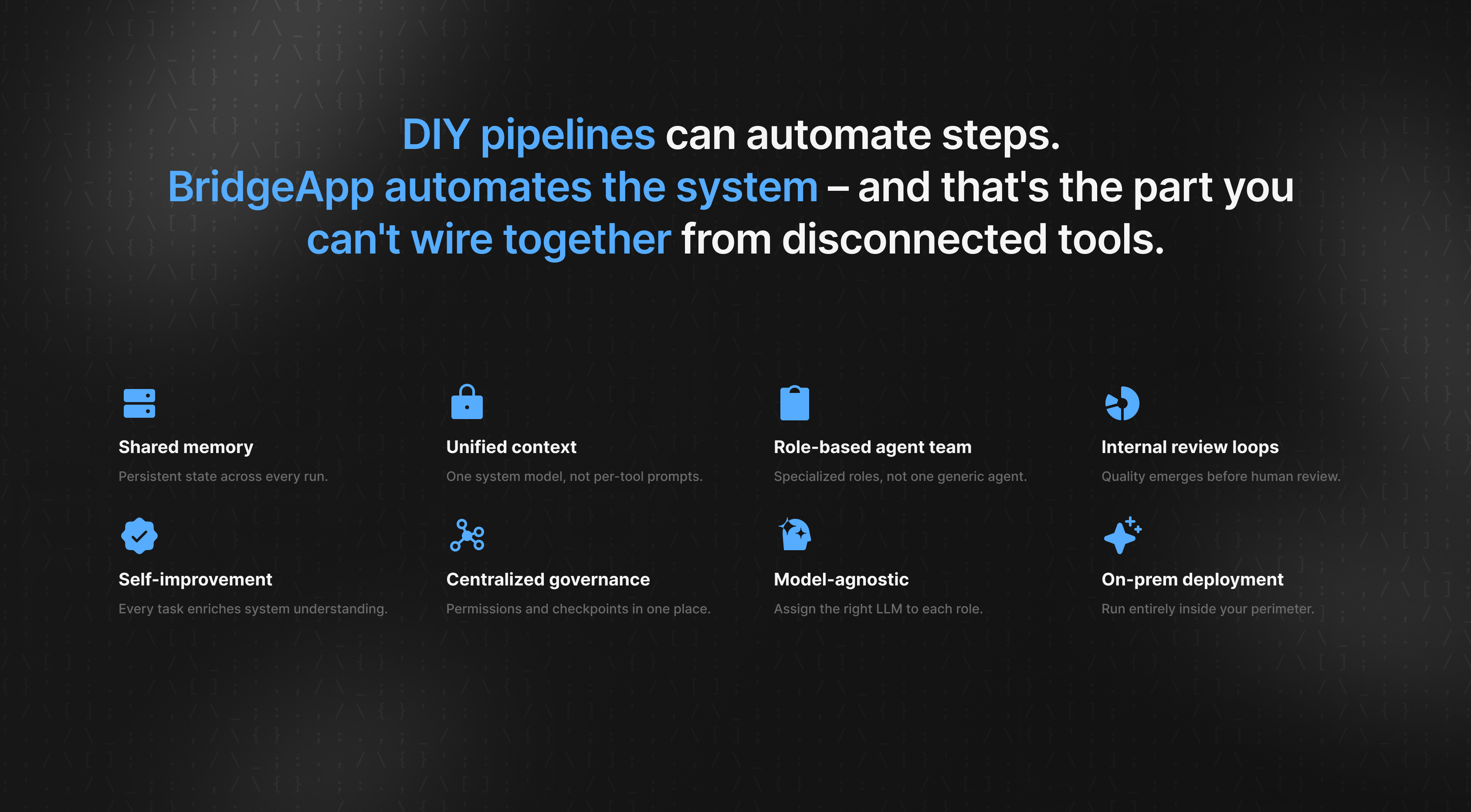
Magic Coder by BridgeApp is an example of an AI-powered coding assistant and multi-agent engine that can generate secure code and tests aligned with organization coding standards, automatically refactor risky code paths flagged by scanners, help correlate vulnerabilities across repos using codebase intelligence, and prepare structured summaries of changes and risk for compliance reviews.
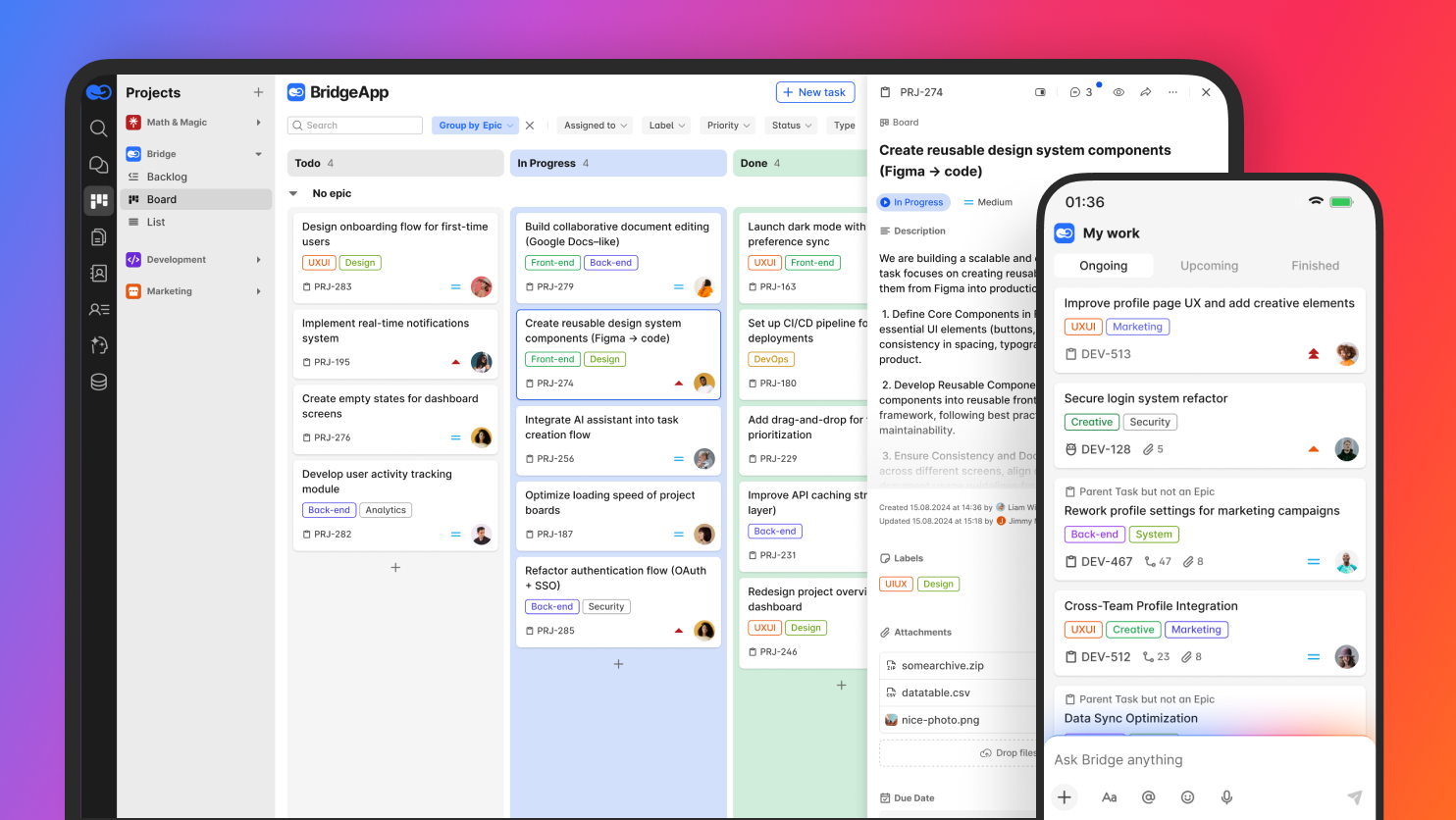
BridgeApp's broader platform context (projects, documents, and agents) ties together requirements, implementation tasks, and CI/CD results, reducing context switching for development teams while preserving traceability. A requirement documented in BridgeApp's project board links to the task, the implementation plan, the PR, and the pipeline result, giving security professionals and auditors a single path to follow.
Measuring SDLC Compliance: Metrics and Continuous Improvement
Combine classic engineering metrics with compliance-specific indicators:
| Metric Category | Example Metrics |
|---|---|
| Delivery | DORA: deployment frequency, lead time, MTTR, change fail rate |
| Security | Mean time to remediate critical vulnerabilities, percentage of repos with enforced CI gates |
| Compliance Evidence | Percentage of PRs with required reviewers, number of high-severity SAST findings waived without documented risk acceptance |
| Coverage | Test coverage on security-critical modules, percentage of apps with current threat models |
Good SDLC compliance programs treat findings as signals for process improvement, not audit checkboxes. Recurring authentication bugs, for example, should trigger a redesign of the auth library and additional training, not just a patch.
Build dashboards that map security posture and compliance status to business services or products. A scorecard with green/yellow/red indicators for "secure coding adherence," "pipeline coverage," and "evidence quality" gives both technical and non-technical stakeholders a shared view.
Practical Roadmap to SDLC Compliance Maturity
A pragmatic sequence for achieving compliance maturity:
- Baseline assessment: inventory current SDLC controls and evidence. What exists? What is documented? What runs automatically?
- Gap analysis: compare against one or two chosen frameworks (e.g., NIST SSDF + OWASP SAMM). Identify the gaps that carry the highest risk or regulatory exposure.
- Pilot: implement improvements with one high-impact product team. Enforce branch protection rules, require code review for all merges, introduce SCA in CI, centralize scan reports. Measurable improvement within one or two sprints is realistic.
- Scale out: roll standardized repository templates, pipeline configurations, and reporting to all teams.
As organizations mature, they can add advanced practices: policy-as-code in CI/CD, SBOM generation for all artifacts, and SLSA-aligned build provenance with signed attestations.
Training is not optional. Short, targeted secure coding workshops for developers and "how to read pipeline evidence" sessions for compliance and audit teams close the knowledge gap faster than documentation alone. Revisit the roadmap every 6 to 12 months to adapt to new regulations, architecture changes (serverless, edge), and evolving threats.
How Magic Coder by BridgeApp Helps Operationalize SDLC Compliance
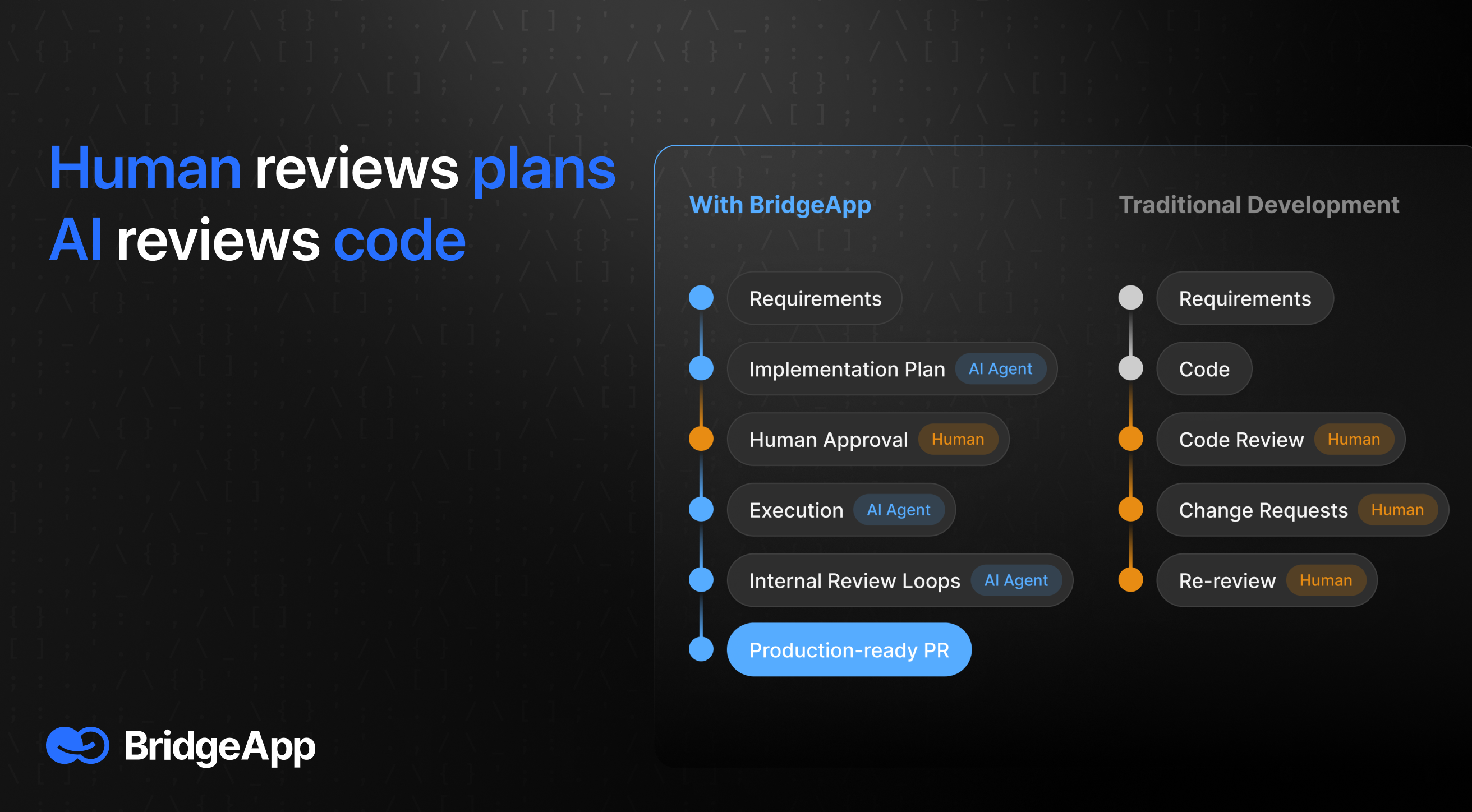
Magic Coder by BridgeApp can act as an autonomous teammate inside the SDLC. It takes tickets from planning tools, generates implementation plans, writes code and tests, and opens pull requests while respecting secure coding standards. The pipeline stops at "Waiting for Merge" by design: humans review the plan, the system reviews the implementation. Agents never advance a task to Done without human approval.
Magic Coder uses codebase intelligence to understand repo structure and dependencies, reducing the risk of changes landing in incorrect modules. For compliance, this matters: traceable, low-risk modifications are easier to audit than scattered, context-free diffs.
BridgeApp's orchestration, multi-agent workflows, and audit-friendly execution logs give organizations a single, queryable trail of who (human or agent) did what, when, and why across planning, coding, and testing phases. This supports SDLC compliance by making it easier to demonstrate that code changes followed defined workflows, show that reviews and tests were performed, and correlate incidents or vulnerabilities back to specific changes and decisions.
This type of AI-assisted automation complements human oversight. It does not replace compliance governance; it produces the structured evidence that governance requires.
Conclusion: SDLC Compliance as a Natural Outcome of Good Engineering
SDLC compliance is not separate from daily engineering work. It is the documented, auditable expression of secure software development practices, code quality, and disciplined operations.
Clear responsibility boundaries between development teams and platform/ops, enforced secure coding standards, automated CI/CD checks, and continuous monitoring make achieving compliance both achievable and sustainable. Development teams empowered with the right tools and practices, including AI assistants like Magic Coder by BridgeApp, can ship secure software that is fast to deliver, built on a secure foundation, and ready for scrutiny by any regulator or customer.
Treat every new project or feature as an opportunity to embed security and strengthen your compliance posture, not just check boxes for the next audit.
FAQ: SDLC Compliance and Secure Development
How can small development teams start with SDLC compliance without a full-time compliance officer?
Pick one widely adopted framework, such as NIST SSDF or OWASP SAMM, and map your existing practices to it using a simple checklist. Focus first on secure coding, code review, and CI tests, because these deliver both security and compliance value at once.
Adopt lightweight tools that plug directly into existing workflows: SAST and SCA in CI, mandatory pull-request reviews, and basic secrets scanning. These do not require developers to context-switch into separate compliance systems.
Schedule a quarterly "mini-audit" where the team walks through one recent feature from requirement to deployment, checking whether evidence (tickets, reviews, pipeline logs) is complete. Improve gaps iteratively rather than trying to achieve compliance in a single sprint.
What kinds of evidence do auditors typically ask for to verify SDLC compliance?
Common evidence types include: requirements and design documents with approvals, code review records from Git platforms, CI/CD pipeline logs showing successful test and scan runs, vulnerability management reports, and incident post-mortems.
Auditors rarely read the code itself. They want to see that a consistent process exists and that it was followed. Every production change should have a ticket, a pull request, reviews, and a pipeline run attached. Centralizing this evidence, or at least maintaining clear links between tools (issue tracker to repo, repo to CI, CI to deployment logs), prevents last-minute manual reconstruction before compliance audits.
How does AI-generated code affect SDLC compliance obligations?
Regulators and auditors generally do not distinguish between human-written and AI-generated code. The organization remains fully responsible for security, correctness, and traceability regardless of origin.
Treat AI-generated code as untrusted input. Enforce the same secure coding standards, reviews, and tests. Consider flagging AI-authored changes in commit messages or metadata for transparency. Tools like Magic Coder by BridgeApp can help on the compliance side by automatically generating tests, refactoring insecure patterns, and summarizing code changes to make reviews more effective while maintaining a full audit trail.
Do all projects need the same level of SDLC compliance rigor?
Most frameworks (NIST SSDF, OWASP SAMM, ISO standards) assume a risk-based approach. Systems handling payment data or health information warrant stricter controls and more detailed evidence than internal dashboards.
Categorize applications by data sensitivity and business impact, then tailor control depth. All applications should get code review and SAST at minimum. High-risk applications add formal threat models, quarterly penetration tests, and stricter access controls. Even low-risk internal tools should meet a baseline of secure coding and CI tests to maintain consistent engineering discipline and protect data across the organization.
How often should SDLC compliance controls and policies be reviewed or updated?
Review policies and controls at least annually, with additional reviews triggered by new regulations (e.g., CRA vulnerability reporting obligations starting September 2026), high-impact incidents, or major architecture changes like moving to Kubernetes or serverless.
Reviews should evaluate both effectiveness (are security vulnerabilities still slipping through?) and practicality (are controls causing excessive friction for development teams?). Document each review as a formal record, including dates, participants, decisions, and rationales. This record shows auditors that the SDLC compliance program evolves with the organization's technology stack and risk landscape.