BlogIndustry Insights
What Is SDLC? Practical Guide to the Software Development Life Cycle in 2026

BridgeApp Team
10 min read

The software development life cycle is the backbone of how modern teams build, ship, and maintain software. Whether you're launching a startup MVP or scaling an enterprise platform, understanding SDLC gives you a repeatable framework for turning ideas into reliable products. This guide breaks down every phase, compares the most common sdlc models, and shows how orchestration tools like BridgeApp keep everything connected.
Under the Hood
SDLC, or the software development lifecycle, is a structured process that guides development teams from initial concept through ongoing maintenance. It standardizes the entire development process so teams can improve code quality, reduce rework, and deliver predictable results that meet customer expectations.
Most SDLCs share seven key phases - planning, requirements, design, development, testing, deployment, and maintenance - regardless of whether a team follows the waterfall model, agile model, iterative model, or big bang model. The phases stay the same; the model determines how you move through them.
Modern SDLCs in 2026 depend heavily on automation, continuous integration, and orchestration layers like BridgeApp to coordinate chats, tasks, documents, and CI/CD pipelines across the entire development lifecycle. Choosing the right model and tooling depends on project risk, regulatory needs, team size, and how often requirements change. Mature SDLCs are not just about delivery speed - they balance compliance, security, software quality, and long-term maintainability.
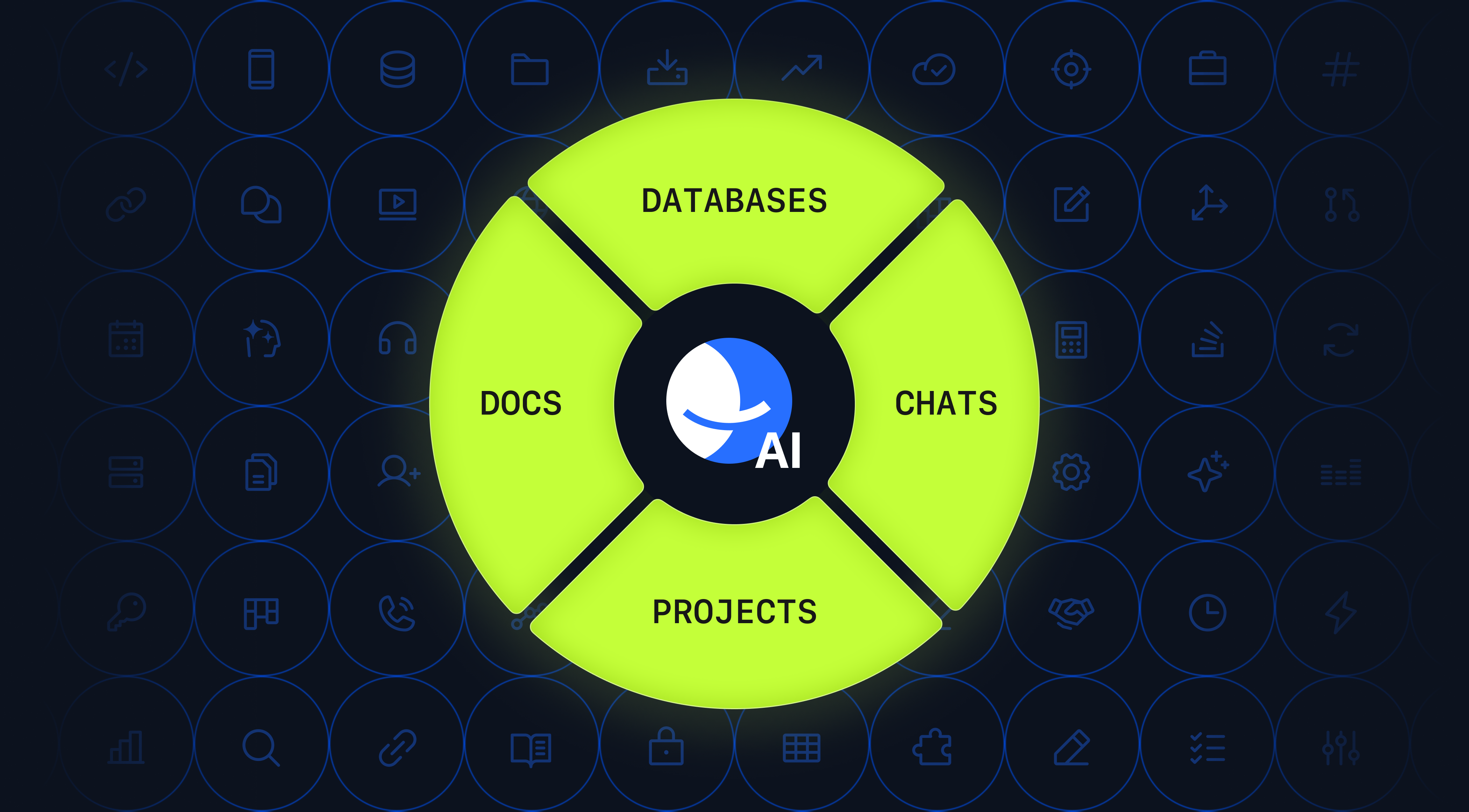
What is SDLC?
SDLC stands for Software Development Life Cycle. It is the end-to-end development process that guides a development team through planning, designing, building, testing software, deploying, and maintaining software systems. Think of it as a map for the entire process of developing software - from the first conversation about what to build, all the way through to ongoing maintenance years after launch.
The development life cycle sdlc applies everywhere: internal dashboards, consumer mobile apps, banking platforms, healthcare records systems. Any team that needs to produce software with predictable outcomes benefits from defining how work flows through each development phase.
SDLC is independent of any specific software development methodology. You can implement it via linear Waterfall, an iterative process, agile methodology, DevOps-driven pipelines, or hybrids. It is also distinct from general project management. While project management covers budgets, timelines, and stakeholder communication, SDLC focuses specifically on the technical development lifecycle and engineering quality gates that ensure high quality software reaches users.
Why SDLC Matters for Modern Software Teams
In 2026, software development teams operate across time zones, rely on complex microservices and cloud infrastructure, and face constant pressure around security and compliance. A well-defined software development process is no longer optional - it is how teams survive complexity.
Consider the numbers: according to the Standish Group's CHAOS Report 2025, roughly 71% of software projects are still "challenged" (exceeding budget, timeline, or scope) or fail outright. Only about 29% deliver fully as planned. A clear SDLC reduces these failure rates by aligning business goals, user requirements, and technical constraints from day one, rather than reacting late in the deployment phase.
SDLC also improves customer satisfaction by enforcing feedback loops - user research, UAT, post-release telemetry - and making requirement changes manageable rather than catastrophic. For project managers and software engineers alike, a defined development process helps prioritize the project's scope, manage engineering capacity, and avoid heroic last-minute fixes. In regulated industries, structured reviews, approvals, and documentation support audits and meet governance requirements that enable on-premise deployments.
Most organizations follow a 6–7 step SDLC: Planning, Requirements, Design, Development, Testing, Deployment, and Maintenance. In real software development teams, these phases often overlap - especially in Agile or DevOps setups - but each phase has distinct goals, artifacts, and owners.
In incremental and iterative development approaches, these phases repeat multiple times per release rather than executing once per project. Below is what happens in each phase, which roles are involved, and what they typically deliver.
Planning and Feasibility Analysis
The planning phase is where product managers, architects, and tech leads analyze business goals, high-level scope, budget, and timelines to decide if the project is realistic. Key activities include stakeholder interviews, competitor research, high-level risk analysis, and initial ROI estimation.
Outputs from this phase typically include a project vision statement, a rough roadmap, and a preliminary software requirement specification or equivalent document. In 2026, teams often use AI-assisted analysis and collaboration platforms like BridgeApp to centralize early assumptions, user research, and risks in one workspace. Getting this phase wrong leads directly to scope creep, misaligned user expectations, and blown budgets later in the development lifecycle.
Requirements Definition
This phase turns the high-level idea into detailed functional and non-functional requirements covering performance, security, compliance, and usability. Typical artifacts include a finalized SRS, user stories or use cases, acceptance criteria, and success metrics such as latency thresholds or uptime targets.
Business analysts, product owners, security officers, and the development team collaborate continuously to validate assumptions and refine software specifications. Traceability is critical: every requirement should map to tests later in the SDLC. This is far easier when requirements live in a centralized tool like BridgeApp's tasks and databases. Strong requirements reduce rework and help testers and software developers align on what "done" really means.
System and Software Design
During the design phase, architects and senior engineers translate requirements into a concrete system design covering architecture, data models, APIs, integrations, and UI flows. Common deliverables include architecture diagrams, database schemas, API contracts, and a Design Document Specification (DDS or SDD).
Teams should consider scalability, fault tolerance, observability, and security - encryption, access control, threat modeling - at this stage rather than after deployment. Prototyping critical software components or UX flows at this point helps catch issues early. According to 2026 benchmarks from Cleverix, a bug that costs approximately $25 to fix at the coding stage can cost over $10,000 if it reaches the production environment. Design decisions strongly influence development speed, code quality, and future maintenance cost.
Development (Implementation)
This is where software developers start writing code. Engineers implement the design using agreed coding standards, branching strategies (GitFlow or trunk-based development), and code reviews. Work is broken into tasks or user stories that flow through boards - Kanban, Scrum sprints - with project management tools like BridgeApp used to track progress and ownership.
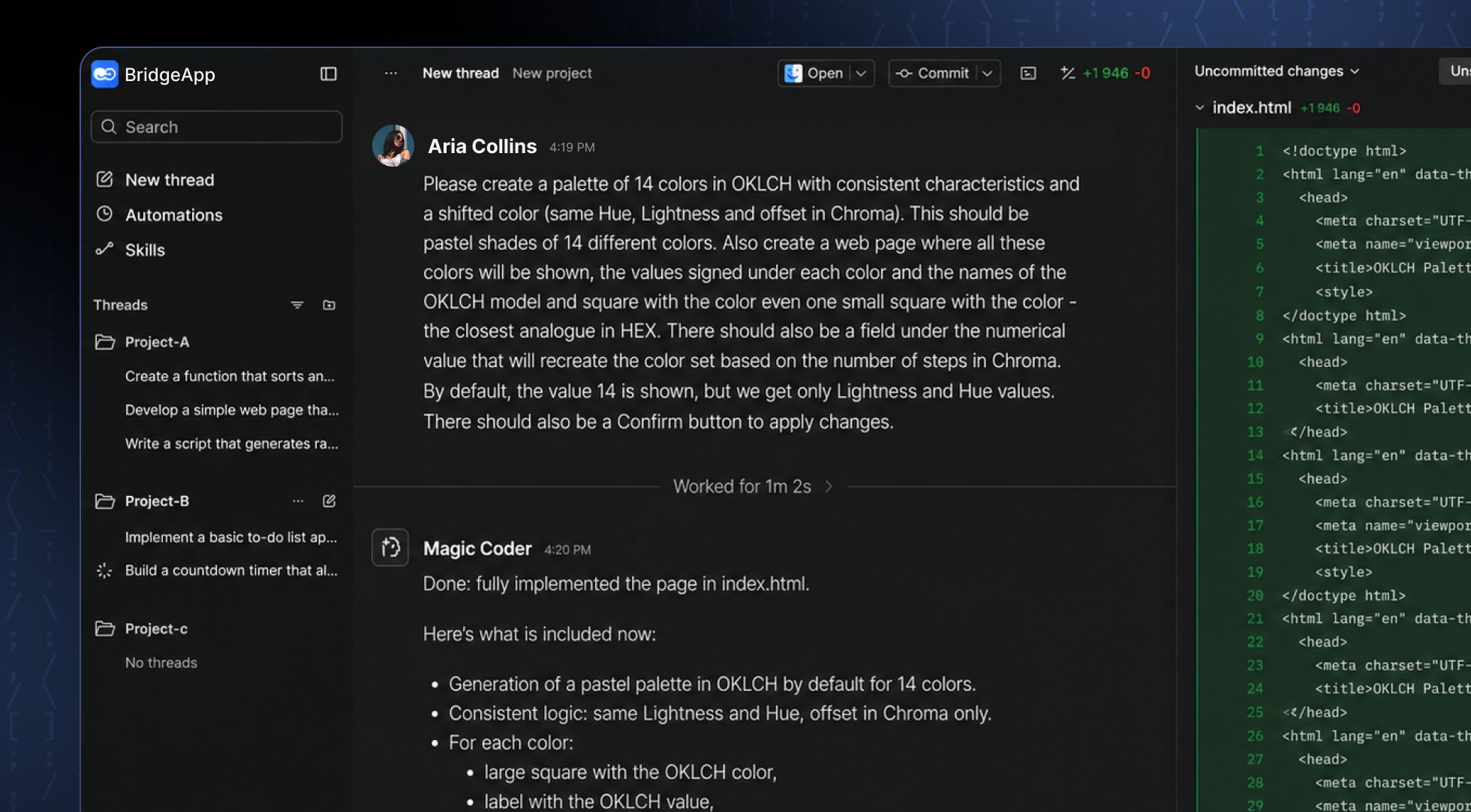
Modern practices include continuous integration, automated builds, static analysis, and code quality gates to prevent regressions. AI coding agents like Magic Coder by BridgeApp can accelerate implementation while keeping changes reviewable and controlled. Unit testing, integration testing, and feature toggles should be implemented alongside new code using version control systems, not bolted on after the fact.
Testing and Quality Assurance
The testing phase employs a layered strategy: unit testing, integration testing, system testing, regression, performance, security testing, and User Acceptance Testing (UAT). QA teams and developers collaborate to create test plans, test cases, and automated test suites integrated into CI pipelines.
Capturing defects, test runs, and quality metrics (defect density, coverage) in a central workspace helps product and engineering leaders see trends. In continuous testing setups, tests run on every merge to main, reducing the risk of late-stage surprises across the entire development process. High-maturity teams embed security scans (SAST, DAST, dependency checks) directly into this phase to help sdlc address security early - catching security vulnerabilities before they reach production.
Deployment and Release Management
The deployment phase moves build artifacts into staging and production environments, typically via automated CI/CD pipelines. Common strategies include blue-green deployments, canary releases, feature flags, and phased rollouts to minimize risk to end users.
Deployment plans should include rollback procedures, monitoring, and communication plans for operations teams and stakeholders. Coordination is easier when release notes, checklists, and sign-offs live in a unified orchestration layer like BridgeApp. In Agile and DevOps organizations, teams deploy software frequently - often daily or weekly - turning this into a continuous activity rather than a one-time event that gates software delivery.
Maintenance, Support, and Evolution
Maintenance is typically the longest phase: handling bug fixes, security patches, performance tuning, and incremental enhancements over months or years of ongoing maintenance. Teams use monitoring, logs, and user feedback to identify issues and prioritize improvements in their backlog to maintain software effectively.
For regulated environments, structured change management with clear approvals and audit trails is essential. Centralized documentation, runbooks, and incident timelines in tools like BridgeApp help keep on-call rotations and support efficient. Mature maintenance processes protect the ROI of the original development effort and ensure long-term customer satisfaction.
Common SDLC Models (Waterfall, Agile, Iterative, and More)
SDLC models describe how phases are organized and repeated, not which phases exist. Most organizations blend more than one model depending on the project. Choosing a software development methodology depends on requirements stability, regulatory constraints, risk tolerance, and the experience level of the development team.
Waterfall Model
The waterfall model is a linear, phase-by-phase approach where each development phase must be completed and signed off before moving on. Its strengths lie in predictability, thorough documentation, and suitability for fixed-scope software projects in heavily regulated industries like aerospace or medical devices.
The limitations are real: poor adaptability to changing requirements, long feedback cycles, and risk of discovering issues late in the development process. A government procurement contract with rigid specifications is a classic Waterfall scenario. Even here, collaboration tools like BridgeApp help mitigate communication gaps by making decisions transparent across departments - a common weakness of traditional software development.
Iterative Model
The iterative model builds software in repeated cycles, starting from a basic version and refining it through multiple short development loops. Benefits include early delivery of core functionality, continuous learning from user feedback, and better handling of evolving requirements.
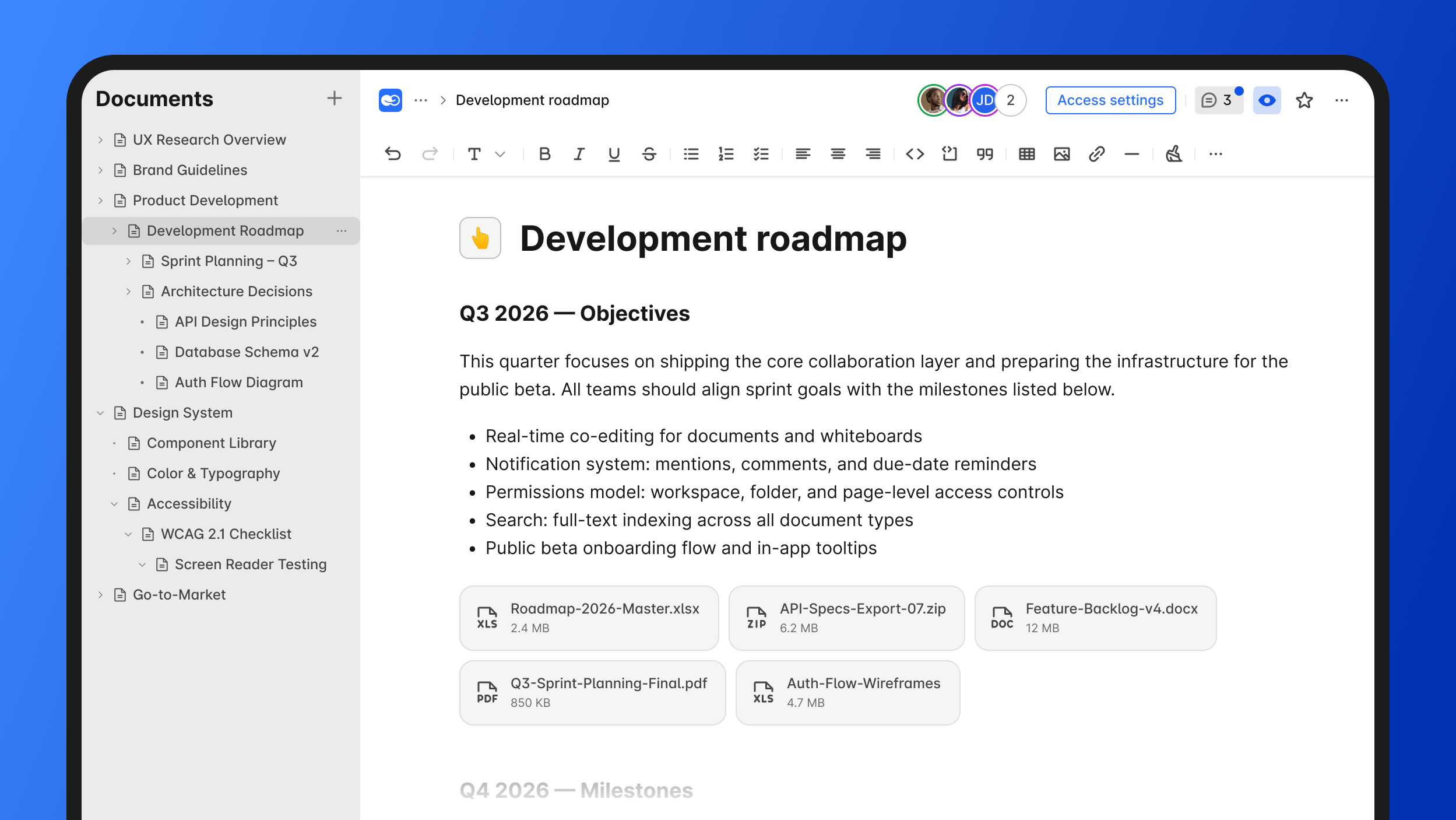
Each iteration goes through a mini-SDLC: planning, design, coding, testing, and review. Releasing an internal analytics dashboard to a pilot group, then expanding features based on usage data, is a typical use case. BridgeApp's boards and docs help teams manage iteration scopes and change decisions in one place.
Agile Model
The agile model structures work into short, time-boxed iterations (sprints) with continuous feedback, reprioritization, and cross-functional collaboration. Agile emphasizes working software over extensive up-front documentation, meaning SDLC phases overlap and compress.
Common frameworks - Scrum, Kanban, Scrumban, SAFe - still respect the same SDLC phases, just repeated frequently. About 97% of organizations now use Agile to some degree, with Agile projects showing roughly 75% success rates versus 56% for traditional approaches. Platforms like BridgeApp support Agile by combining roadmaps, sprint boards, discussions, and docs in a single orchestration layer, enabling teams to track development progress without context-switching.
Spiral Model
The spiral model is an iterative approach centered on risk analysis, with each loop including planning, risk assessment, development, and evaluation. It is useful for large and complex projects where early risk mitigation is critical - telecom core systems, defense software, or any initiative where the cost of failure is extreme.
Each loop yields a more complete prototype, informed by updated risk evaluations. The overhead of repeated risk analysis makes the spiral model less suitable for small, low-risk projects. Tracking identified risks, mitigation plans, and decisions in structured BridgeApp databases keeps the approach disciplined without drowning teams in spreadsheets.
V-Model (Verification and Validation Model)
The validation model (V-Model) extends Waterfall by pairing each development activity with a directly corresponding testing activity - for example, requirements map to acceptance tests, and design maps to system testing. This creates strong alignment between what is specified and how it will be validated.
The V-Model is well-suited for safety-critical or compliance-bound domains that require formal verification and traceability. Its drawbacks mirror Waterfall's: difficulty handling frequent requirement changes and the cost of adjusting specifications mid-project. Traceability matrices stored in BridgeApp documents or databases simplify audits.
Big Bang Model
The big bang model has minimal formal structure: developers start coding with a rough idea, and the architecture emerges organically. It can work for very small, low-risk, experimental projects where speed of discovery matters more than predictability.
The risks are significant: weak predictability, high rework, and potential failure if requirements are misunderstood. The big bang model is rarely appropriate for production systems with SLAs, compliance needs, or long-term maintenance requirements. Even in a prototype, teams should document decisions and assumptions centrally to avoid chaos when the project evolves into something real.
Key Benefits of a Well-Executed SDLC
The benefits of a disciplined SDLC compound over time. Teams that follow a structured process see higher code quality, faster releases, more predictable outcomes, and happier users.
Core benefits include:
- Cost reduction: Catching defects earlier saves dramatically. A bug at the coding stage costs roughly $25; in production, that figure can exceed $10,000 per defect. The cost of poor software quality in the U.S. alone reaches an estimated $2.41 trillion annually.
- Predictability: Clear phases, artifacts, and quality gates make timelines and budgets more reliable.
- Better communication: Development teams, project managers, and stakeholders share a common vocabulary and workflow.
- Compliance support: Documentation and traceability satisfy auditors and regulatory bodies.
- Maintainability: Structured design and testing produce software applications that are easier to evolve over years.
These benefits amplify when SDLC is paired with automation, observability, and an orchestration layer like BridgeApp that keeps everyone aligned. The absence of a disciplined SDLC almost always shows up as missed deadlines, scope creep, and post-release firefighting.
How BridgeApp Orchestrates the Entire Development Life Cycle
BridgeApp is an AI-native unified workspace that acts as the orchestration layer for the whole SDLC - from ideation to deployment and maintenance. Instead of scattering work across disconnected tools, BridgeApp combines team chat, tasks, documents, databases, and a no-code AI agent builder in one platform.
Here is how it maps to the software development lifecycle:
| SDLC Phase | BridgeApp Capability |
|---|---|
| Planning | Channels and group chats for stakeholder discussions; docs for vision statements and feasibility studies |
| Requirements | Tasks and databases for user stories, acceptance criteria, and traceability |
| Design | Documents for architecture specs, API contracts, and design reviews |
| Development | Projects with Board (Kanban), Backlog, and Roadmap views; Magic Coder for AI-assisted coding |
| Testing | Databases for test plans and defect tracking; AI agents for summarizing test runs |
| Deployment | Chat channels for release coordination; docs for runbooks and rollback plans |
| Maintenance | Incident channels, postmortem docs, and structured change management |
Custom AI agents and flows automate repetitive SDLC tasks - updating statuses, notifying stakeholders on deployment, or flagging stale tasks. Organizations needing strict data control can deploy BridgeApp as SaaS, on-premise, or in private cloud, which matters for regulated industries where business processes require data sovereignty across the entire process.
Modern SDLC Best Practices in 2026
SDLC is not a fixed checklist. It evolves with practices like DevOps, DevSecOps, and AI-assisted development. The best software development teams in 2026 treat their SDLC as a living system that they continuously refine.
- Embrace continuous integration, automated testing, and frequent deployments to shorten feedback loops.
- Maintain lightweight but comprehensive documentation (SRS, design notes, runbooks) in a single source of truth like BridgeApp - avoid scattered wikis and email threads.
- Define clear "Definition of Ready" and "Definition of Done" across teams to prevent half-finished work from entering later phases.
- Run regular retrospectives at project and release levels to remove friction from the development process.
Integrating Continuous Integration and DevOps into SDLC
Continuous integration means merging code frequently and running automated test suites on every change, catching defects early in the iterative process. DevOps expands SDLC thinking beyond development to include automated deployment, infrastructure as code, and observability - bringing operations teams into the fold.
Common development tools like Jenkins, GitLab CI, and GitHub Actions form the build-test-deploy chain. BridgeApp can host deployment runbooks, incident channels, and pipeline notifications, keeping all stakeholders aligned on release status. Integrating CI/CD and DevOps into the SDLC improves throughput, reduces lead time, and stabilizes releases in the production environment.
Balancing Compliance, Security, and Speed
Many teams must embed security and compliance checks into multiple SDLC phases: requirements (policies), design (threat modeling), coding (secure coding standards), and testing (security scans). A DevSecOps mindset automates these checks continuously rather than gating them at a final review.
Capturing approvals, risk assessments, and audit-relevant decisions in BridgeApp provides traceability for complex projects in finance, healthcare, and government. Early security and compliance work reduces costly rework and reputational damage from breaches or failed audits. AI should be used judiciously - human review remains essential for critical code paths, architecture, and policies, enabling teams to deploy software with confidence.
How to Choose the Right SDLC Model for Your Team
No single SDLC model is universally best. The right choice depends on your project type, regulatory demands, and how often requirements shift.
Key decision factors:
- Requirement stability: Well-defined scope favors Waterfall or V-Model. Shifting requirements favor Agile or iterative development.
- Domain risk and compliance: Finance and healthcare demand traceability and formal verification; an early-stage consumer app does not.
- Team maturity: Experienced teams can handle complex Agile at scale; newer teams may benefit from more structure.
- Release frequency: Weekly deploys point to Agile/DevOps; annual releases tolerate Waterfall.
- Stakeholder availability: Active stakeholder involvement supports Agile; limited access suits more documentation-heavy models.
Hybrid models work well for many teams - for example, Waterfall for early regulatory documentation combined with Agile sprints for implementation and testing. BridgeApp supports transitions between models by keeping all project artifacts and conversations in one place, even as processes evolve. The goal is always to produce software that meets customer expectations while remaining maintainable and secure.
FAQ
These questions address common practical concerns about the software development life cycle that go beyond the core definitions covered above.
Is SDLC the same as Agile?
No. SDLC is the overall concept describing the development phases - planning, design, development, testing, deployment, maintenance. Agile is a family of models and practices for how to move through those phases iteratively. An agile methodology is one way of structuring the software development lifecycle, alongside alternatives like Waterfall, Iterative, and Spiral. Teams often blend Agile with DevOps and CI/CD, but the underlying SDLC phases remain recognizable.
How long does one SDLC cycle usually take?
Duration varies widely. A small feature in an Agile team might complete a full mini-cycle in 1–3 weeks, while a large regulated system can span 12–24 months. Modern teams prefer shorter cycles with continuous releases, reducing risk and getting user feedback faster. Tracking lead time and cycle time in tools like BridgeApp helps you understand and improve your own organization's SDLC speed.
Which SDLC model is best for startups?
Early-stage startups typically benefit most from an Agile or iterative model that allows frequent pivots based on customer feedback. Heavy, document-driven Waterfall is usually overkill unless regulation or enterprise customers demand it. Startups can use BridgeApp to keep product discovery notes, roadmaps, and sprint work together, making quick iteration less chaotic.
What is the role of documentation in SDLC if we are using Agile?
Agile does not eliminate documentation - it favors "just enough" documentation that stays accurate and useful. Essential docs include user stories, acceptance criteria, architecture overviews, API contracts, and incident postmortems. Storing living documentation in centralized tools like BridgeApp documents keeps it up to date, collaboratively edited, and linked directly to tasks and releases.
How can AI tools like Magic Coder by BridgeApp fit into the SDLC?
AI coding agents can assist across several phases: generating boilerplate during development, proposing refactors, writing test cases, or summarizing design docs. AI output should always be reviewed by human software engineers, especially for security-critical code, architecture, and performance-sensitive software components. Using Magic Coder within BridgeApp's shared workspace keeps AI-driven changes aligned with team standards, coding guidelines, and project context defined elsewhere in the SDLC.