BlogIndustry Insights
Best Rocket.Chat Alternatives: Top Team Communication Platforms

BridgeApp Team
10 min read
Finding the right Rocket.Chat alternative has become a priority for many organizations seeking better scalability, simpler administration, or more advanced features. While Rocket.Chat offers solid open-source foundations with self hosting capabilities, common challenges organizations face include steep admin overhead, complex interfaces, and performance issues at scale.
This guide breaks down the top six alternatives for internal communication in 2026, comparing security features, deployment flexibility, pricing, and integration capabilities to help you make an informed decision.
How We Chose the Best Rocket.Chat Alternatives
Selecting the best chat alternatives requires evaluating multiple factors that directly impact team productivity and organizational requirements. Here’s the criteria framework we used:
Security and Compliance
End-to-end encryption is a critical security feature that ensures only the communicating users can read the messages, preventing unauthorized access. We evaluated each platform’s data encryption standards, two factor authentication options, and compliance capabilities for regulations like GDPR and HIPAA.
Customization and Licensing
Open-source software, like Rocket.Chat, allows for greater transparency in security, as the code can be reviewed and improved by a community of developers, which can lead to quicker identification and resolution of security vulnerabilities. We assessed whether platforms offer open source platform licensing versus proprietary models.
Pricing Models
Pricing models for team collaboration tools often include tiered subscription plans based on the number of users, with costs typically ranging from $2 to $12.50 per user per month depending on the features offered.
Integration Ecosystem
Integration capabilities are essential for team collaboration tools to seamlessly connect with existing software infrastructure, optimizing workflows and enhancing communication. We compared API depth and third party apps availability.
Deployment Options
We prioritized platforms offering cloud, on-premise, and hybrid deployment to address data sovereignty concerns—especially relevant given EU Data Act mandates.
Collaboration Features
Native video calls, file sharing, screen sharing, and workflow automation capabilities were evaluated for depth and reliability.
Top 6 Rocket.Chat Alternatives for Team Communication
Let’s examine each platform’s strengths, limitations, and ideal use cases.
1. BridgeApp
BridgeApp represents a new generation of AI-native digital workspace that unifies team communication, project management, databases, and AI automation into a single platform. Rather than bolting AI onto existing infrastructure, BridgeApp built its architecture with AI at the core. Make your workflows smarter with AI agents and copilots embedded in your workspace.
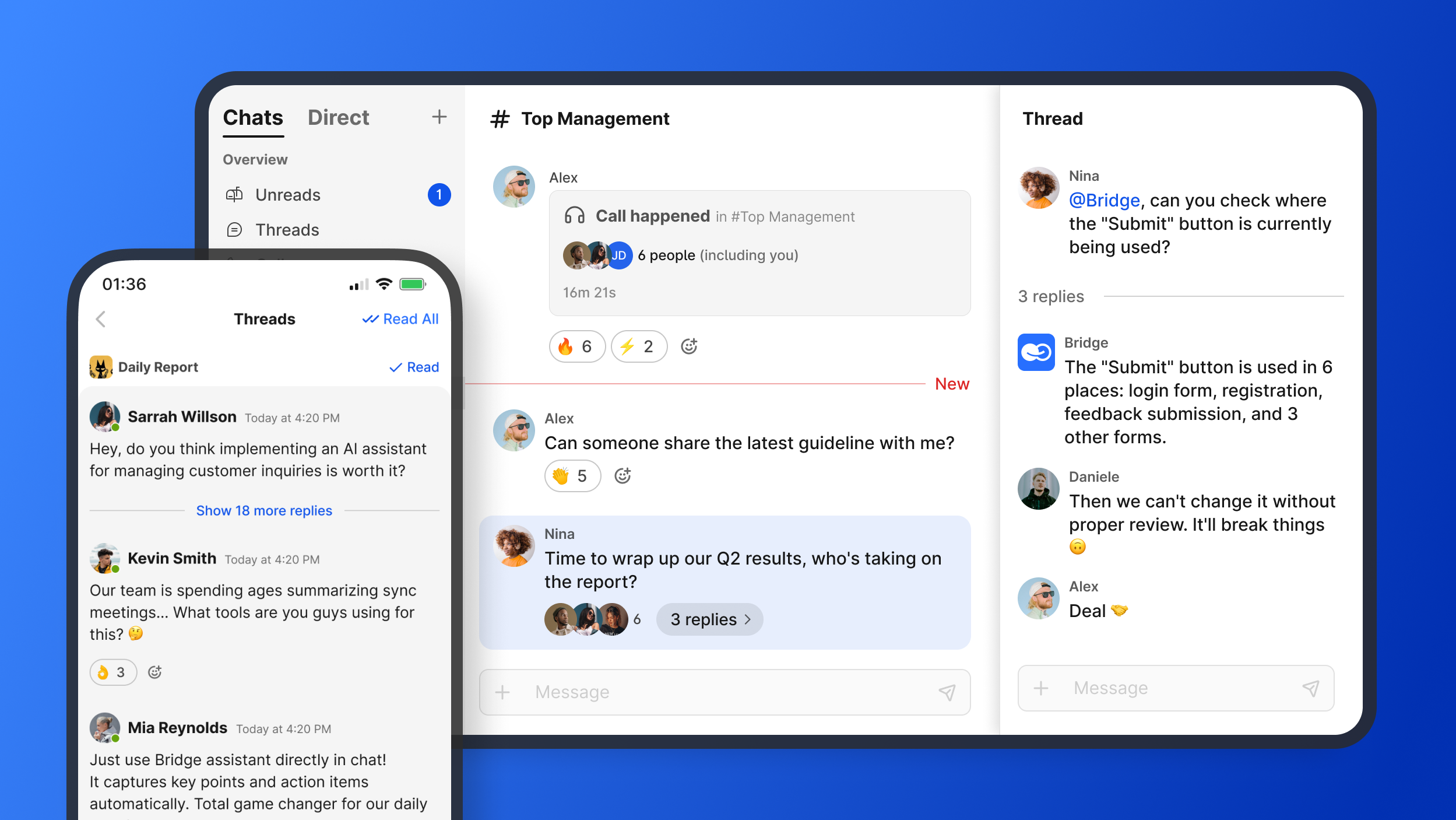
BridgeApp is built with security and privacy in mind, offering both cloud and on-premise deployment options, EU-hosted infrastructure, and GDPR-compliant data handling.
Why It Stands Out
BridgeApp's visual no-code AI agent builder lets teams create custom agents that automate tasks based on rules and company context. These agents access all major AI models (GPT, Claude, Gemini) and connect to external MCP servers for unlimited automation scenarios. After connecting an MCP to a specific agent, the agent instantly gains all its capabilities — and you unlock an unlimited range of scenarios to build and automate. We also support multiple MCPs within a single agent, giving you maximum flexibility and scalability.
The platform replaces 6-7 fragmented SaaS tools—combining channels, video conferencing, Kanban task tracking, collaborative documents, and custom databases in one interface.
Best For
- Teams seeking to automate tasks and eliminate routine work
- Organizations requiring data sovereignty with EU-compliant hosting
- Businesses wanting to consolidate multiple productivity tools
- White-Label & Extensible — enterprises can adapt BridgeApp with their own branding, agents, workflows, and modules.
Key Strengths
| Feature | Benefit |
|---|---|
| 40% productivity increase | Unified workspace + AI automation |
| 4.6 hours saved per employee/week | Routine task automation |
| All AI model access | Not locked to single provider |
| Flexible deployment | Cloud, on-premise, or hybrid |
The platform offers a free version with unlimited members, Pro at €7.5/user/month (yearly), and custom Enterprise pricing for on-premise deployment with BYOK encryption.
2. Mattermost
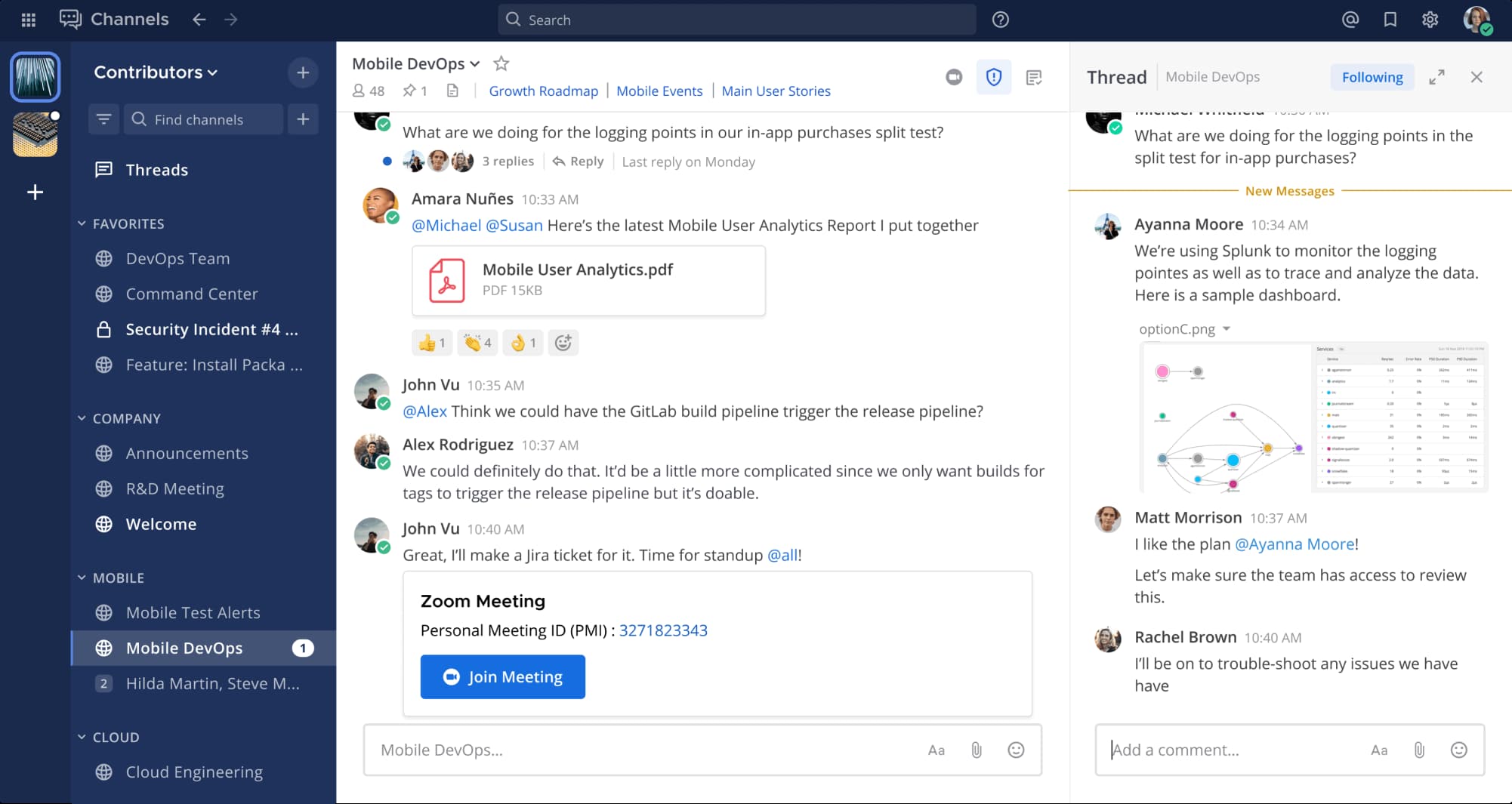
Mattermost is a popular open-source alternative to Rocket.Chat, known for its strong focus on data protection and flexibility in deployment options, allowing both self-hosted and cloud-based solutions. Originally forked from Slack-like architecture in 2016, it has evolved into a leading rocket alternative for enterprise DevOps teams.
Why It Stands Out
Mattermost emphasizes playbook automation for incident response, with claims that 75% of Fortune 500 companies utilize its workflows. FedRAMP authorization and granular audit logs make it attractive for regulated industries.
Best For
- Large enterprises with strict security requirements
- Development teams needing GitLab, Jenkins, and DevOps integrations
- Organizations in defense, healthcare, or finance
Key Strengths
- 500+ plugins surpassing Rocket Chat’s 200+ ecosystem
- Self-hosted deployment on your own server with air-gapped options
- Advanced authentication including SAML/LDAP
- Scales to 100,000+ users on Kubernetes
Possible Limitations
- Setup complexity: G2 analysis shows 25% of reviews cite 2-4 week implementation times
- Pro tier at $10/user/month is higher than some alternatives
- No native omnichannel customer support features
3. Slack
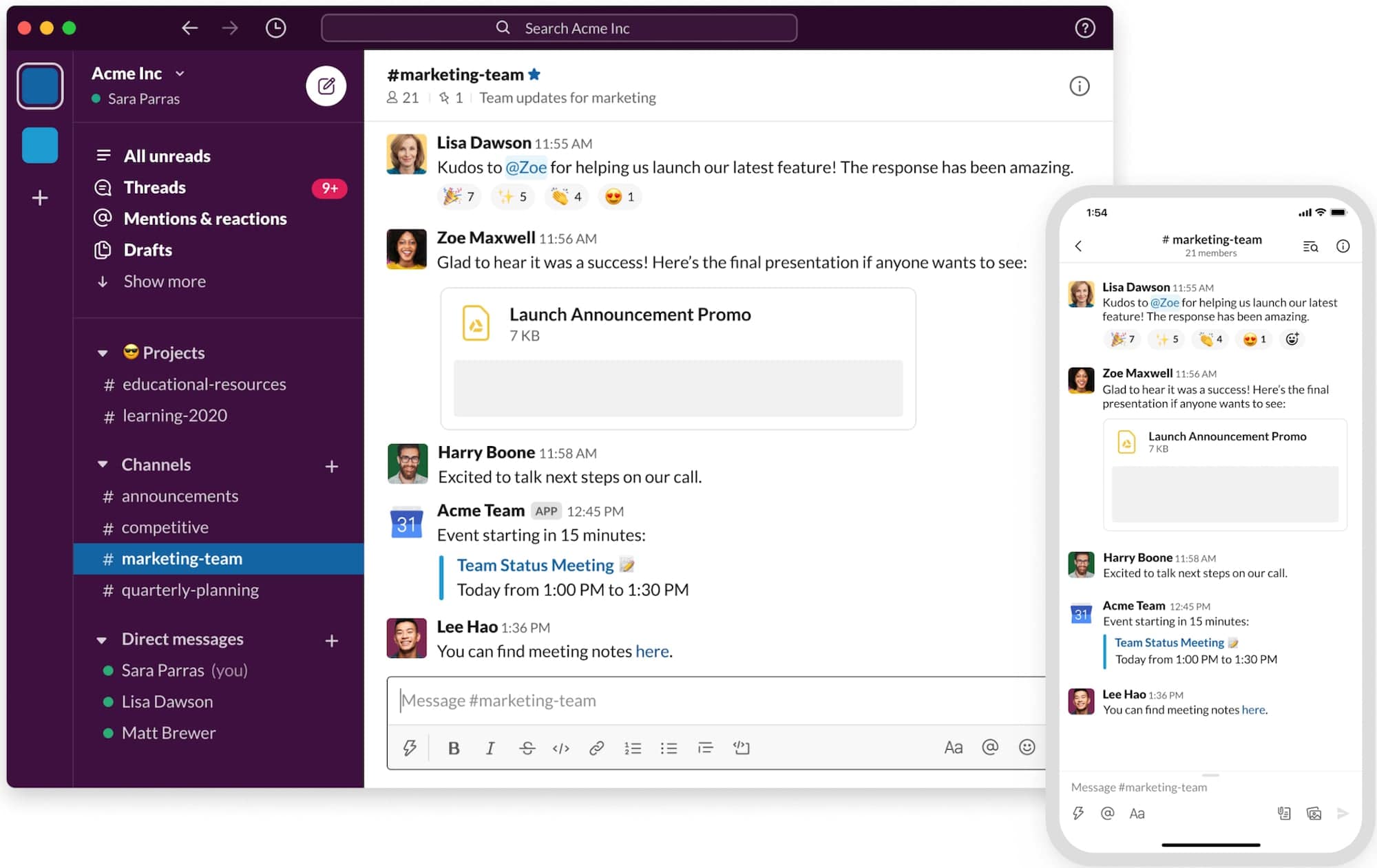
Slack dominates the cloud communication market with 18 million+ daily users, leveraging proprietary machine learning for search accuracy and the industry’s largest integration ecosystem at 2,600+ apps.
Why It Stands Out
The platform’s intuitive interface achieves onboarding in under 5 minutes, making it ideal for small teams prioritizing quick deployment. Slack AI ($10/user add-on) provides message summaries and workflow automation.
Best For
- Small to medium teams prioritizing ease of use
- Organizations with diverse software stacks needing integrations
- Companies wanting a slack alternative that just works
Key Strengths
| Feature | Details |
|---|---|
| Integrations | 2,600+ including Salesforce CRM |
| Search | 95% recall accuracy per internal benchmarks |
| Mobile apps | Reliable push notifications across devices |
| Collaboration | Huddles, Canvas workflows, group chats |
Pricing: Free tier (90-day history limit), Pro at $7.25/user/month, Business+ at $12.50/user/month.
Possible Limitations
- No end to end encryption (message encryption only)
- Cloud-only deployment limits data sovereignty options
- Per-user pricing scales to $50K+/year for 500 users
- 2024 outages averaged 2.1 hours/month
4. Microsoft Teams
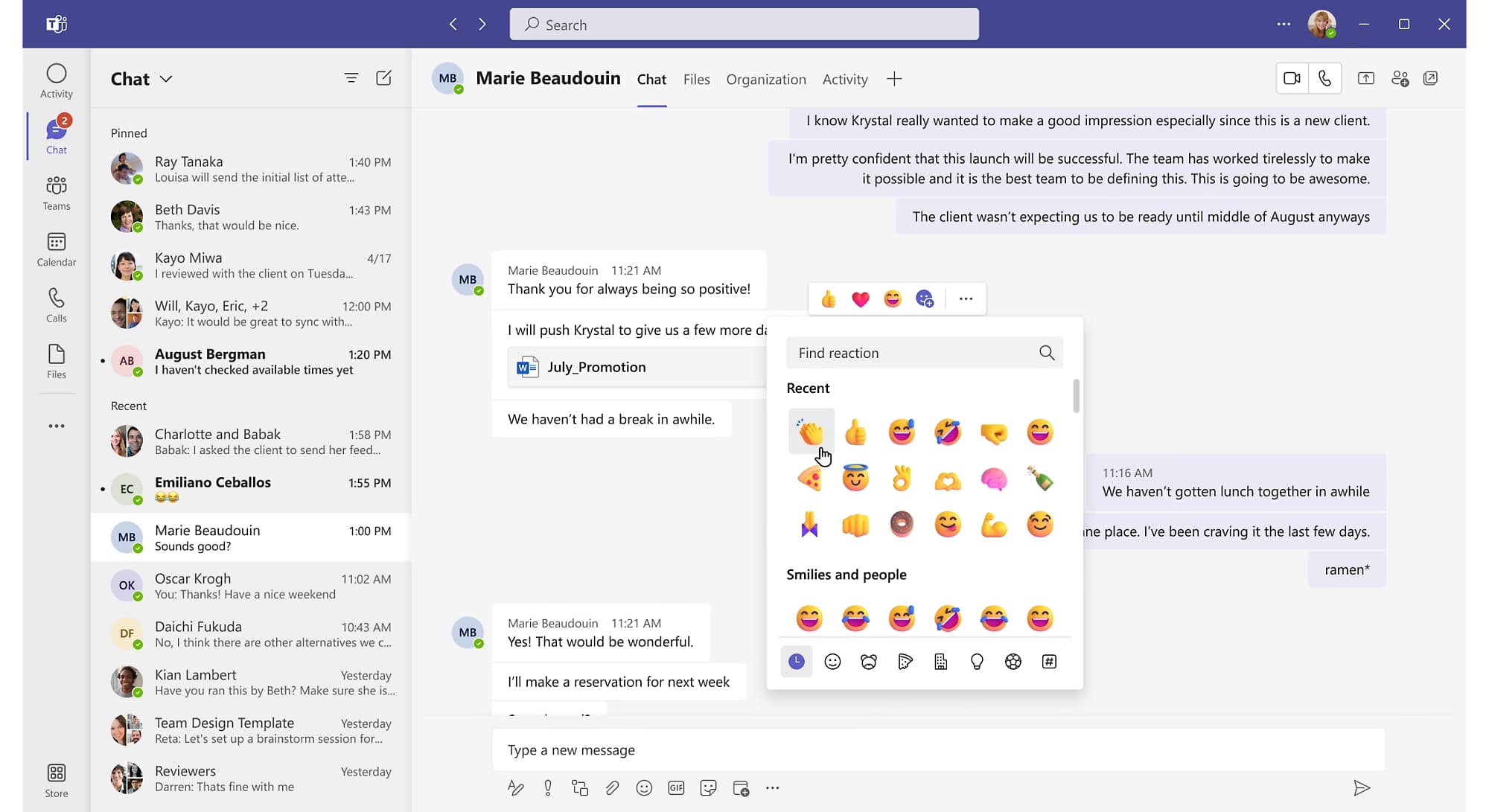
Microsoft Teams has evolved from a 2017 Slack competitor into a comprehensive hub for organizations using Microsoft products, now serving 300 million monthly users with deep Office 365 integration.
Why It Stands Out
Native SharePoint-backed channels, real-time Word/Excel co-editing, and Copilot AI generating 1.7 billion daily chats make Teams powerful for microsoft teams environments. Video calls support up to 50,000 participants via AV1 codec.
Best For
- Organizations already invested in Microsoft 365 (400M+ seats)
- Teams requiring seamless Office integration
- Enterprises wanting centralized management through existing admin tools
Key Strengths
- Essentially “free” for M365 E3 subscribers ($36/user/month bundle)
- Unlimited SharePoint storage per channel
- eDiscovery and compliance holds built-in
- 1,000+ integrations via Power Platform
Possible Limitations
- 80% of non-365 users abandon adoption per Gartner research
- Bloated interface (Forrester usability score 7.2/10)
- Limited customization without Power Platform ($20/user extra)
- Heavy Microsoft lock-in concerns
5. Zulip
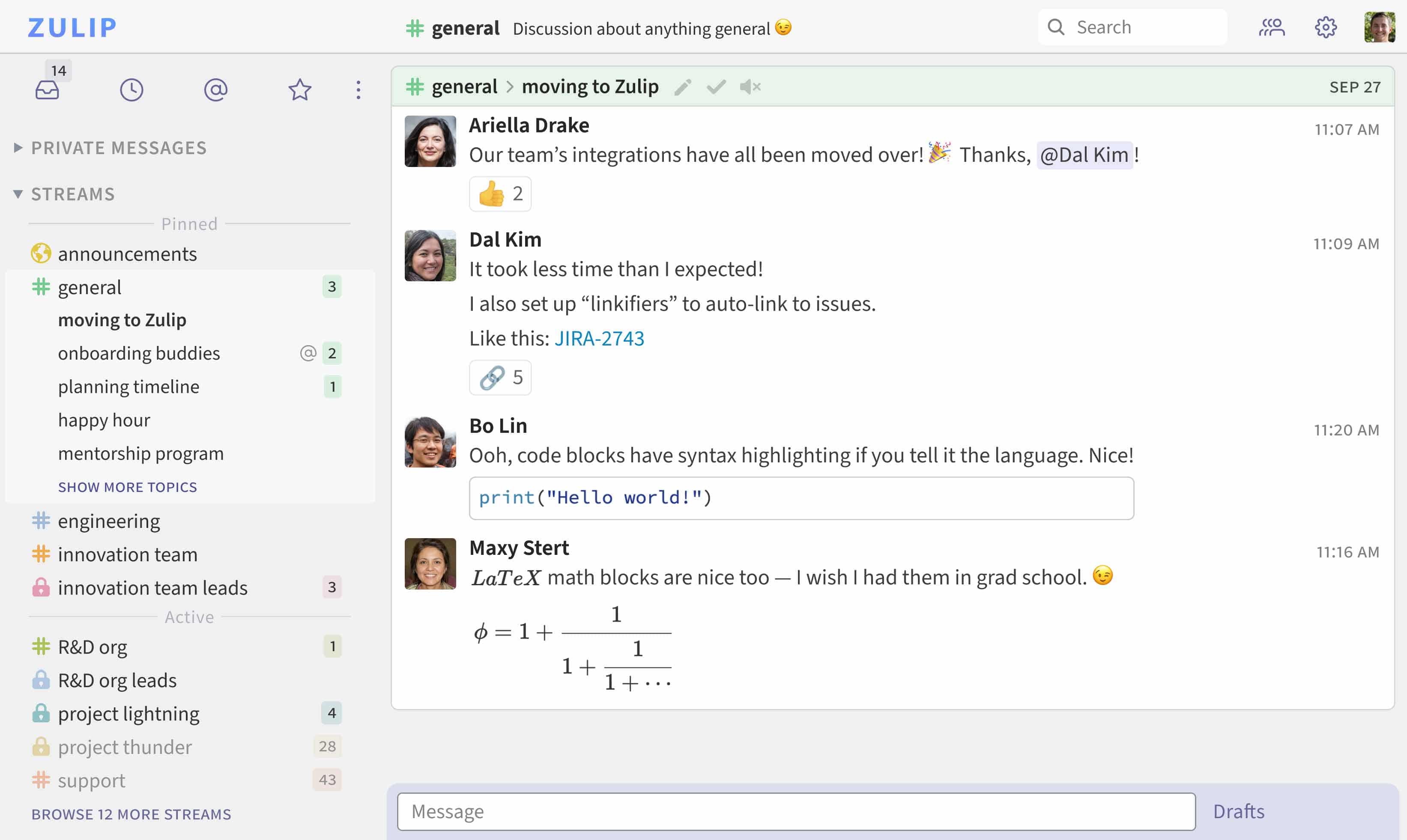
Zulip pioneered topic-based conversation threading with its 2012 founding, organizing chats to reduce information overload. Studies show 40% faster information retrieval compared to linear timelines like chat rocket implementations.
Why It Stands Out
The unique topic-based model lets many teams follow specific discussion threads without drowning in noise. Markdown-rich editing and keyboard shortcuts appeal to developers and technical users.
Best For
- Development teams and technical organizations
- Companies prioritizing organized conversations (used by Ubuntu, KDE projects)
- Teams with heavy documentation and async communication needs
Key Strengths
- CERN reduced email volume 35% after adoption
- Open-source (Apache 2.0) with self-host options
- Cloud Standard at $6.67/user/month
- Scales to 100,000+ users per server
Possible Limitations
- 20% initial drop-off due to topic-model learning curve
- Smaller integration ecosystem (~50 vs hundreds elsewhere)
- No native video conferencing (requires Jitsi plugin)
6. Element
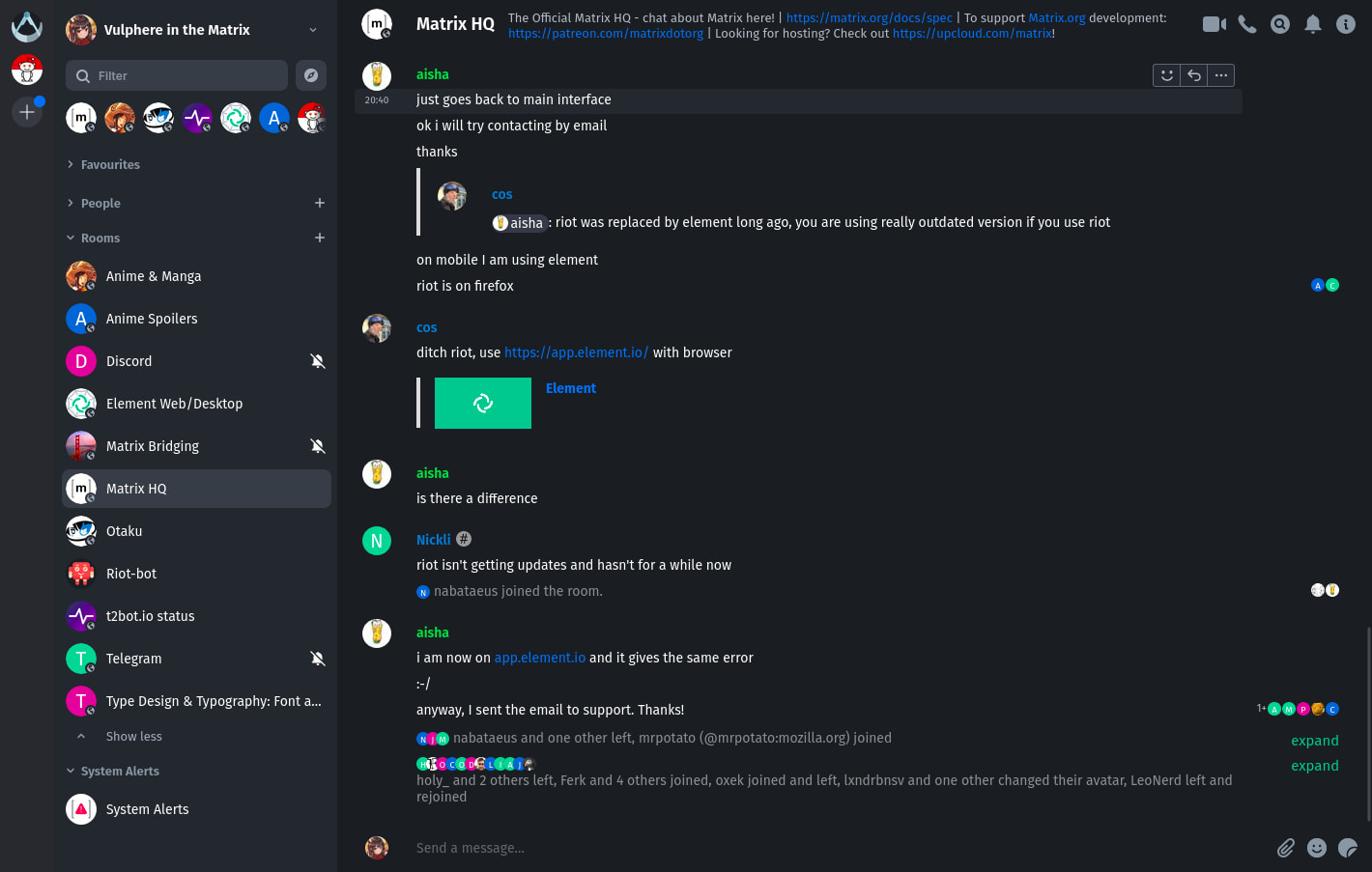
Element is recognized as a secure alternative to Rocket.Chat, providing end-to-end encryption and being built on the Matrix platform, which allows for private server data storage. Its decentralized architecture enables federation across 100 million+ Matrix users.
Why It Stands Out
Default end-to-end encryption via Olm/Megolm cryptographic libraries provides military-grade security. Bridges to IRC, Slack, and other platforms enable interoperability without data silos.
Best For
- Government agencies and defense contractors
- Organizations with maximum privacy requirements
- Companies prioritizing full control over data through self-hosting
Key Strengths
| Feature | Details |
|---|---|
| Encryption | Default E2EE (Olm/Megolm) |
| Case Study | French Gendarmerie migrated 80,000 users in 2022 |
| Federation | Connect across Matrix ecosystem |
| Deployment | Air-gapped viable for secure environments |
Business tier at $5/user/month adds admin UI and enhanced support.
Possible Limitations
- Technical interface challenges non-developer users
- Bridge setup requires 1-2 days configuration
- 25% higher mobile battery drain reported
- Smaller ecosystem compared to mainstream platforms
Quick Comparison of the Best Rocket.Chat Alternatives
| Platform | Best For | Starting Price | Deployment | Key Differentiator |
|---|---|---|---|---|
| BridgeApp | AI-powered productivity | Free | Cloud/On-prem/Hybrid | Skilled AI agents, all LLMs, MCP |
| Mattermost | Enterprise security | $10/user | Self/Cloud | DevOps integrations, FedRAMP |
| Slack | Quick deployment | $7.25/user | Cloud only | 2,600+ integrations |
| Microsoft Teams | M365 environments | $4/user | Cloud | Office 365 native |
| Zulip | Topic organization | $6.67/user | Self/Cloud | Threading patent |
| Element | Maximum privacy | $5/user | Self/Federated | Default E2EE, Matrix |
Note: Pumble is an alternative to Rocket.Chat that offers unlimited messaging history and allows users to create an unlimited number of channels, making it a cost-effective option for companies seeking basic communication without feature complexity.
How to Choose the Right Rocket.Chat Alternative
Choose Based on Security and Compliance Needs
Organizations often prioritize security features such as data sovereignty and compliance with regulations, which can be better managed with self-hosted solutions compared to cloud-only platforms.
For maximum security, Element’s default encryption leads the pack. Mattermost’s FedRAMP authorization suits government contractors. BridgeApp offers GDPR-compliant EU hosting with BYOK options for Enterprise customers.
Consider these questions:
- Does your industry require specific compliance (HIPAA, FedRAMP, GDPR)?
- Can you manage data on your own server, or do you need managed security?
- Is air-gapped deployment necessary for sensitive operations?
Choose Based on Integration Requirements
Modern team collaboration tools should connect with other applications to help automate work and improve productivity. Organizations often seek platforms that offer robust integration options with existing systems to address unique business processes and requirements.
Integration depth varies significantly:
- Slack: 2,600+ apps, strongest for diverse SaaS stacks
- Teams: 1,000+ with Power Platform extensibility
- Mattermost: 500+ DevOps-focused (GitLab, Jenkins)
- BridgeApp: Native integrations plus MCP protocol for unlimited agent capabilities
Evaluate which different apps your teams rely on daily and verify connector availability.
Choose Based on Team Size and Budget
Many team collaboration tools offer free plans with limited features, allowing users to test the software before committing to a paid subscription. The total cost of ownership for team collaboration tools can vary significantly based on the chosen pricing model, including factors such as user count, feature set, and whether the solution is self-hosted or cloud-based.
For small teams on tight budgets:
- BridgeApp Free (unlimited users, 1K database rows)
- Slack Free (90-day history limit)
- Zulip self-hosted (free forever)
For enterprises:
- Calculate TCO including infrastructure costs (self-host averages $10K/year for mid-sized deployments)
- Factor in admin time—Mattermost may require dedicated resources
- Consider consolidation savings—BridgeApp replacing 6-7 tools yields significant ROI
Which Option Is Best for You?
Choose BridgeApp if you want AI-powered automation and a unified workspace. With 40% productivity gains, access to all major AI models, and flexible deployment including on-premise, it’s ideal for it teams seeking to automate tasks and save time while maintaining data control. Organizations can see ROI in 3 months through routine automation.
Choose Mattermost if you need enterprise-grade security with extensive compliance features. Ideal for regulated industries requiring FedRAMP authorization and DevOps workflow integration.
Choose Slack if you prioritize ease of use and need to integrate with thousands of third-party applications. Best for businesses wanting quick deployment without infrastructure management.
Choose Microsoft Teams if you’re heavily invested in the Microsoft 365 ecosystem. The seamless Office integration and included pricing make it compelling for existing subscribers.
Choose Zulip if improving communication through better conversation organization matters most. The topic-based threading significantly reduces noise for development teams and async-heavy organizations.
Choose Element if maximum privacy and data encryption are non-negotiable requirements. The Matrix protocol’s decentralized architecture provides unmatched security for sensitive communications.
Wrapping Up
The best Rocket.Chat alternative depends on your specific needs around security, integrations, team size, and budget. Open-source team collaboration tools like Rocket.Chat allow for extensive customization options, enabling organizations to tailor the software to their specific needs and workflows. The ability to customize the interface and features of a collaboration tool is crucial for organizations that require specific functionalities to support their operational processes—and customization in team collaboration tools can significantly enhance user adoption and deployment speed.
Looking ahead, AI-native platforms like BridgeApp represent where team collaboration is heading. Rather than bolting automation onto legacy architectures, purpose-built AI workspaces connect communication, project management, and intelligent agents in ways that deliver measurable productivity gains.
The 55% of organizations citing cost and security as migration drivers (per Switchboard 2024 survey) have more options than ever. Start by identifying your non-negotiables—whether that’s end-to-end encryption, specific integrations, or deployment flexibility—then test promising platforms with your actual workflows.
Your team’s communication platform shapes daily productivity for every employee. Choose deliberately.