BlogIndustry Insights
Difference Between LLM and Orchestrator: Why It Matters for Real AI Systems

BridgeApp Team
15 min read

If you're building anything beyond a chatbot prototype, you've probably run into this question: where does the model's job end, and where does the system around it begin? This article breaks down the practical difference between large language models and orchestrators, why the distinction matters, and how they work together in production AI.
Key Takeaways
- A large language model (LLM) is the predictive engine that generates text, reasons over instructions, and produces outputs. An orchestrator is the control layer that manages workflows, tools, data, and multiple models around it. They are fundamentally different architectural components.
- Modern AI applications - from chatbots and AI agents to developer tools - need both: LLMs for reasoning and generation, orchestration for reliability, governance, and seamless integration with real systems.
- LLM orchestration covers intelligent routing, tool calling, context management, conversation history, and observability across providers like OpenAI, Anthropic, DeepSeek, and others.
- Confusing an LLM with a complete AI system leads to brittle prototypes that break in production. Understanding where LLM capabilities end and orchestration begins is the first step toward building maintainable AI applications.
- Platforms like BridgeApp use a purpose-built orchestration engine to turn raw llm capabilities into production-grade, governed AI systems - particularly for dev-automation pipelines.
1. Introduction: Why "LLM vs. Orchestrator" Is a Real Architectural Question
Picture a scenario that's increasingly common in 2025–2026: an engineering team built a proof-of-concept using a single LLM API. It worked well in demos. Now leadership wants it running in production - handling customer data, calling internal APIs, switching between multiple AI models based on cost and latency, logging every action for compliance, and recovering gracefully when a provider goes down.
The team quickly realizes that "calling the OpenAI API" and "having an AI system" are not the same thing.
This confusion is at the heart of the LLM vs. orchestrator question. Here's how to think about it:
- LLM / large language model = a probabilistic model that predicts text. It generates, reasons, and summarizes - but it doesn't manage workflows, access your database, or know your business rules.
- Orchestrator / orchestration layer = the coordination and control system around one or many models. It decides what to call, when, with what context, and what to do with the result.
The rest of this article will:
- Compare roles and responsibilities of each component.
- Show how they work together in llm driven applications.
- Provide guidance on when to invest in orchestration tooling.
The focus here is practical engineering for AI applications, not model research.
2. What Is an LLM (Large Language Model)?
A large language model is a neural network trained on vast text corpora to predict the next token. If you've used GPT-4o, Claude 3.5 Sonnet, Gemini 1.5 Pro, or Llama 3.1, you've interacted with an LLM. These are the core reasoning engines behind most generative AI applications today.
Core capabilities of large language models (LLMs):
- Natural language understanding and generation - from summarization to creative writing to code production.
- Reasoning over instructions, code, and documents when given appropriate prompts.
- Limited tool-usage when wrapped by external code or protocols (e.g., function calling specifications).
Intrinsic limitations that matter for system design:
- No built-in business logic, scheduling, or workflow state. An LLM doesn't "know" it's step 3 of a 7-step pipeline.
- Fixed context window and knowledge cutoff (typically 2024–2025 for current models). Information beyond that boundary is invisible unless injected.
- No direct access to databases, APIs, or your infrastructure without an external layer mediating the connection.
In most production AI systems, there isn't a single llm model powering everything. Teams use multiple LLM instances - different vendors, sizes, and fine-tunes - selecting the right one for each task. A lightweight model handles classification; a high-capacity one handles complex reasoning; a specialized fine-tune handles domain-specific generation. That selection logic? It's not part of the LLM itself. It belongs to the orchestrator.
3. What Is an Orchestrator in AI Systems?
An orchestrator - or orchestration layer - is the system component that:
- Manages workflows involving one or more LLMs, tools, and data sources.
- Decides which model to call, with what prompt and context, and what to do with the result.
As IBM's practitioners put it, "LLM orchestration helps prompt, chain, manage and monitor large language models… facilitating data access and retrieval… managing prompts, API interaction, data retrieval and state management across conversations."
Typical responsibilities of an orchestrator:
- Workflow and state management (multi agent flows with branching and dependencies).
- Intelligent routing between models and tools - including load balancing and cost optimization.
- Error handling, retries, throttling, failover, and logging across llm providers.
- Context management and memory persistence across sessions and agents.
- Enterprise governance: policies, permissions, audit trails, and compliance enforcement.
In 2026, this is typically implemented via:
- Orchestration frameworks (e.g., LangChain, LlamaIndex, Semantic Kernel).
- AI gateways and orchestration platforms (multi-provider routers with observability).
- Custom orchestration engines embedded into platforms like BridgeApp, which wraps these capabilities into an opinionated, production-ready system for dev-automation.
The critical distinction: the orchestrator is not a model. It is an architectural layer - code plus runtime - that uses language models as components. It doesn't generate text. It manages everything around the generation.
4. Core Difference: "Brain" vs. "Control Plane"
The simplest way to understand the difference: an LLM is the statistical "brain" that answers questions and generates content. An orchestrator is the "control plane" deciding when, how, and under what constraints to use that brain within a larger AI system.
Think of it this way:
- The LLM is a highly skilled consultant who can read, write, and reason - but has no calendar, no project management system, no access to your internal databases, and no memory of last week's meeting.
- The orchestrator is the project manager plus workflow engine - assigning tasks, setting order, validating outputs, and integrating results with company systems.
Explicit dimension-by-dimension differences:
- Focus: Text prediction and generation vs. task and data flow management across complex processes.
- Scope: A single turn or conversation thread vs. an entire multi-step business process that may span hours or days.
- Inputs/outputs: Prompts and tokens (llm inputs and llm outputs) vs. events, jobs, API calls, and structured payloads.
- Responsibility: Correctness of a single answer (output quality) vs. reliability, auditability, and cost across many llm calls.
- State: Stateless between API calls (the LLM forgets) vs. persistent state management (the orchestrator remembers and tracks).
- Governance: No innate policies (the LLM does whatever the prompt says) vs. centralized control over permissions, tool access, and compliance.
Both are necessary. Production AI depends on a strong model layer and a disciplined orchestration layer working together.
5. Where LLMs End and Orchestrators Begin: Responsibilities Split
Drawing a clear line between what belongs inside the LLM's "job" and what the orchestrator handles prevents architectural confusion and brittle systems.
What lives on the LLM side:
- Natural language reasoning, summarization, content generation - the core llm capabilities.
- Local decision-making when given clear constraints and tools by the orchestrator (e.g., choosing the right function to call based on a user's question).
- Producing structured outputs, drafting code, translating between languages or formats.
What belongs to the orchestrator:
- Long-running state (e.g., a week-long onboarding workflow or a multi-day dev sprint with persistent conversation history).
- Data management: retrieving from vector databases, SQL stores, APIs, and injecting contextual data into prompts.
- Scheduling, retries, backoff, and rate limit management across multiple llm providers.
- Model routing decisions: which provider, which model size, which region.
- Governance enforcement: who can access what tools, what gets logged, when humans must approve.
Concrete scenarios that illustrate the split:
- Customer support assistant: A user request triggers the orchestrator to retrieve order data from a CRM (via API), fetch relevant docs from a knowledge base (vector database), then call an LLM to draft a reply. If the customer's sentiment is angry, the orchestrator escalates to a human agent. The LLM produces the draft; the orchestrator wires all the steps, handles the escalation logic, and logs the interaction.
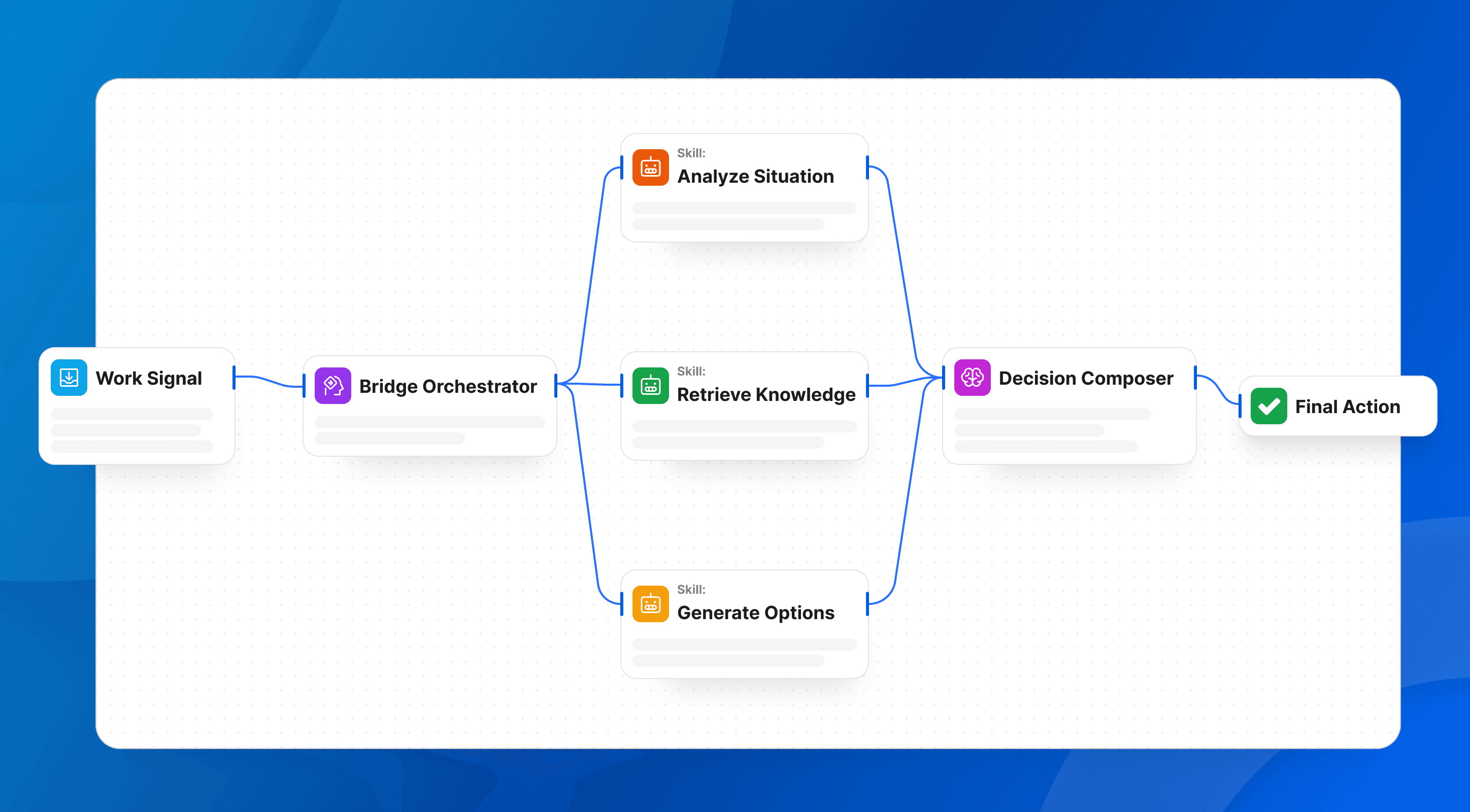
- Dev automation pipeline: A task arrives ("add feature X"). The orchestrator uses a planning agent to design the approach, a code agent to implement, a code reviewer agent to evaluate, and then integrates with the code repository and CI pipeline. LLMs power each agent's reasoning; the orchestrator powers the flow, dependencies, and state transitions.
Trying to push orchestration responsibilities into pure prompt engineering quickly becomes what experienced teams call "prompt spaghetti" - brittle chains of instructions that break unpredictably as complexity grows.
6. LLM Orchestration in Practice: Tasks the Orchestrator Handles
Here's what good llm orchestration actually does in a real stack - a concise checklist of orchestration manages responsibilities:
Prompt chaining and multi-step LLM calls:
- Linking multiple llm calls while preserving context and intermediate results. One model's output becomes another's input, with prompt templates and few-shot examples managed by the orchestrator.
- Handling branching logic: if the first call classifies a request as "billing," route to billing-specific prompts; if "technical," route to a different chain.
LLM integration across providers:
- Standard interfaces for multiple llm providers and models (OpenAI, Anthropic, Mistral, local models). A unified interface means switching or adding providers doesn't require rewriting application logic.
- Supporting multiple llm instances simultaneously for A/B testing or parallel processing of concurrent requests.
Data management and retrieval augmented generation:
- Fetching and preparing context via RAG - querying vector databases and document stores, then cleaning and structuring payloads before they reach the model.
- Data preprocessing: filtering, chunking, and reranking retrieved documents so the LLM receives only relevant contextual data.
Intelligent routing:
- Sending simple tasks to cheaper, faster models and complex reasoning tasks to higher-end models - optimizing resource utilization and controlling costs.
- Automatic failover when a provider is down or rate-limited, with circuit breakers and load balancing.
Memory handling:
- The orchestrator manages conversation history beyond the model's context window, compressing or summarizing older turns.
- Externalized long-term memory for AI agents across sessions - so an agent "remembers" past interactions without stuffing everything into the prompt.
LLM orchestration frameworks such as LangChain or LlamaIndex offer building blocks for these tasks. Platforms like BridgeApp wrap similar capabilities into an opinionated engine - handling orchestration, model routing, and governance in a unified system rather than requiring teams to assemble pieces.
7. LLM vs. Orchestrator in Multi-Agent and AI Agent Setups
Multi agent systems are one of the defining patterns of 2025–2026 AI architecture. Instead of a single monolithic prompt, different role-based agents - researcher, coder, reviewer, planner - collaborate on complex tasks. This is where the difference between LLM and orchestrator becomes most visible.
How the roles split in multi agent setups:
- Each AI agent is typically powered by one or more LLMs (the reasoning core). The agent's "intelligence" comes from the language model.
- The orchestrator coordinates agents: task assignment, dependency ordering, timeouts, conflict resolution, and shared memory. The agent's "reliability" comes from orchestration.
A typical agent pipeline looks like this:
Research agent → planning agent → execution agent → QA agent, all coordinated by an orchestration layer that manages handoffs, tracks state, and enforces rules.
Why orchestration is critical for multiple AI agents:
- Prevent deadlocks - agents waiting on each other in circular dependencies.
- Enforce budget, token usage, and time limits. Without this, agent loops can burn through resources endlessly.
- Maintain a shared source of truth for context and memory, so agents don't contradict each other or repeat work.
- Handle parallel execution where safe, and serialize where order matters.
Magic Coder by BridgeApp uses exactly this pattern: a multi-agent pipeline with Team Lead, System Architect, Developer, Code Reviewer, and QA agents - all managed by an orchestration engine. The pipeline enforces review loops (plan review, local code review) and stops at "Waiting for Merge" by design, so humans approve final changes. The LLMs do the reasoning; the orchestrator ensures the process is controlled and maintainable.
8. LLM Orchestration for Data & Context: RAG, Memory, and "Truth"
Large language models do not inherently "know" your private data, nor do they maintain long-term memory between calls. Every call starts fresh unless something external provides continuity. This is where data retrieval and context management become core orchestration concerns.
Retrieval Augmented Generation (RAG) is the dominant pattern for grounding LLM responses in real data. The orchestrator queries knowledge sources - a vector database, SQL store, or API - retrieves relevant documents, and injects them into the prompt before the LLM generates a response. The model itself doesn't "search"; the orchestration layer handles web search, database queries, and data preprocessing.
How the orchestrator manages context for context augmented llm applications:
- Selecting which documents or facts to include based on relevance scoring and access control.
- Compressing and summarizing history to fit within token limits - so the model gets maximum signal in minimum tokens.
- Applying reranking or filters to keep context on-topic and prevent hallucination from irrelevant data.
Output verification as an orchestration responsibility:
- Cross-checking LLM responses against knowledge bases before delivering them to users.
- Running a separate "critic" or evaluator model for risky outputs - a pattern where the orchestrator calls a second llm model specifically for quality control.
None of this is something the LLM does on its own. Data management, context engineering, and fact verification are orchestration tasks - fundamental parts of building sophisticated llm applications that users can trust.
9. Reliability, Security, and Governance: Why Orchestration Is a Must
Raw llm calls cannot solve several reliability concerns on their own:
- Provider outages, rate limits, and transient network errors are facts of life when working with external llm api endpoints.
- Non-deterministic llm outputs lead to inconsistent behavior across runs - the same prompt can produce different results.
How the orchestrator addresses reliability:
- Retries with backoff, circuit breakers, and queueing ensure that a single provider hiccup doesn't crash the workflow.
- Semantic caching and idempotency for long-running workflows prevent duplicate work and reduce costs.
- Performance monitoring and performance tracking across providers, with key metrics like latency, error rates, and performance metrics for token economics.
Security and enterprise governance:
- Central policies for which models and tools can access which data. Orchestration manages tool permissions at a granular level.
- Audit logs of prompts, llm responses, and tool calls for compliance - essential in regulated industries like finance and healthcare.
- Sandboxed execution environments that isolate LLM-driven code from production infrastructure.
This is where serious orchestration platforms differ from "just call the API." BridgeApp, for example, runs LLM-driven automations inside isolated microVM sandboxes, applies layered permission rules to every tool an agent can access, and logs each step for human review. Secrets are encrypted at rest, Git credentials are short-lived and scoped, and every authentication mutation is audited - the kind of governance that raw model interactions simply cannot provide.
10. How BridgeApp Uses Orchestration to Turn LLMs into Real Dev-Automation
To anchor these concepts in a real-world llm driven applications platform, consider how BridgeApp and Magic Coder by BridgeApp implement the LLM + orchestrator architecture for the software development lifecycle (SDLC).
The multi-agent dev pipeline inside BridgeApp:
- Team Lead agent - intake, triage, and orchestration of tasks; assigns work and approves plans.
- System Architect agent - inspects code and requirements; authors the implementation plan.
- Developer agents (backend / UI) - implement approved plans, write tests and docs, open PRs.
- Code Reviewer and QA agents - evaluate code against the plan, catch issues before merge.
What the orchestration engine handles:
- State transitions: Todo → Planning → Plan Review → Execution → Local Code Review → Waiting for Merge. Each state has clear entry/exit conditions, and agents never advance a task to Done - the pipeline stops at "Waiting for Merge" so humans review the final output.
- Parallelizing work across multiple AI agents where safe, and resuming from the last checkpoint after failures.
Connecting to earlier concepts:
- Intelligent routing across different llm providers via a unified model layer (OpenAI, Anthropic, DeepSeek, and others) - the orchestrator picks the right model for each agent's task.
- Data management using knowledge bases and codebase graphs (code global analysis of callers, call chains, cross-service traces) to give each agent the right contextual data.
- Governance with explicit skills, rules, and sandboxed execution - every agent operates within defined boundaries.
The goal here isn't a product pitch. It's showing that the abstract distinction between LLM and orchestrator maps directly to how real systems get built: the models reason, and the orchestrator makes sure that reasoning happens reliably within a controlled, auditable pipeline.
11. When Do You Need an Orchestrator vs. "Just an LLM"?
Not every AI use case needs a full orchestration platform. Here's where a single LLM API call is enough:
- One-off content generation - drafting a blog post, summarizing a document.
- Simple Q&A over public web knowledge - no private data, no multi-step logic.
- Internal prototypes or experiments where speed matters more than reliability.
Contrast that with situations where AI orchestration becomes non-negotiable:
- Multiple models, providers, or regions with cost optimization requirements.
- Multi-step llm workflows with tools, databases, and external systems.
- Need for observability, SLAs, and team-wide governance - performance tracking, audit trails, cost controls.
- Scenarios involving multiple AI agents that coordinate on complex tasks.
A simple decision checklist for engineering leads:
- Do you need to call more than one tool or model? → Consider orchestration.
- Do you need audit logs, cost tracking, and model routing? → You need an orchestrator.
- Will non-technical teams rely on this AI system for core business processes? → Invest in orchestration early.
A 2026 research paper evaluating LLM orchestration found that orchestration improved accuracy by roughly 4–5 percentage points over optimized chain-of-thought baselines, but came with approximately 2–4× the token cost. The trade-off is real, and it's worth making deliberately rather than discovering it after your prototype hits production.
If you're building a system that matters, think "LLM + orchestrator" from the start rather than bolting orchestration on after things break.
12. Summary: LLMs, Orchestrators, and the Future of AI Applications
- LLMs are the reasoning and generation engines - they produce the intelligence.
- Orchestrators are the execution, routing, and governance layers - they produce the reliability.
- Scalable ai systems and ai agents require both working together, each handling what it does best.
LLM orchestration is now as fundamental as the model itself for production AI. In 2025–2026 multi-model, multi agent architectures, the orchestration layer is what separates a demo from a product. Platforms like BridgeApp combine llm integration, orchestration, and dev-automation best practices so teams can go beyond prototypes to reliable AI-powered SDLC pipelines - with team capabilities that scale as the organization grows.
Take a hard look at your current architecture. Where are raw LLM calls doing "hidden orchestration work" buried in code or prompts? Where could a dedicated orchestration layer - whether open-source orchestration frameworks, a managed orchestration platform, or a purpose-built engine - simplify, harden, and make your system observable? That's the right llm orchestration framework question to ask.
FAQ
Here are common follow-up questions that go beyond what's covered in the main article.
Do small teams really need an LLM orchestrator, or is it only for large enterprises?
Very small, low-risk prototypes can rely on direct LLM calls without a separate orchestration layer. But the moment a team runs multiple use cases, works with more than one model or provider, or deploys to an environment where reliability matters, an orchestrator saves significant engineering time and reduces operational risk. Many llm orchestration frameworks - including open-source options - are lightweight enough for startups. BridgeApp specifically targets engineering teams that want production-grade automation without building their own orchestration engine from scratch, making it accessible well below the enterprise tier.
How is an LLM orchestrator different from an AI gateway or API proxy?
An AI gateway focuses on unified access, billing, rate limiting, and basic routing across llm providers - essentially traffic management for model interactions. An orchestrator adds workflow logic, tool coordination, context management, prompt chaining, and evaluation on top of raw routing. Some modern platforms combine both roles into a unified system, but conceptually the orchestrator handles higher-level application logic and llm resources management, not just request proxying.
Can one orchestrator manage both closed-source and open-source language models?
Yes. Most modern orchestration layers are designed to work with heterogeneous model backends: hosted APIs (OpenAI, Anthropic, Google) and self-hosted or cloud-hosted open-source models (Llama, Mixtral, and others). BridgeApp's model layer follows this pattern, abstracting over multiple providers so that orchestration logic, flows, and governance rules don't depend on a single vendor - enabling true cost optimization across the model landscape.
Isn't function calling inside an LLM enough? Why do I still need orchestration?
Built-in tool or function calling lets a model decide when to invoke specific tools during a single conversation turn, but it does not replace cross-request state management, retries, scheduling, or multi-agent coordination. It also doesn't handle governance policies across an organization. Orchestration and function calling are complementary: the orchestrator defines the toolbox, sets the rules, and controls the environment, while the LLM decides tactically which tool to use within those boundaries.
How does BridgeApp's orchestration differ from generic workflow automation tools?
Generic workflow tools orchestrate APIs and human tasks, but they are not architecture-aware for codebases, multi-agent AI pipelines, or token and cost management. BridgeApp's orchestration engine is built specifically for autonomous development pipelines: it understands repositories through codebase intelligence (code global analysis), uses an llm model layer for intelligent routing across providers, applies strict governance and sandboxed execution, and manages agent memory across sessions - capabilities that generic workflow platforms simply don't offer.