BlogHow-To Guides
What Is AI Agent Orchestration? A Practical Guide for Multi‑Agent Systems

BridgeApp Team
16 min read

As organizations move from experimenting with individual AI agents to deploying them across real business processes, a new problem emerges: coordination. One agent answering questions is manageable. Five agents touching the same customer ticket, codebase, or financial record without clear rules is a recipe for conflict, duplicated work, and silent failures. AI agent orchestration is the discipline that solves this, and understanding it is quickly becoming a prerequisite for any team building production-grade AI systems.
Core Insights
AI agent orchestration is still a relatively new practice for most teams, but the core principles are well-established. Here is what matters most:
- AI agent orchestration is the execution control layer that coordinates multiple AI agents across complex workflows, tools, and data - governing who acts, when, and under what rules.
- Multi agent orchestration with specialized agents outperforms a single agent when you need domain expertise, parallel execution, clear permission boundaries, or auditability - but coordination complexity grows quickly with each agent you add.
- Common agent orchestration patterns include sequential pipelines, concurrent workers, handoff chains, manager–worker hierarchies, and group chat reviews. Choosing the right pattern early shapes cost, latency, and observability.
- Modern production stacks increasingly rely on interoperability standards like Model Context Protocol (MCP) and on orchestration engines such as Magic Coder by BridgeApp to implement these patterns safely.
- Human oversight and governance controls remain non-negotiable, especially in regulated industries where audit trails and approval gates are required.
What Is AI Agent Orchestration?
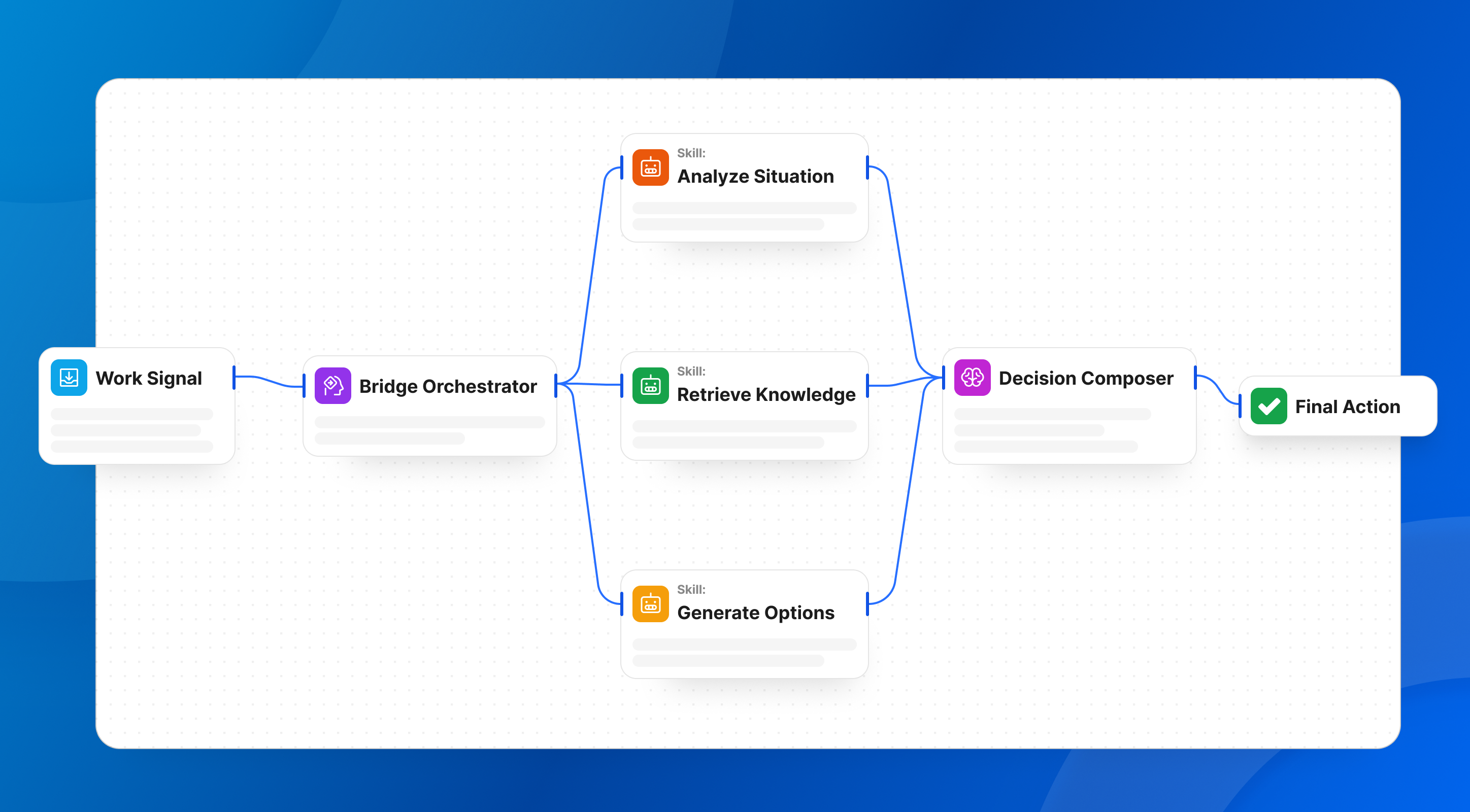
AI agent orchestration is the coordination layer that manages how one or multiple AI agents plan, act, use tools, and pass state to each other. Think of it as the control plane sitting above individual agent decisions. It doesn't do the reasoning - it decides who reasons about what, when they do it, and what happens if something breaks.
It is important to separate three concepts that often get conflated. An AI agent is an autonomous component combining reasoning, tool usage, and decision-making. An agent system - or multi agent system - is a collection of agents with different specializations sharing a goal. And orchestration is the layer that controls sequencing, assignment, data flow, error handling, and governance among those agents. As JetBrains defines it, orchestration "translates a high-level objective into a sequence of executable steps, ensures those steps happen in the right order with the right context, and keeps the workflow from breaking down."
AI agent orchestration coordinates multiple AI agents for complex workflows. It enables agents to share context and collaborate effectively. Orchestration governs task routing, tool access, limits (turns, cost, time), data flow, and when to involve humans. Critically, orchestration can apply to a single complex agent managing a toolbox or to multiple autonomous AI agents working across an entire workflow.
Single‑Agent vs Multi‑Agent Orchestration
From an engineering perspective, the question isn't whether to orchestrate - it's whether one smart agent with tools is enough, or whether you need multiple specialized agents with distinct roles.
In single agent orchestration, one agent manages tools, state, and decisions while the runtime enforces guardrails: timeouts, retries, permissions, and cost caps. Single agent systems offer simpler debugging, fewer moving parts, and less coordination complexity. They're ideal for narrow or well-scoped tasks.
In multi agent orchestration, multiple ai agents with distinct prompts, permissions, and roles collaborate under an orchestrator. The advantages are real: domain specialization, parallelism, clearer separation of responsibilities, and the ability to swap or upgrade individual agents without rebuilding the whole system. Orchestrated workflows can result in faster completion of tasks than single-agent setups, especially when higher automation allows agents to execute complex processes in parallel.
Most production systems start as single-agent and evolve into multi agent designs as scope and governance needs grow. Don't over-engineer on day one.
Why AI Agent Orchestration Matters for Enterprises
Orchestration stops being optional the moment an organization deploys more than a handful of ai agents. Without it, agents operate in silos, creating overlapping responsibilities, conflicting outputs, and duplicated work.
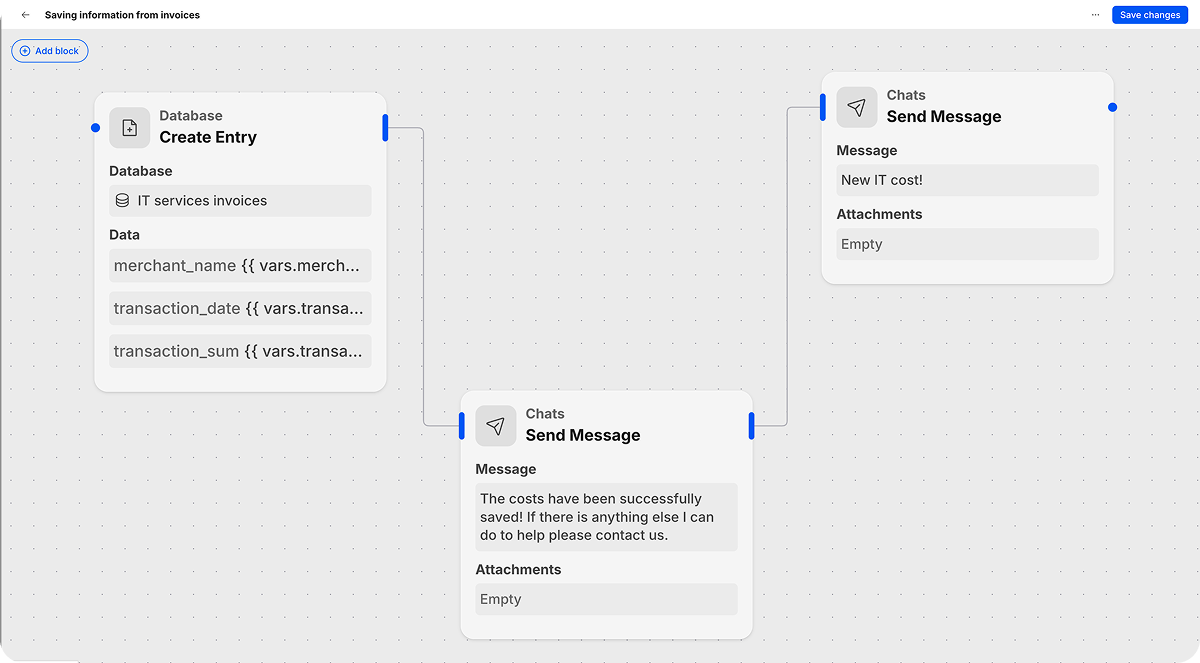
Here's why enterprises treat orchestration as infrastructure:
- Operational efficiency. AI agent orchestration enhances operational efficiency by reducing redundancies. It provides a single source of truth for task ownership, what state a task is in, and which agent may act next. AI agent orchestration also enhances cross-system synchronizations in enterprise environments.
- Governance and compliance. It provides a governance layer to enforce security and compliance. Governance applies limits, error handling, and human approval gates for high-risk actions. Centralized orchestration is preferred in regulated environments for audit trails.
- Scalability. Organizations can scale AI deployments without compromising performance. AI agent orchestration supports scalability by adding new agents easily without redesigning the system.
- Cost and latency control. Orchestration caps depth of delegation, retry counts, and tool calls, and decides when to fall back to humans - preventing runaway execution and unexpected bills.
- Developer workflows. Agent orchestration can slot into CI/CD, incident response, or SDLC pipelines as an extra control layer, coordinating multiple ai agents across code, review, and deployment stages.
Centralized orchestration uses a single control layer for task management, which is the most common starting point. As systems mature, decentralized orchestration allows agents to communicate directly with each other, offering flexibility in dynamic environments.
Workflows, Agents, and Orchestration: Getting the Terms Straight
These three terms overlap enough to cause confusion, so let's draw clear lines.
- Workflows are deterministic sequences of steps (BPMN diagrams, CI pipelines, n8n flows) that run the same way whenever inputs meet conditions. Predictable and auditable, but rigid.
- AI agents are autonomous components that interpret context, decide on actions, and may call tools or APIs with some freedom. Flexible, but less predictable and costlier per step.
- Agent orchestration embeds AI agents inside workflows (agents as steps) or lets a manager agent trigger deterministic subflows. It combines the predictability of workflows with the flexibility of agent reasoning.
The practical takeaway: use code for deterministic routing and validation. Use agents for interpretation, planning, and unstructured reasoning. Use orchestration to bind both into something reliable.
Core Agent Orchestration Patterns
Most agent systems reuse a handful of recurring orchestration patterns. These aren't theoretical abstractions - they're the design decisions that shape how agent orchestration work gets done in practice.
Execution patterns dictate how work flows in an orchestration system. These patterns apply to both single-agent and multi-agent systems, and production platforms typically mix several. The main patterns are: one agent with tools, sequential pipelines, concurrent workers, handoff, manager–specialist (hierarchical), and group chat or collaborative review. Beyond these, magentic orchestration dynamically plans workflows based on goals, adapting the pattern at runtime.
Choosing a pattern early strongly influences system performance, cost, and observability.
One Agent with Tools
The simplest pattern: a single ai agent uses a toolbox of APIs, databases, and services while the surrounding runtime manages limits and state. Coordination complexity is minimal because there is no multi agent coordination - only orchestration of the agent loop itself.
This is ideal for bounded tasks like classification, routing, enrichment, or summarization with clear inputs and outputs. Use this pattern before introducing multiple specialized agents. Single-agent flows in tools like BridgeApp Copilot or Magic Coder demonstrate this approach for scoped coding tasks.
Sequential (Pipeline) Orchestration
In the sequential pattern, tasks pass through multiple ai agents or agent steps in a fixed order (A → B → C). Sequential orchestration runs agents in a strict order.
Concrete examples:
- Content pipeline: research agent → outline agent → writer agent → QA agent
- SDLC pipeline: spec → code → tests → review
Benefits include easy reasoning about execution flow, straightforward logs, and natural fit for approvals and compliance flows. The main risk is error propagation - if early outputs are wrong, downstream agents build on flawed data. Mitigation includes validation checkpoints and human review between stages.
Concurrent (Parallel Worker) Orchestration
Concurrent orchestration allows multiple agents to run simultaneously on independent subtasks, then aggregates results. For example, multiple market-analysis agents each focused on a different region run in parallel, and a synthesis agent merges insights.
This pattern delivers lower end-to-end latency but higher token and infrastructure cost, with harder debugging and reconciliation logic. Parallel execution is where multi agent coordination and robust state management become essential to avoid race conditions between independent agents.
Handoff Orchestration
Handoff orchestration passes control from one agent to another. A triage agent classifies the request, then responsibility moves to a billing agent, a technical support agent, or a retention specialist - each agent handles a full segment of the interaction.
This pattern is common in customer support, sales, and HR flows where the request type is unclear at the start. Design questions include how much context to pass with the handoff, which transfers are allowed, and how to avoid ping-pong loops. The orchestration layer - not the agents themselves - should enforce handoff policies and maximum handoff counts.
Manager–Worker and Hierarchical Patterns
The supervisor model assigns tasks to specialist agents in a centralized manner. A manager agent plans work, delegates subtasks to specialized agents, reviews outputs, and composes the final answer. This extends into hierarchical orchestration where multiple levels exist - an org-wide orchestrator delegates to domain orchestrators, which delegate to workers.
A concrete example from software development: a Team Lead agent delegating to System Architect, Backend Developer, UI Developer, QA, and Code Reviewer agents. Each agent acts within its scope; the manager agent handles conflict resolution when outputs clash.
Magic Coder by BridgeApp uses a similar manager–specialist pattern to automate SDLC stages while keeping humans in the final merge step - a practical demonstration of how this pattern works at scale.
Group Chat and Collaborative Review Patterns
Group chat orchestration enables collaborative problem-solving among agents. Several specialist agents exchange messages in a shared context to critique or refine an artifact - architecture reviews, policy drafting, adversarial security review, or incident post-mortems involving independent analysis from multiple perspectives.
The trade-off: this pattern increases conversation length, token usage, and the risk of self-reinforcing wrong assumptions where collaborative agents converge on incorrect conclusions. Practical guardrails include max turns, a coordinator agent that decides when to stop, and periodic human oversight.
How AI Agent Orchestration Works Under the Hood
Here is how a single "run" typically unfolds in an orchestrated system.
A user or system event creates a task. The orchestrator initializes execution state: user identity, permissions, initial task description, and any linked records (tickets, PRs, orders). This state is durable - stored outside transient chat sessions - so it survives crashes and can be audited later.
The runtime then enters its core loop. At each step, it selects the next action: call an LLM, invoke a tool, route to another specialized agent, wait for human input, or terminate. Agent selection depends on rules, intent classification, or the current stage in a predefined state machine.
Each step updates durable state - task status, decisions taken, tool outputs, pending approvals - not just chat history. When an agent fails, the orchestrator decides whether to retry, fall back, escalate, or halt. AI agent orchestration improves reliability through fault tolerance mechanisms baked into this loop.
Orchestration may be implemented via SDKs, graph runtimes, workflow engines, or a dedicated platform like BridgeApp, but the lifecycle concepts remain the same.
Key Components of Agent Orchestration Systems
When evaluating agent orchestration frameworks or building your own, look for these capabilities:
| Component | What It Does |
|---|---|
| Task routing engine | Routes work to the right agent based on rules or LLM-based intent classification. AI agent orchestration requires a task routing engine for efficiency. |
| State store and memory | Manages short-term state per run plus long-term memory shared across runs. Memory integration is crucial for context persistence in orchestration. |
| Policy engine and guardrails | Enforces who can do what, where human approvals are required, and which tools are allowed per agent. |
| Observability and logging | Traces every step - model calls, tool invocations, cross-agent handoffs - for debugging and audits. |
| Cost and quota controls | Caps turns, delegation depth, and compute to avoid runaway execution. |
| Integration layer | Connects orchestrated agents to CRMs, ticketing systems, CI/CD, data warehouses, and messaging tools. |
These components together form the orchestration framework that enables agents to operate predictably in production environments.
State vs Context in Multi‑Agent Systems
Confusing "state" and "context" is a common source of bugs in multi agent coordination, especially in multi agent setups with several agents touching the same workflow.
State is the durable record of facts and execution progress: task IDs, statuses, approvals, artifacts, timestamps. It persists across agent calls and runs.
Context is the subset of information passed into a specific model call or agent at a given step. Not everything in state belongs in context.
Context management tracks shared context and state across all active agents. But dumping the entire conversation into every agent's prompt leads to context drift, outdated information, and bloated prompts - a direct cause of higher cost and degraded agent performance.
Best practices:
- Use structured objects (IDs, enums, timestamps) for state
- Assemble context selectively per agent and step
- Implement a memory layer for retrieval of relevant historical data
- Version context resources to detect staleness
Good state/context separation is essential when multiple specialized agents operate on the same workflow concurrently.
Agent Orchestration Challenges and Failure Modes
Agent orchestration challenges are real, and teams should plan for them before going to production:
- Coordination complexity. More agents and orchestration patterns create more dependencies, race conditions, and emergent behavior. Multi-agent dependencies can lead to widespread failures if not managed.
- Compounding uncertainty. Plausible but wrong model outputs cascade through multi agent chains without validation. When one agent fails or hallucinates, downstream agents build on flawed premises.
- Context drift. Long-running agent workflows accumulate stale or contradictory information that degrades decisions.
- Unbounded execution. Without explicit stopping rules and quotas, agents loop, retry, or re-plan indefinitely - burning tokens and time.
- Permission expansion. Combining tools and agents may accidentally create broader access than any single component was supposed to have. Data privacy concerns arise from AI agents processing sensitive information across multiple systems.
- Operational recovery. Runs that crash mid-way need idempotent tools, checkpoints, and replay logic to resume safely.
None of these are reasons to avoid multi agent systems. They're reasons to invest in orchestration rather than hoping agents will figure it out on their own.
Multi‑Agent Coordination in Real‑World Use Cases
Theory matters less than seeing how orchestration patterns map to actual business problems. Different industries, such as healthcare, finance, and supply chain management, benefit from AI agent orchestration.
Customer support. A triage agent classifies requests; a billing agent, technical support agent, and compliance agent handle specialized steps with orchestrated handoff and shared context. Multi-agent orchestration enables faster customer issue resolution. Orchestrated agents provide personalized support for better customer experiences. AI agents can autonomously handle complex customer inquiries without manual intervention, and multi agent systems improve first contact resolution rates in customer support.
Supply chain. A forecasting agent, supplier-risk agent, and pricing agent run concurrently, then a planner agent reconciles outputs. Agents interact across inventory, logistics, and procurement data to produce a unified plan.
Financial services. KYC agent, fraud agent, and credit-risk agent each run checks in a sequential or concurrent pattern before approval gates. Agents communicate through structured state to ensure nothing is missed.
Healthcare and regulated domains. The orchestrator enforces human-in-the-loop steps before high-impact actions such as treatment changes or data exports. Human oversight is mandatory, not optional.
Developer workflows. Multi agent SDLC pipelines where separate agents implement code, write tests, run QA, and perform local review before a human reviewer makes merge decisions. Multiple agents working together across the pipeline deliver velocity that no single agent could match.
Model Context Protocol (MCP) and Other Interoperability Standards
As organizations adopt multiple ai agents and tools from different vendors, the "M×N integration problem" becomes painful. Open protocols are the answer.
Model Context Protocol (MCP) is a standard for exposing tools, data sources, and services to language-model-based agents in a consistent way. It defines how agents discover tools, authenticate, access data resources, and propagate context - reducing custom integration code dramatically.
Adoption has been rapid. By early 2026, MCP servers exceeded 10,000 active servers with approximately 97 million monthly SDK downloads. A proposed extension, the Secure Model Context Protocol (SMCP), would add identity management, mutual authentication, and structured error semantics - currently under open discussion in the MCP community rather than a shipped part of the standard.
Other emerging protocols include Agent Communication Protocol (ACP) and Agent-to-Agent Protocol (A2A), which allow independent agents to exchange tasks and results while orchestration remains in control. Even approaches like the microsoft agent framework ecosystem contribute to standardizing how agents interact.
The critical point: MCP and related protocols do not replace orchestration. They make it easier for orchestrators to compose heterogeneous tools and agents safely - enabling multiple ai agents from different frameworks to work within a single orchestrated system.
How BridgeApp Uses AI Agent Orchestration in Software Development
To make orchestration concrete, consider how it works in a developer-automation context.
BridgeApp provides a workspace (Projects, Documents, Databases) plus Magic Coder by BridgeApp as the engine orchestrating multiple ai agents for SDLC tasks. The system is built around the manager-worker pattern described earlier, with explicit state machines and human checkpoints.
The multi-agent pipeline in Magic Coder includes:
| Agent Role | Function |
|---|---|
| Team Lead | Intake, triage, orchestration; assigns tasks; approves plans |
| System Architect | Inspects code and requirements; authors implementation plans |
| Backend/UI Developer | Implements approved plans; writes tests and docs; opens PRs |
| QA Agent | Runs test and QA workflows |
| Code Reviewer | Reviews code against the approved plan; approves or bounces |
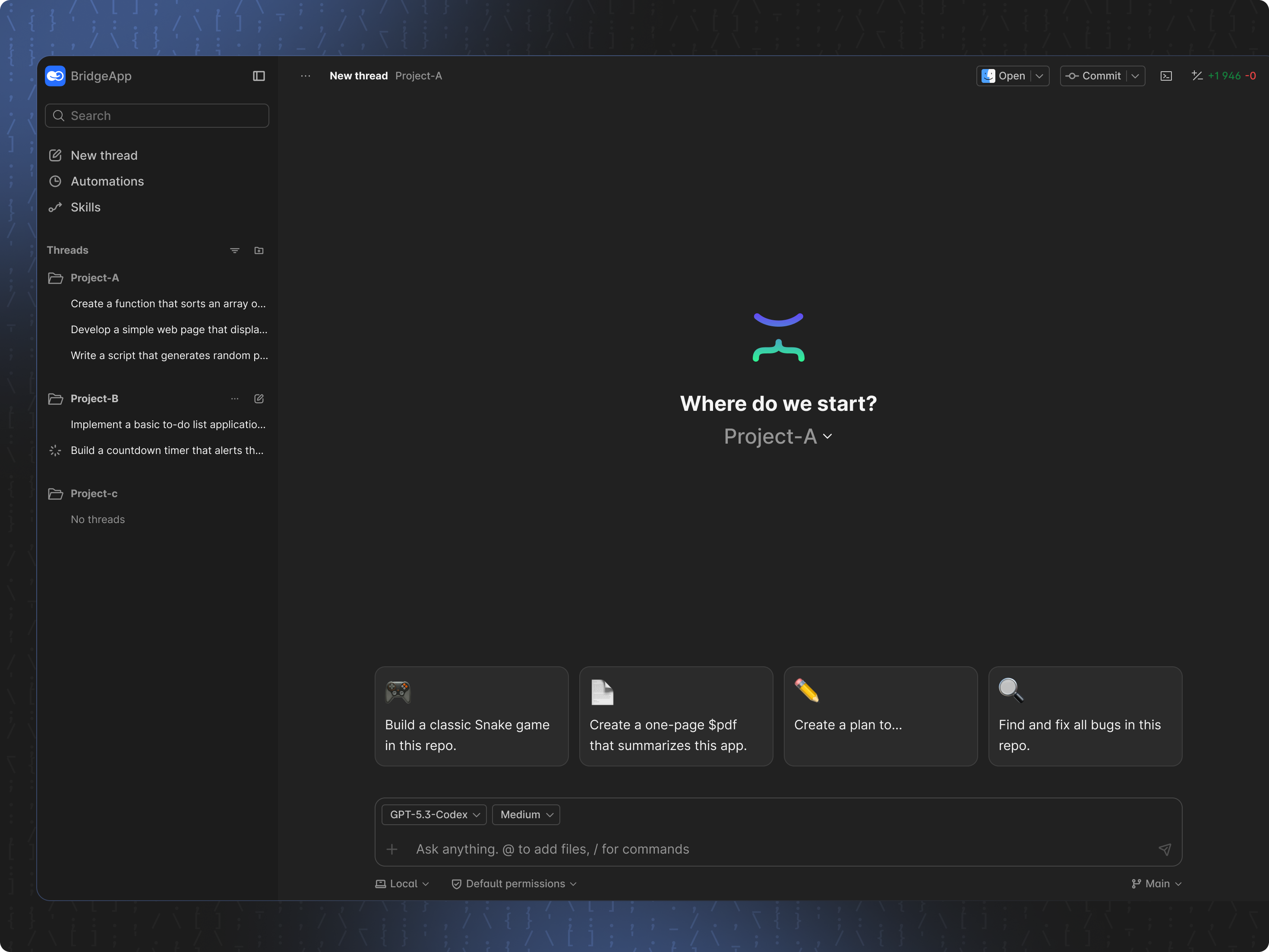
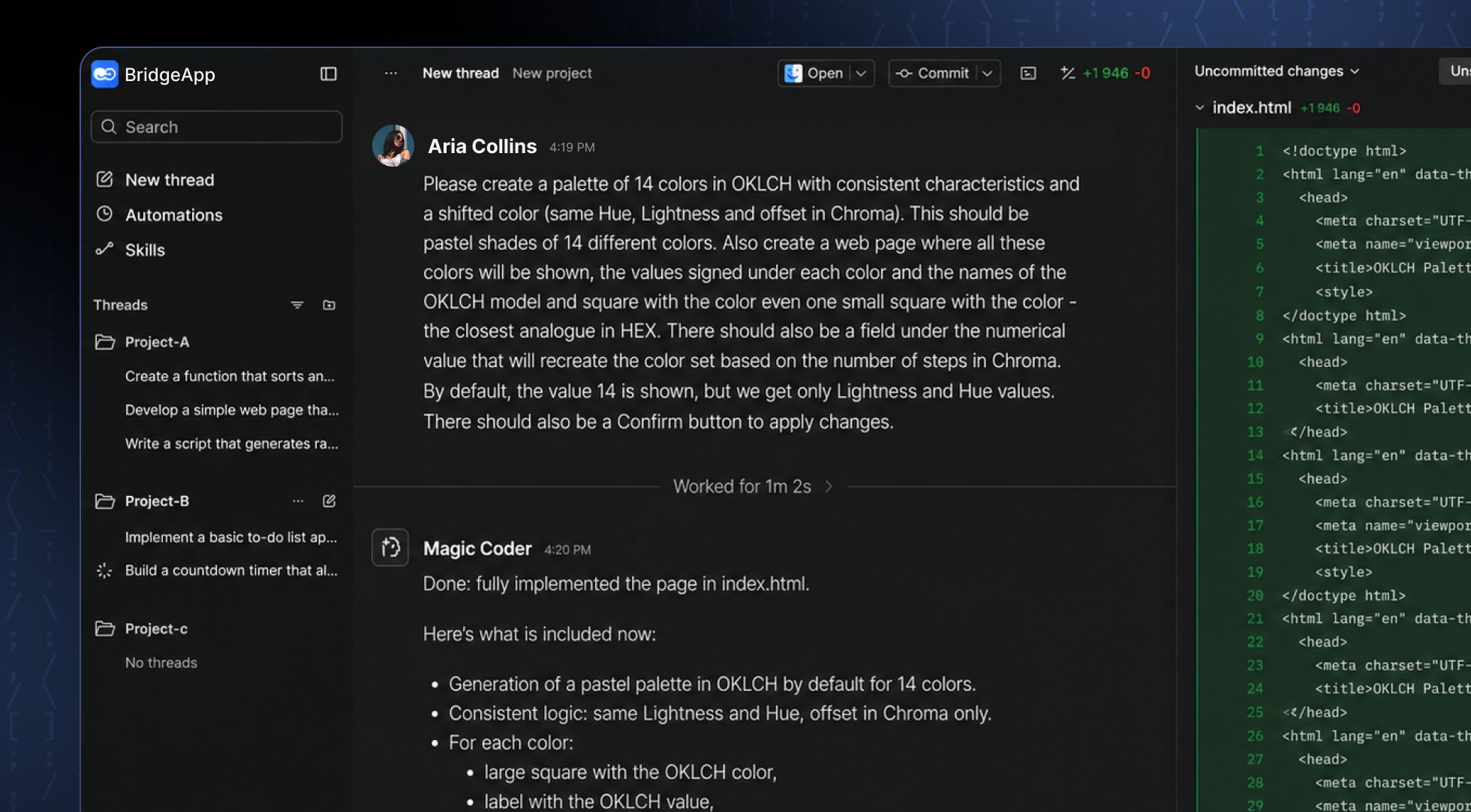
The orchestrator enforces a state machine: Todo → Planning → Plan Review → Execution → Local Code Review → Waiting for Merge → Done. Two review loops (Plan Review and Local Code Review) repeat until approved. Agents never advance a task to Done - the pipeline stops at "Waiting for Merge" by design. The human reviews the plan, the system reviews the implementation.
This maps directly to the orchestration concepts covered throughout this article: multi agent coordination using manager–worker patterns, durable state and memory across runs, guardrails on repo access through governance controls, and human-in-the-loop checkpoints for production safety. New agents can be added to the roster without redesigning the pipeline. Agent capabilities are scoped through rules and skills, preventing uncontrolled self-escalation.
The result: agent orchestration lets organizations treat this automated pipeline as a predictable, auditable process rather than a black-box chatbot writing code. BridgeApp estimates that this approach cuts cost per completed dev task by roughly 10× - from hundreds of euros in human time to tens of euros with AI.
Designing an Agent Orchestration Strategy
Here is a practical roadmap for teams moving from experiments to production orchestration. Multi-agent orchestration involves a seven-step implementation process, but the principles are straightforward:
- Start small. Begin with direct LLM calls, then a single agent with tools. Only introduce multiple specialized agents when the benefits (specialization, permissions, parallelism) clearly justify the added complexity. Assessment identifies processes suitable for multi-agent orchestration.
- Define ownership. For every stage, specify whether the orchestrator, a particular agent, or human operators own the decision and state transition. Clear task ownership prevents ambiguity.
- Model workflow state explicitly. Tasks, artifacts, approvals, and unresolved issues should be structured objects - not implicit in chat logs. Framework setup takes two to four weeks in typical orchestration implementation.
- Limit model discretion deliberately. Use code for deterministic routing and validation. Use models for interpretation, planning, and unstructured reasoning.
- Design for interruption and recovery. Assume tool timeouts, invalid outputs, and partial progress. Build checkpoints and idempotent actions into the orchestration layer.
- Choose the right pattern. Match your execution pattern to the workflow shape - sequential for linear processes, concurrent for independent analysis, handoff for triage, manager–worker for complex projects.
- Plan governance from day one. Agentic systems can dynamically adjust workflows as conditions change, which makes governance controls even more important as systems mature.
Decentralized models support greater flexibility in dynamic environments, but start centralized and loosen controls only when you have observability to back it up.
Agent Orchestration Platforms, Frameworks, and Tools
Orchestration can be built from scratch or via existing agent orchestration platforms and frameworks. Here is how the landscape breaks down:
- Agent SDKs (e.g., OpenAI Agents SDK, Semantic Kernel) provide low-level building blocks for defining agent loops, tools, and basic handoffs. State is handled externally. Good for custom builds.
- Graph and workflow runtimes (e.g., LangGraph-style approaches) model orchestration as agent nodes and edges with branching, loops, and checkpoints. Good for teams comfortable with DAG-based design.
- Higher-level platforms like BridgeApp for dev automation combine orchestration, memory/state, governance, and integrations in one environment - reducing glue code and speeding up time to production.
When evaluating, look for: support for enabling multiple ai agents, built-in orchestration patterns, latency and scaling characteristics, governance features, and compatibility with standards like MCP. Also consider whether the platform enables coordinating agents across your existing toolchain or forces you to rip and replace.
Future Directions for AI Agent Orchestration
The orchestration landscape is evolving rapidly. Here are the trends shaping 2026 and beyond:
- Agents as callable services. Autonomous agents will increasingly look like composable components, while orchestration becomes the "operating layer" deciding how these components collaborate. Agent orchestration work will shift from custom plumbing to configuration.
- Federated and hybrid orchestration. Federated orchestration shares policies across multiple orchestrators. Different departments or regions will run local orchestrators under shared global policies. Hybrid orchestration combines centralized governance with decentralized execution - giving teams autonomy without sacrificing compliance.
- Open interoperability. The growing importance of MCP and similar standards will help organizations avoid lock-in as they adopt agent orchestration frameworks and tools from multiple vendors.
- Non-negotiable human oversight. Human-in-the-loop and strong governance will remain essential in high-stakes domains, even as agent autonomy increases. AI orchestration without human checkpoints will remain unacceptable in healthcare, finance, and legal contexts.
FAQ
These questions address practical concerns not fully covered in the sections above.
Do I really need multiple AI agents, or can one powerful agent handle everything?
Many use cases start effectively with a single well-tooled agent. Multi agent systems pay off when you need clear separation of permissions, domain expertise, or parallel work. A single agent handling billing, technical troubleshooting, and compliance simultaneously risks confused outputs and permission sprawl. Start with one agent and only add specialized ai agents when single-agent orchestration becomes a bottleneck or a governance risk.
How do I choose the right orchestration pattern for my workflow?
Use a simple decision rule: sequential for clear linear steps, concurrent for independent parallel analysis, handoff for triage and specialization, and manager–worker for complex projects needing planning and delegation. Prototype with the simplest pattern that can work, then evolve to more dynamic patterns like group chat or dynamic orchestrators only if needed. Orchestration improves operational efficiency by reducing redundancies, but over-engineering the pattern creates its own overhead.
What is the role of Model Context Protocol in agent orchestration?
Model Context Protocol standardizes how agents discover and call tools and retrieve context, making it easier to plug external systems into orchestrated workflows. MCP does not perform orchestration itself - it reduces integration friction so the orchestrator can focus on sequencing, policies, and monitoring. Think of MCP as the wiring standard; orchestration is the circuit design.
How does agent orchestration affect latency and user experience?
Each additional agent, tool call, or orchestration step adds latency. Concurrent patterns can offset this, but may increase cost and complexity. Design "fast paths" for interactive use - few agents, limited tools - and richer multi agent workflow configurations for background or asynchronous jobs. Monitor system performance continuously and adjust patterns as workload profiles change.
Where does BridgeApp fit into an AI agent orchestration stack?
BridgeApp provides an orchestration layer focused on software development. Magic Coder coordinates multiple specialized dev agents across the SDLC - from planning through code review - using durable state, guardrails, and human checkpoints for safe automation. Teams can plug Magic Coder into existing repositories and workflows, treating it as an orchestrated multi agent system that speeds up development while preserving human review and compliance. It's designed to orchestrate ai agents across the entire workflow without requiring teams to build orchestration infrastructure from scratch.