BlogIndustry Insights
Agentic vs Non-Agentic Workflows: Which Approach Is Right for Your Development Team?

BridgeApp Team
7 min read

Choosing between agentic and non-agentic workflows comes down to one question: does your process need to make decisions on its own, or should every step follow a script written by a human? Non-agentic workflows execute predefined rules in a fixed sequence. Agentic workflows use AI agents that interpret goals, select tools, and adapt their execution path based on context and intermediate results. The right choice depends on your team's size, the complexity of the systems you build, and how much unpredictability your organization can tolerate.
The Short Answer
If your development processes are stable, well-understood, and compliance-sensitive, non-agentic workflows give you deterministic outcomes and simpler debugging. If your team handles cross-system orchestration, evolving requirements, or high ticket volume where manual intervention creates bottlenecks, agentic workflows deliver faster cycle times and adaptive automation. Most mature engineering organizations will end up running both: deterministic workflows for CI/CD and infrastructure provisioning, agentic systems for feature development, bug triage, and complex multi-step tasks. The AI agent market is projected to grow at a 45.1% CAGR from 2024 to 2030.
What Are Non-Agentic Workflows?
Non-agentic workflows follow a linear, deterministic path. Each step is defined before execution begins, and the system requires explicit commands for each action. A CI/CD pipeline, for example, runs the same sequence every time: pull code, run tests, build artifact, deploy. The same input produces the same output. There is no reasoning engine evaluating whether a different sequence might work better.
Common examples in software development include automated linting, scheduled builds via cron jobs, static analysis checks, and scripted infrastructure provisioning. Non-agentic workflows are best for stable, repetitive tasks where the execution path does not need to change between runs.
The strengths are real. Non-agentic systems follow fixed pipelines with predetermined components, which makes them easy to audit, debug, and certify for compliance. When a pipeline fails, the failure point is unambiguous. When a regulator asks what happened, the audit trail is a simple log of sequential steps. Non-agentic workflows require high human intervention for anything outside the predefined path, but within that path, they deliver consistent outcomes every time.
What Are Agentic Workflows?
Agentic workflows are dynamic, iterative, and goal-driven. Instead of following fixed rules, AI agents receive a high-level objective, break it into subtasks, execute those subtasks using available tools, evaluate the results, and revise their approach based on context and results. Agentic AI operates through four stages: Perceive, Reason, Act, Learn. This iterative process allows the system to handle ambiguity in ways that deterministic workflows cannot.
Agentic systems make independent decisions to achieve goals. A research agent triaging support tickets, for example, reads the ticket, gathers relevant data from the codebase, identifies the root cause, proposes a fix, writes tests, and opens a pull request. Each of those steps involves autonomous decision making about which tools to call, which files to read, and what approach to take. Agentic systems can perform self-correction by detecting errors in their own outputs and adjusting before delivery.
Data access in agentic systems is dynamic and context-aware. Agentic systems autonomously access and retrieve required data, and they can connect to over 100 data sources automatically, eliminating the need for custom data connectors. Non-agentic models, by contrast, rely on static data from the initial prompt.
The practical benefit: agentic workflows are valuable when the system must determine its own actions rather than follow a predetermined script. They excel in situations with ambiguous or changing inputs, where task complexity would require a human to constantly intervene and redirect a traditional automation pipeline.
BridgeApp elevates development to a whole new level by transforming fragile local scripts into a production-ready, fault-tolerant environment built specifically for agentic workflows. Unlike rigid, non-agentic automations, the platform orchestrates virtual AI teams using directed execution graphs. Tasks run strictly in order, handle failures gracefully, and can be cancelled or restarted without duplicating triggers. Operating within isolated micro-VMs, these multi-agent systems run in parallel while inheriting only the precise context they need—all tightly controlled by strict step limits, token budgets, and centralized access governance.
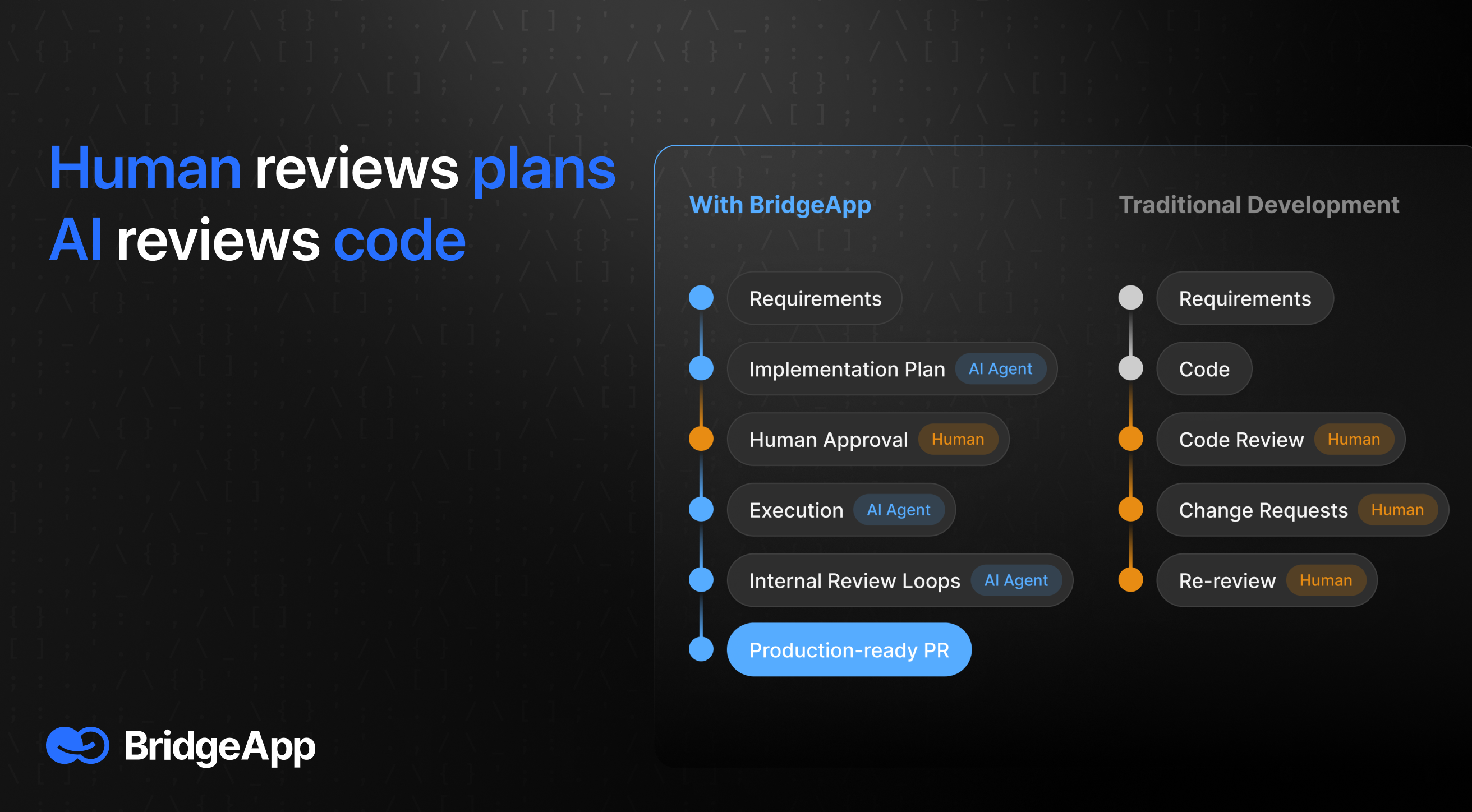
The platform's true strength lies in its advanced handling of memory, knowledge, and code structure. BridgeApp automatically cleans and syncs organization-level memory, handles document versioning for RAG, and maps repositories into queryable code graphs. This allows agents to understand full call chains and service links, delivering precise edits rather than just plausible-looking code diffs.
Backed by a single unified model layer (supporting OpenAI, Anthropic, DeepSeek, and others) with built-in retry resilience and token-caching economics, BridgeApp provides teams with a secure, highly organized, and cost-effective ecosystem that bridges the gap between chaotic AI loops and deterministic production workflows.
Agentic vs Non-Agentic Workflows: How They Compare at a Glance
| Factor | Non-Agentic Workflows | Agentic Workflows |
|---|---|---|
| Best for | Stable, repetitive processes (CI/CD, linting, compliance checks) | Complex, evolving tasks (feature dev, bug triage, cross-system work) |
| Execution style | Linear, deterministic; same input yields same output | Iterative, adaptive; execution path varies by context |
| Decision-making | Human-specified steps; follows predefined rules | Autonomous goal-based planning via reasoning engine |
| Predictability | High; deterministic outcome every run | Variable; emergent behavior possible |
| Maintenance overhead | Low; update scripts when requirements change | Higher; requires governance, observability, memory management |
| Cost structure | Human labor + fixed compute | Human labor + AI model costs (api calls, token usage) + monitoring |
| Error handling | Fails at known breakpoints; easy to trace | Can self-correct, but failure modes include cascading decision failures |
Non-agentic workflows trade flexibility for predictability. Agentic workflows trade predictability for adaptive reasoning across complex scenarios.
Decision-Making and Autonomy
The core difference between these two approaches sits in how decisions get made during execution. In non-agentic systems, every decision is made before runtime by the engineer who wrote the script. The system follows fixed pathways and executes predefined logic. When an exception occurs outside those pathways, execution stops and waits for human input.
Agentic systems use dynamic orchestration with reasoning engines. When an agentic workflow encounters an unexpected test failure, it can read the error log, trace the call chain, identify the breaking change, and propose a fix. Non-agentic systems require explicit commands for each action; an equivalent non-agentic pipeline would halt and file an alert for a human to investigate.
This distinction matters most at scale. dLocal, a FinTech company with roughly 400 engineers, deployed an agentic SDLC platform and resolved 45% of engineering tickets autonomously, from reading the ticket through to deployment. That produced a 20% boost in productivity and cut lead time by 50%. A non-agentic pipeline handling the same ticket volume would require human intervention at every decision point, creating bottlenecks proportional to team size.
Autonomous agents also introduce risk. Multi-step reasoning chains can lead to cascading decision failures. An agent that misidentifies a root cause early in its chain may confidently implement a wrong fix. Agentic systems face non-deterministic failures that are hard to reproduce, because the execution path depends on context that changes between runs.
Winner: Agentic workflows for teams dealing with high ticket volume and complex scenarios where manual triage is the bottleneck. Non-agentic workflows remain the safer choice when decisions are few, well-understood, and must produce a deterministic outcome.
Predictability and Control
For enterprise systems in regulated industries (finance, healthcare, government), the ability to prove exactly what a system did and why is non-negotiable. Non-agentic workflows win here by design. A deterministic pipeline running the same input produces the same output, and the audit trail is the pipeline definition itself.
Agentic ai systems introduce variability. The same task, given to the same agent twice, may follow a different execution path depending on model capability, available context, and intermediate results from tool calls. This makes traditional auditing insufficient. Agentic systems require specialized observability for decision paths, including logging of every tool use, every reasoning step, and every data source accessed.
Operational complexity increases with the number of agentic workflows running in production environments. Debugging agentic systems involves tracing multi-step reasoning chains rather than reading a linear log. Manual data access bottlenecks further degrade agentic system performance when agents cannot reach the data sources they need.
The governance gap is addressable. Google Cloud's documentation on agentic workflows emphasizes that human-in-the-loop checkpoints are standard practice for enterprise deployment. dLocal's adoption included establishing a governance framework before scaling agent autonomy. Audit trails are achievable in agentic systems; they just require deliberate architectural investment that non-agentic systems get for free.
Winner: Non-agentic workflows for organizations where compliance and auditability are primary requirements. Agentic workflows can close the gap with proper governance layers, but the burden of proof shifts to the team implementing them.
Handling Complex Development Scenarios
Modern software runs across distributed systems, microservices, and multiple systems with cross-service dependencies. A change in one service can break data flows through downstream systems three hops away. This is where non-agentic workflows hit their ceiling.
A scripted pipeline can run tests for the service being changed, but it cannot autonomously trace a breaking change across service boundaries, identify affected consumers, and generate fixes for each. That workflow requires context and intermediate results from multiple steps, tool calls to different repos, and adaptive reasoning about architecture. Non-agentic AI systems lack the capacity to navigate this kind of task complexity without a human mapping every possible path in advance.
Agentic workflows handle cross-system orchestration by reading the full dependency graph, identifying impact, and executing fixes across repos. The AIDev dataset study tracked agent-generated pull requests and found velocity spikes after adoption, though it also documented an 18% rise in static-analysis warnings and a 35% increase in cognitive complexity. Speed and quality do not automatically move together.
Magic Coder by BridgeApp addresses this tension through architecture-aware code generation. The engine reads the existing codebase structure (codebase intelligence, tag COD-05 in the BridgeApp Engine), identifies reusable components, and enforces team standards during generation. The pipeline uses a state machine with two built-in review loops: Plan Review (System Architect validates the implementation plan) and Local Code Review (Code Reviewer checks the output against the approved plan). Agents never advance a task to "Done"; the pipeline stops at "Waiting for Merge" by design. Human oversight reviews the plan, the system reviews the implementation.
This matters because coordinating specialized agents across a multi-step development workflow without guardrails produces the quality degradation the AIDev study documented. BridgeApp's approach uses governance rules (GOV-07) with layered precedence and skill-level permissions, plus secure execution in isolated microVMs (SEC-08), to prevent the uncontrolled self-escalation that makes enterprise teams hesitate to adopt autonomous agents.
Winner: Agentic workflows for teams building across multiple services and complex workflows. The caveat: without architecture-aware tooling and human review checkpoints, the velocity gains come at the cost of rising technical debt.
Development Velocity and Team Productivity
The velocity question has hard numbers behind it. The agentic SDLC reference architecture study published in 2026 measured verification accuracy on SWE-bench Verified rising from 1.96% in October 2023 to 78.4% by April 2026. Controlled studies within the same research found time savings between 13.6% and 55.8%.
McKinsey's analysis of enterprises rewiring delivery around agentic execution found 3x to 5x productivity improvements, with some organizations achieving 60% reductions in equivalent team size. These results required architectural discipline and machine-readable specifications of architecture and requirements.
Non-agentic workflows offer faster setup, predictable execution time, and zero variability between runs. For a team of five engineers maintaining a single service, the overhead of configuring multiple specialized agents, memory systems, and governance layers may not justify the returns.
The read-to-write ratio tells an important story about where agent time goes. The "23,479 Sessions" study analyzed 3,474,754 lines of interaction data across 27 projects over 42 days. Agents spent roughly 80% of tool invocations reading or understanding code and 20% writing it, a read-to-write ratio of 9.6:1. The agents' primary value is not raw code generation; it is gathering and synthesizing context that would otherwise consume developer time.
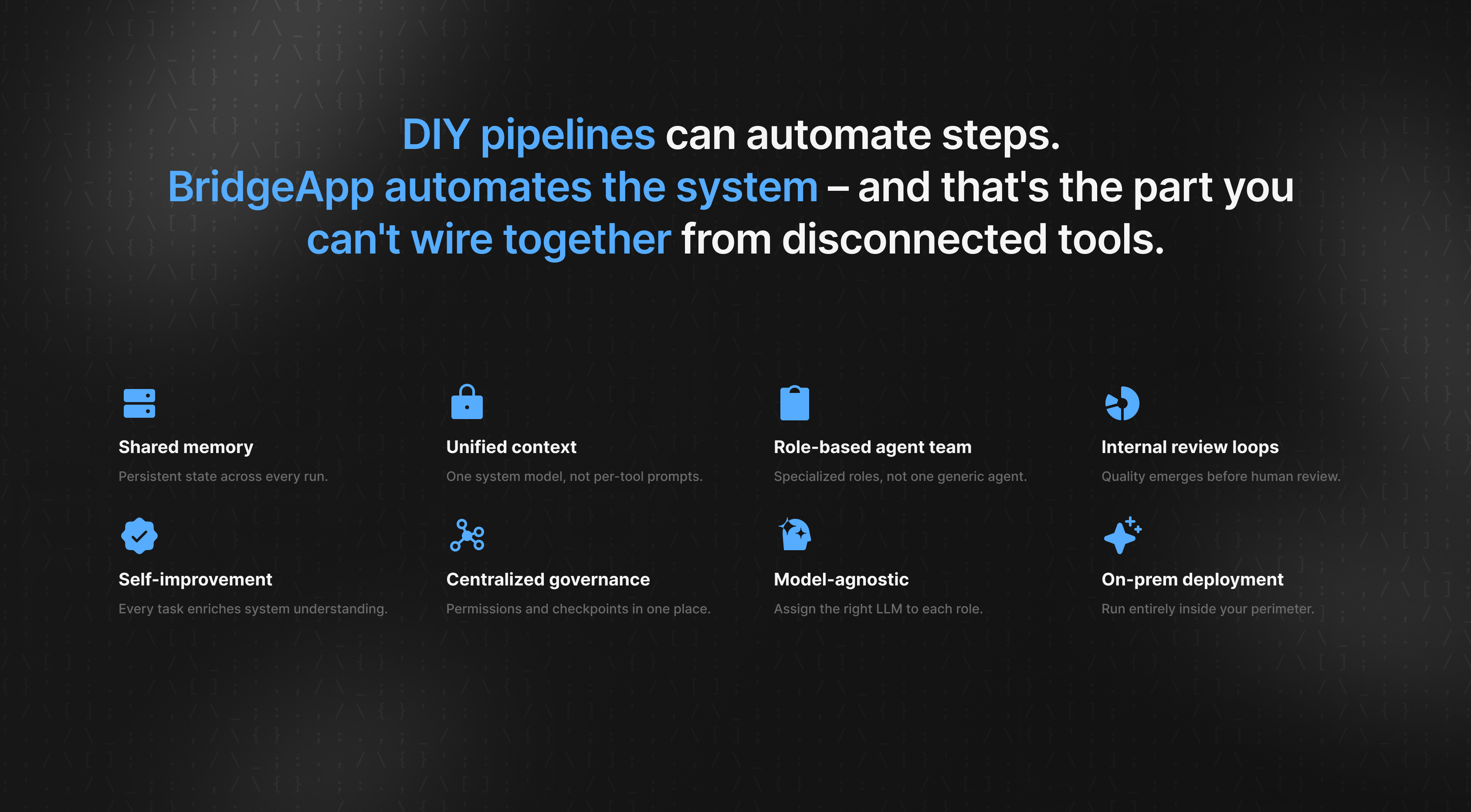
Agentic workflows can reduce integration time from weeks to hours when configured with the right tooling. Agentic AI systems can autonomously manage complex, multi-step tasks that previously required multiple humans coordinating across a ticketing system, a codebase, database queries, and deployment infrastructure.
Agentic workflows can improve decision-making speed and accuracy, but there are tradeoffs. The AIDev study showed that after the initial velocity spike, quality metrics continued to degrade even as velocity normalized. Teams need active quality monitoring alongside velocity metrics.
Winner: Agentic workflows for teams larger than 10 engineers working on multi-service architectures. For smaller teams with straightforward codebases, non-agentic workflows deliver predictable throughput without the setup cost.
Which Workflow Approach Should You Choose?
- Choose non-agentic workflows if your processes are stable and well-defined, your team operates under strict compliance requirements, your project scope is bounded to a single service or a small codebase, or if your primary goal is reproducibility in production systems.
- Choose agentic workflows if you manage complex workflows spanning multiple systems, your team spends more time gathering context than writing code, you need to scale ticket resolution without proportionally scaling headcount, or your requirements evolve faster than your scripts can keep up.
- Consider a hybrid approach when you have both stable infrastructure (CI/CD, linting, existing automation tools) and dynamic development work (feature builds, bug triage, adaptive testing). Hybrid workflows combine deterministic control with agentic flexibility: keep your CI/CD pipeline as a non-agentic backbone, and layer agentic systems on top for the tasks that require adaptive reasoning.
For enterprise development teams evaluating multi-agent collaboration platforms, the three axes that separate tools in this space are: whether the agent is architecture-aware (reads and understands the codebase structure), whether it operates as a full terminal-CLI agent (executes real commands, not just generates suggestions), and whether it produces controlled, maintainable code (with governance, review loops, and audit trails). Magic Coder by BridgeApp is built on all three, with its multi-agent pipeline (MAS-03), per-agent memory (MEM-04), and governance layers (GOV-07) running inside an all-in-one workspace where tasks, documents, and code execution share context.
Frequently Asked Questions
Can you combine agentic and non-agentic workflows in the same development pipeline?
Yes, and most production setups do. A common pattern: agentic systems handle task planning, code generation, and code review, then hand off to a non-agentic CI/CD pipeline for build, test, and deploy. The key differences at the handoff are governance and format. The agentic system produces a pull request; the deterministic pipeline takes over from there. BridgeApp's pipeline embeds this pattern: agents stop at "Waiting for Merge," and the deterministic merge/deploy process runs separately.
What are the security implications of agentic workflows in enterprise development?
Autonomous AI agents that can act autonomously on codebases and production systems introduce real risk. Without governance, an agent could access incorrect data, violate policies, or execute unauthorized operations. Mitigation requires scoped permissions (agents get only the data access and tool access their role requires), isolated execution environments (BridgeApp uses microVMs with short-lived scoped Git credentials), human approval gates for high-risk actions, and full audit trails on every authentication mutation.
How do you measure the ROI of switching from non-agentic to agentic workflows?
Four metrics matter most. Lead time (feature request to deployed feature; dLocal cut this by 50%). Ticket throughput (tickets resolved autonomously vs. requiring human intervention; dLocal reached 45% autonomous). Velocity (PRs closed per engineer per week). Quality (static-analysis warnings, cognitive complexity, code duplication). Track all four together. Velocity without quality tracking leads to technical debt accumulation, as the AIDev study documented.
What level of technical expertise is needed to implement agentic workflows?
Implementing a multi-agent system from scratch requires expertise in LLM orchestration, tool-use configuration, context management, and governance design. Platforms like BridgeApp reduce this barrier by providing pre-configured agent roles (Team Lead, System Architect, Backend Developer, Code Reviewer, QA Agent), built-in flows and automations, and a governance resolver that handles skill and permission layering. The team still needs engineers who understand natural language prompt design, review workflows, and the model context protocol for tool integration. The skill shift is from writing every line of code to reviewing plans, setting rules, and monitoring agent behavior in dynamic environments.