BlogIndustry Insights
Test Automation Frameworks in 2026: Types, Examples, and How to Choose

BridgeApp Team
18 min read

Choosing the right test automation framework can mean the difference between a test suite that scales with your product and one that crumbles under its own weight. This guide breaks down every major framework pattern, compares the tools that power them, and gives you a practical path to picking the right approach for your team in 2026.
What’s Inside
- A test automation framework is the reusable structure around tools, code, and test data-not just a tool like Selenium or Playwright. It defines how automated tests are organized, maintained, and run.
- Most teams blend multiple patterns-linear automation, data-driven framework, keyword-driven testing framework, and library architecture framework-across web, mobile testing, and API testing.
- The best test automation frameworks for 2026 are context-specific. Common choices include Playwright, Cypress, Selenium, Appium, Robot Framework, and BDD tools like Cucumber.
- In the QA Trends Report 2026, 74.6% of QA teams reported using two or more automated testing frameworks simultaneously.
- BridgeApp and Magic Coder by BridgeApp can automate parts of building and maintaining these frameworks-Magic Coder runs on an agent engine that maps the repository as a call graph, so it can trace which framework changes ripple across which test modules before touching anything.
What Is a Test Automation Framework (and How Is It Different from a Tool)?
A test automation framework is a structured set of guidelines, libraries, and patterns that govern how you create, organize, and execute automated tests. It covers everything from coding standards and naming conventions to test data management, reporting, and CI/CD integration.
A tool, by contrast, is a product or library that operates inside a framework. Selenium WebDriver, Playwright, and Cypress are tools that drive browser automation. They provide low-level APIs for interacting with web elements, but on their own, they don't prescribe how to structure your test scripts, share test libraries, or handle test data across environments.
Here are concrete examples of how tools fit inside frameworks:
- Selenium WebDriver + TestNG in a data driven testing framework: test logic lives in Java, datasets live in CSV or Excel, and a page object model manages locators.
- Cypress with page objects and custom commands: UI interaction logic is centralized and reused across multiple tests.
- Robot Framework: a keyword driven testing framework where testers write high-level keywords in tables, and implementations underneath handle web application testing, api testing, or database checks.
Typical components of any automation framework include object repositories, reusable helper libraries, test data sources, reporting and logging, environment configuration, and CI/CD hooks. Modern testing frameworks in 2026 rarely focus only on ui testing-they span web, mobile, API, and integration testing layers.
Why Teams Need a Test Automation Framework in 2026
Release cadences have accelerated to the point where many teams deploy weekly or daily. Ad-hoc test scripts can't keep up. Without a structured automation framework, maintenance costs explode: brittle locators, duplicated test logic, inconsistent patterns, and painfully slow CI feedback.
A well-designed framework brings concrete benefits:
- Consistency across distributed teams, even when different squads own different microservices
- Faster onboarding for new QA engineers and SDETs who can follow established patterns
- Lower flakiness through standardized wait strategies, retry logic, and locator management
- Better traceability from test cases back to requirements, reducing human error in coverage tracking
Consider a QA organization supporting both manual testers for exploratory work and automation engineers building regression testing suites. A framework with shared documentation, naming conventions, and keyword abstractions helps manual testers understand automated tests-and sometimes even contribute through keyword-driven layers.
Scaling from dozens to thousands of tests across browsers, devices, and API versions demands solid patterns. Without parallel test execution, artifact collection, and flaky test detection built into your CI pipeline, quality at speed is impossible.
BridgeApp helps centralize these standards. Teams store framework guidelines, flows, test data specs, and environment definitions in one workspace. That single source of truth prevents divergence and ensures every contributor-human or AI agent-works from the same playbook.
Core Types of Test Automation Frameworks
Most real-world testing projects in 2026 combine multiple framework types to address different layers of the testing process. A web-first product might use a modular framework for UI, a data driven framework for business logic, and an API-focused framework for service-level validation.
The major patterns, expanded in the sections below, are:
- Linear automation framework (record and playback framework)
- Modular testing framework
- Data driven framework
- Keyword driven testing framework
- Hybrid test automation framework
- Behavior-driven development (BDD) frameworks
- Library architecture testing framework
These patterns are technology-agnostic. You can implement any of them with Selenium, Playwright, Cypress, Appium, REST-assured, Karate, or Robot Framework. Selecting a pattern should come before picking a specific test automation tool, because the pattern controls long-term maintainability and scalability of your test suite.
Linear Automation Framework (Record and Playback)
A linear automation framework consists of simple, step-by-step test scripts generated from recorded user actions or manually coded without modular reuse. Think of it as the fastest route from zero to a running test.
Strengths:
- Very fast to start-minimal programming knowledge required
- Useful for smoke tests and quick UI checks in web application testing
- Good for proof-of-concept automation or stable legacy flows
Weaknesses:
- Poor reusability across test scenarios
- Fragile when locators or workflows change
- Difficult to cover data variations or complex scenarios
- High maintenance burden as the test suite grows
Concrete examples include basic Selenium IDE workflows, TestComplete recordings, or simple Cypress Studio flows. A record and playback framework works well when you need rapid feedback on a stable, low-risk feature.
In 2026, linear automation is best used as a starting point. Teams typically begin here, then refactor into a modular framework or hybrid framework as the number of automated tests increases and the cost of maintaining linear scripts becomes unsustainable.
Modular and Library Architecture Frameworks
Both the modular framework and the library architecture framework emphasize reusability and separation of concerns, but they operate at different levels of abstraction.
A modular testing framework groups tests into independent modules-login, checkout, profile update-each with its own reusable functions, test data, and assertions. Changes in one module don't ripple across others, which makes regression testing safer.
A library architecture framework goes further by extracting common functions into shared test libraries used across the entire test suite. These shared libraries typically include:
- UI interaction helpers (click, wait, navigate)
- API client wrappers
- Database utilities
- Custom matchers and assertion helpers
- Test data builders
Practical examples include the page object model in Selenium or Playwright, shared API clients in REST-assured or Karate, and helper libraries exposed through Cypress custom commands.
Choose this pattern when you're testing modern web applications or B2B SaaS products with long development lifecycle expectations. If your team includes developers or SDETs comfortable with custom code and code-based test design, a library architecture framework provides the strongest foundation for scaling.
Data Driven Frameworks
A data driven framework separates test logic from input data, enabling the same script to run tests with multiple datasets. Instead of duplicating test scripts for every permutation, you write one script and feed it different data.
Common data sources include CSV, Excel, JSON, database tables, or external test data services. This pattern is especially valuable in finance, billing, CRM, and ERP systems where you need to validate many input combinations-currencies, locales, billing cycles, edge cases.
Tool examples:
| Tool/Library | Language | Data Driven Approach |
|---|---|---|
| TestNG / JUnit | Java | @DataProvider, parameterized tests |
| pytest | Python | @pytest.mark.parametrize |
| Playwright Test | TypeScript/JS | Test fixtures, projects |
| Robot Framework | Various | External data files, variables |
| Karate | Java DSL | Built-in data tables, JSON |
A data driven testing framework offers broad coverage with fewer scripts, easier negative testing, and clearer mapping between requirements and test cases.
Challenges include keeping test data current (data decay is real), avoiding brittle dependencies on production-like datasets, and securing sensitive data-tokens, PII, credentials-especially under GDPR, CCPA, or HIPAA compliance. Thoughtful test data management is essential to make this pattern work at scale.
Keyword Driven Testing Frameworks
A keyword driven testing framework maps high-level key words-LOGIN, ADD_TO_CART, VERIFY_EMAIL-to underlying automation actions. Testers write sequences of keywords in tables or spreadsheets, and implementations underneath execute those actions against the application.
This pattern is popular when manual testers, business analysts, or non-technical stakeholders contribute to the testing process. They can write test cases without needing to understand the programming languages powering the framework.
The most prominent example is Robot Framework, which natively supports keyword-style test design for web, API, and database testing. Teams also build custom keyword layers over Selenium or Appium to expose high-level actions to less technical team members.
Benefits:
- Improved collaboration between technical and non-technical team members
- Readable test cases that double as living documentation
- Ability to change implementation underneath without rewriting high-level test scenarios
Trade-offs:
- Keyword libraries can become bloated over time
- Debugging requires mapping from keywords back to code
- Governance is needed to prevent duplication and inconsistent naming across large keyword sets
Hybrid, BDD, and API-Focused Frameworks
A hybrid testing framework mixes patterns to meet complex needs. For instance, one suite might use data driven tests for calculation verification, keyword driven flows for UI steps, and shared libraries for API calls and database checks. In practice, most production frameworks in 2026 are hybrids.
Behavior driven development frameworks write test scenarios in natural language-typically Gherkin syntax (Given–When–Then)-using tools like Cucumber (Java, JS), SpecFlow (.NET), Behave (Python), or Gauge. BDD aims to make acceptance testing readable by business stakeholders. The downside is overhead: maintaining feature files and glue code can become expensive if overused.
API-focused frameworks form the backbone of service-level automation in microservices architectures. Tools like REST-assured, Karate, Postman/Newman, and pytest with HTTPX handle contract tests, integration testing, and backend validation. API tests run faster and are more stable than UI tests, which is why the recommended test pyramid in 2026 targets roughly 70% unit testing, 20% integration, and 10% E2E.
Enterprises adopt hybrid frameworks when large-scale systems-e-commerce, banking, logistics, even medical devices-release multiple times per week and need UI, mobile testing, and API tests aligned under a single testing project with consistent standards.
How to Choose the Best Test Automation Framework for Your Team
There is no single "best test automation framework." The right pattern depends on your product, stack, team skills, and release cadence. Here are the key decision factors:
- What you're testing: web applications, mobile apps, APIs, desktop, or a mix? Different layers need different tools.
- Team skills: developers and SDETs can handle code-heavy library architecture frameworks; teams with manual testers may benefit from keyword driven or Robot Framework approaches.
- Existing tooling: large Selenium investments shouldn't be abandoned overnight. Consider incremental migration.
- Release cadence: fast cycles need low flakiness and high parallelism-independent March 2026 benchmarks show Playwright completing suites in 3m20s against Selenium's 8m45s, with stability around 92% versus roughly 72% for Selenium.
- Compliance and governance: regulated industries need audit trails, secure test data management, and controlled test execution environments.
Guidance for typical cases:
| Team Profile | Recommended Starting Point |
|---|---|
| JS-first web teams | Playwright or Cypress with modular framework |
| Enterprise mixed-language | Selenium 4 + hybrid framework, incrementally adopt Playwright |
| Mobile-heavy | Appium 2+, Espresso (Android), XCUITest (iOS) |
| API / backend-heavy | Karate, REST-assured, pytest + HTTPX |
| Non-technical testers involved | Robot Framework or keyword-driven layer over Playwright |
Start with a modular or hybrid framework for most new projects, layering in data driven and keyword driven elements as the suite grows. Pilot the chosen pattern on a real feature-a checkout journey or key API endpoint-for a few sprints before committing organization-wide. This keeps the investment reversible.
Integrating Test Automation Frameworks with CI/CD and Collaboration
In 2026, automation frameworks that don't integrate with CI/CD are frameworks that don't ship. Your test suite must run on every pull request, with fast unit and API tests completing in minutes and UI tests gated on feature branches or shadow builds.
Key CI/CD integration practices include:
- Parallel test execution across browsers and devices to keep feedback loops short
- Artifact collection: screenshots, trace logs, DOM snapshots on failure
- Flaky test detection with historical pass/fail dashboards
- Automated notifications in team chats when failures exceed thresholds
- Release gating based on test results-no green pipeline, no deploy
Test reporting goes beyond pass/fail counts. Teams need visibility into historical trends, test execution times, and coverage gaps. According to the QA Trends Report 2026, roughly 50.6% of teams now use AI for test-data creation and 46% for test-case formulation, embedding intelligence directly into testing workflows.
BridgeApp helps here by storing automation standards as documents, tracking framework-related tasks and bugs as work items, and enabling custom AI agents to summarize test failures inside team chats. For regulated or security-sensitive organizations, BridgeApp's on-premise or private cloud deployment keeps framework artifacts, test data, and execution logs under strict organizational control.
How BridgeApp and Magic Coder Accelerate Framework Development
A framework rarely fails because a team picked the wrong pattern. It fails the way the sections above describe: naming drifts between squads, a keyword library grows past what anyone remembers the origin of, a data driven ruleset gets copied instead of reused - because the standard lives in a doc nobody has open while they're writing or reviewing a test. BridgeApp is an AI-native unified workspace built to close exactly that gap: team chat, tasks, documents, databases, and a no-code AI agent builder that keep the framework's actual standard next to the code and the review, not filed away from both.
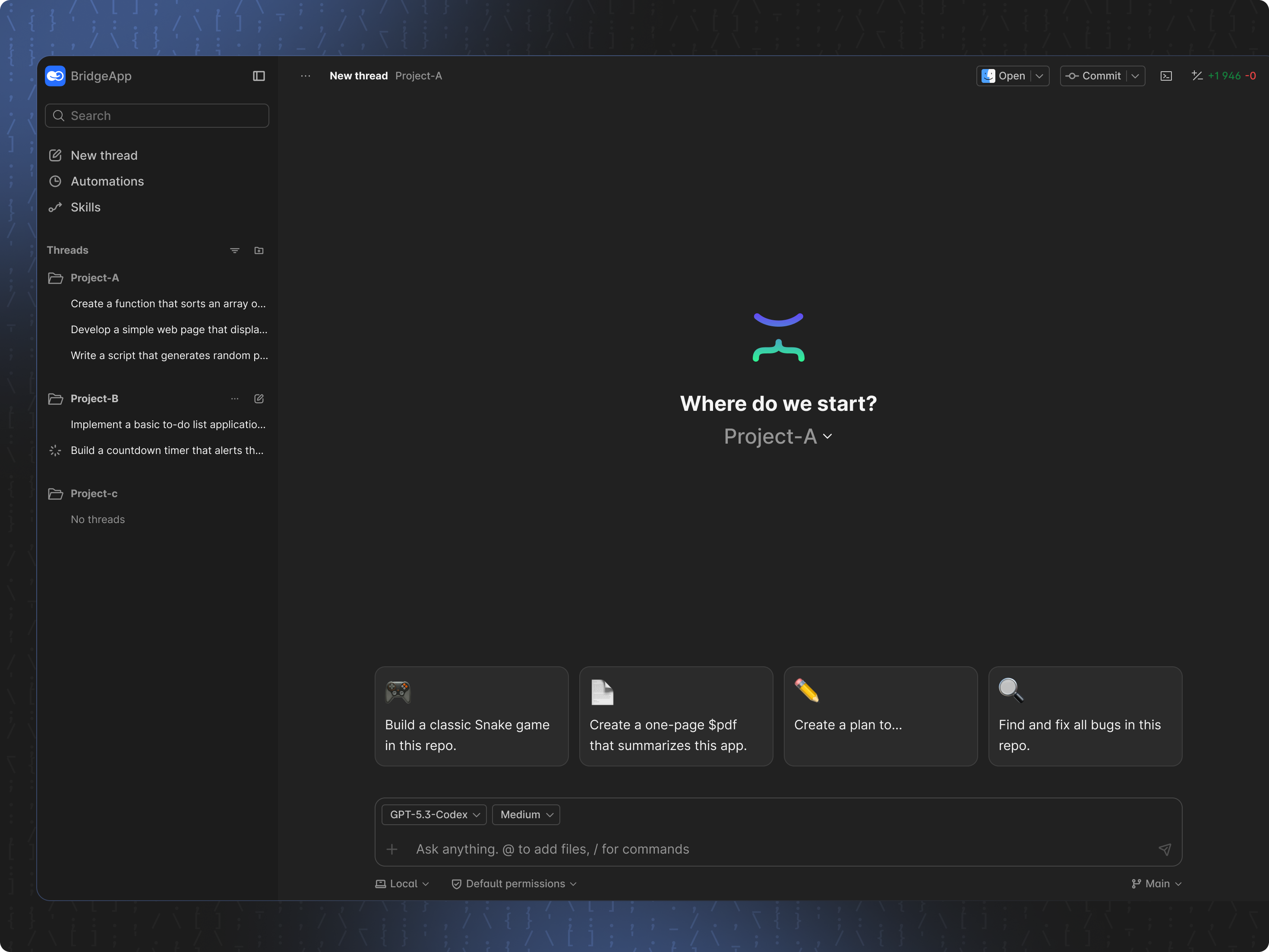
Teams use BridgeApp documents to define framework guidelines-coding standards, naming conventions, data driven rules, test plan templates-and mark them as Knowledge for custom AI agents. Those agents can then reference your standards when answering questions, reviewing test design decisions, or generating documentation.
BridgeApp databases model entities like test cases, environments, API endpoints, and test data records. With service-account API access, these databases integrate with test runners and CI pipelines, enabling you to manage test data, track test scenarios, and link test results back to work items-all in one place.
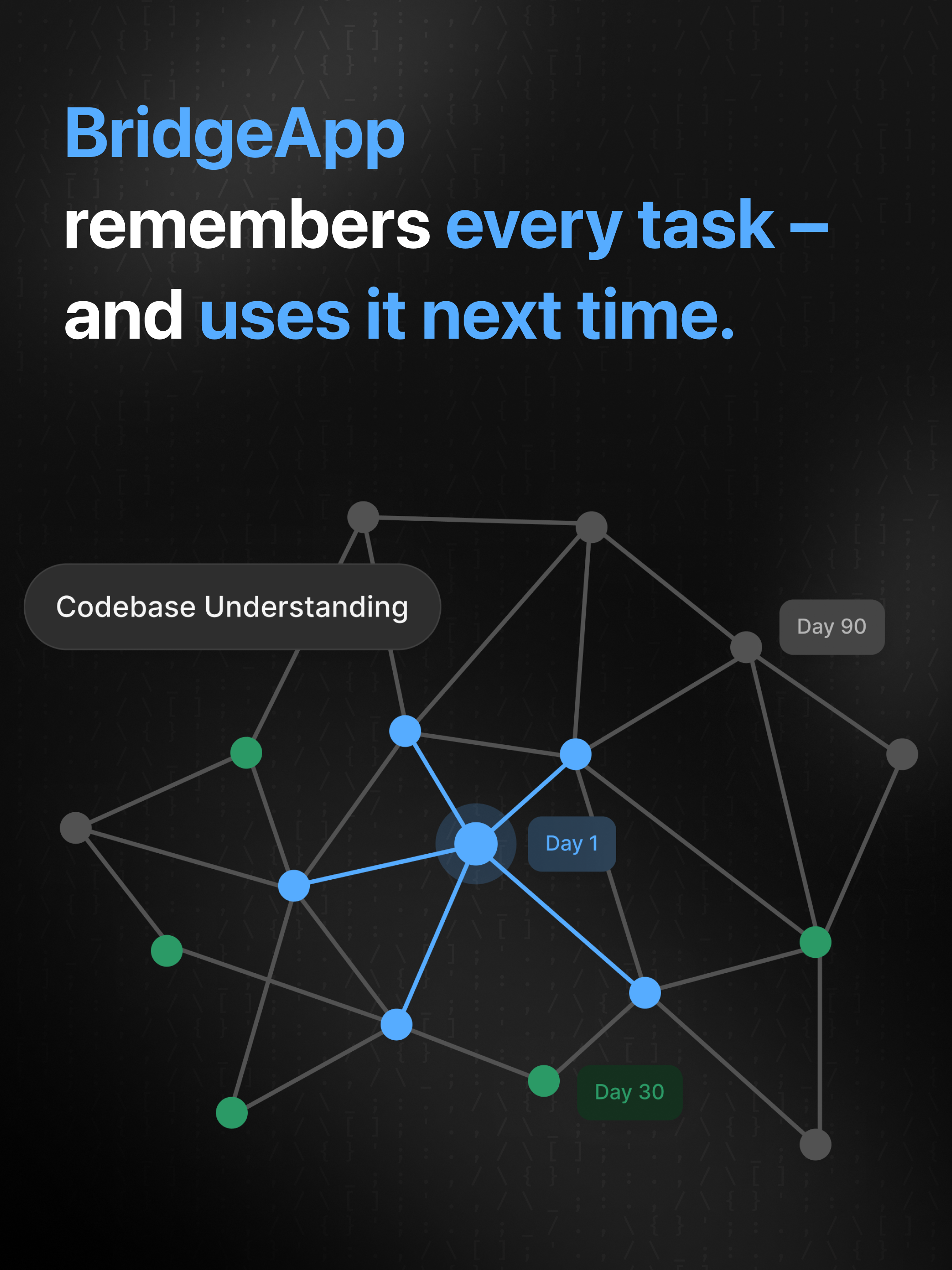
Magic Coder by BridgeApp is a terminal-based AI coding agent that can scaffold framework code, refactor brittle tests, generate page objects, and update API clients across repositories. Because Magic Coder connects to BridgeApp workspace context-tasks, documents, team rules-it ensures generated code follows your established standards.
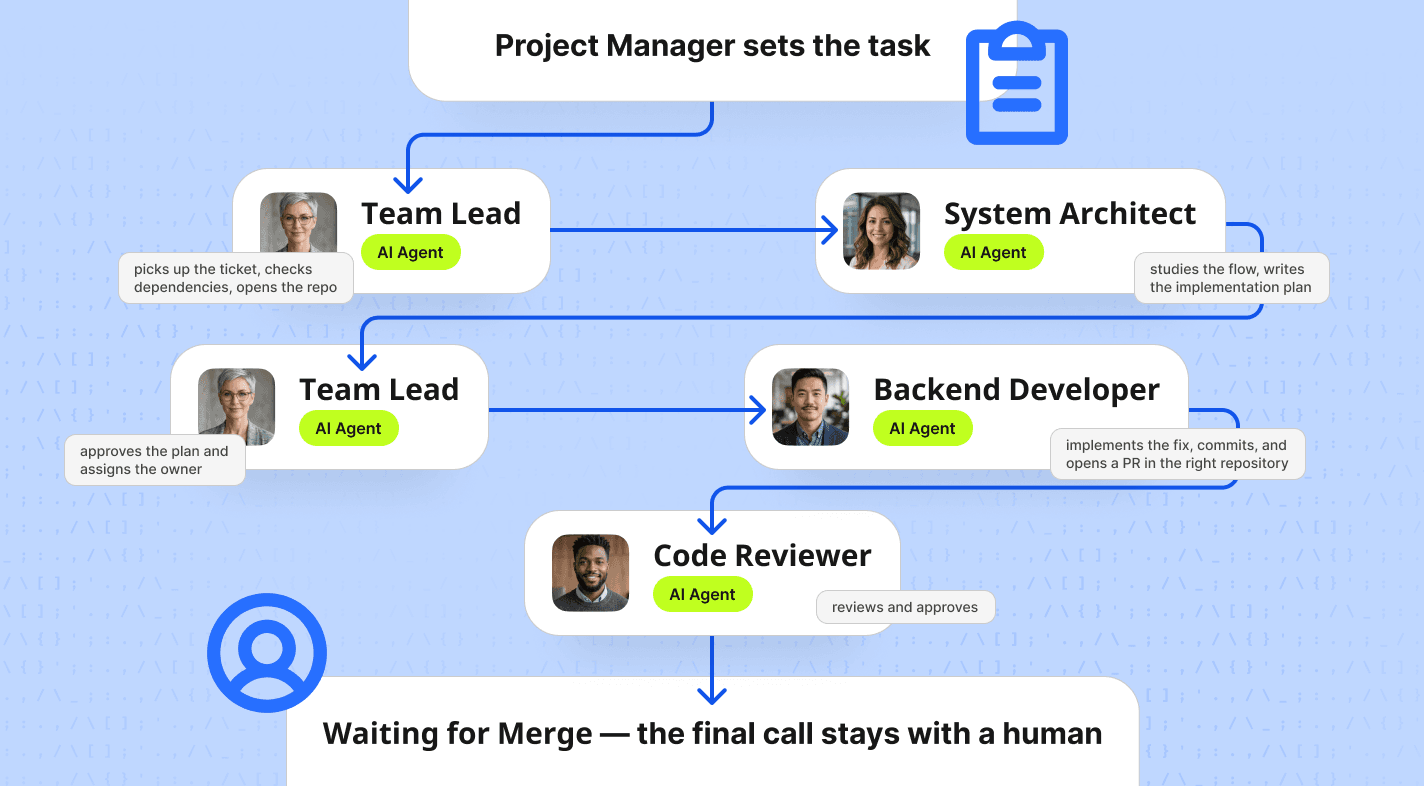
Under the hood, Magic Coder runs on BridgeApp's own agent engine, which is what makes large-scale test refactoring tractable rather than risky. The engine builds a call graph of the repository-tracking what calls what and how services connect-so when Magic Coder migrates legacy Selenium tests or updates a shared client, changes land in the files that actually need them rather than producing a plausible-looking diff in the wrong place. Multiple subagents can work in parallel on different modules of the suite, each with its own scoped context, while code execution happens in isolated micro-VMs with short-lived, task-scoped repository access-so a refactor job never runs with more access than the task requires.
Concrete use cases:
- Migrating legacy Selenium tests into a modular data driven framework: Magic Coder extracts scattered locator logic, generates page objects, and restructures test scripts.
- Adding API testing to a UI-only framework: Magic Coder scaffolds REST-assured or HTTPX client libraries and initial test suites under the same architecture.
- Generating reusable libraries for cross browser testing or cross platform support: shared helpers, environment configs, and CI pipeline definitions created in minutes instead of days.
These capabilities accelerate test development and reduce manual refactoring overhead - but the bigger effect is that standards stop diverging from the suite, because there's no longer a separate place for them to diverge in.
FAQ
Which type of test automation framework should I start with if I'm moving from manual testing?
Start with a modular hybrid framework. Use simple linear automation for a few smoke tests to build confidence, then gradually add reusable modules and data driven patterns as your team's programming knowledge grows. Tools like Robot Framework or a keyword driven layer over Playwright are approachable for teams transitioning from manual testing because they let you write test cases in near-natural language. BridgeApp can store your existing step-by-step manual test cases as documents and help convert them into automated scenarios over time using custom AI agents.
Can I use one framework for web UI, mobile, and API testing together?
Most teams in 2026 combine multiple tools under a single umbrella framework pattern rather than relying on one product for everything. For example, you might use Playwright or Cypress for testing web applications, Appium or Espresso for mobile testing, and Karate or REST-assured for API testing-all managed under shared coding standards, test libraries, and reporting. The unifying element is the framework design-data driven, keyword driven, or library architecture-not a single tool. Using multiple frameworks under one architectural pattern lets you run tests consistently across platforms, manage test data centrally, and maintain cross platform support without sacrificing performance testing or visual testing capabilities.
How do AI and autonomous agents change test automation frameworks in 2026?
AI now assists with test generation, locator maintenance, flakiness analysis, and coverage gap detection. In a RoboCon 2026 attendee survey - a snapshot of 65 testing professionals, not a formal industry study - 78.5% flagged AI-driven test automation as the top trend for the year. Tools with self-healing capabilities can adapt to UI changes using accessibility tree heuristics instead of expensive LLM calls per run. Magic Coder by BridgeApp acts as an autonomous coding agent that updates framework code, refactors tests, and aligns repositories with shared standards stored in BridgeApp. That said, AI augments rather than replaces engineers. Human judgment remains essential for risk assessment, framework architecture decisions, and deciding which test scenarios matter most in the software development and development process.
How often should we revisit our automation framework design?
Review your framework design at least annually, or whenever major changes occur-a new front-end stack, a shift to microservices, a move from on-premise to cloud deployment, or adoption of new programming languages. Track framework pain points as tasks and discussion threads in BridgeApp so your team can spot patterns: recurring flakiness, slow builds, high test execution times, or difficulty onboarding new members. Favor incremental improvements-adding a data driven layer, refactoring into a library architecture framework, introducing performance testing or acceptance testing support-over disruptive full rewrites. Small, continuous investments in your framework during each development lifecycle phase keep it healthy without stopping feature work.
Is a linear automation framework ever a good long-term choice?
A linear framework or record and playback framework alone is rarely sufficient for long-term, large-scale automation in 2026. The maintenance burden grows quickly, and you lose the ability to write test cases that handle complex scenarios, multiple datasets, or cross-browser testing effectively. However, linear automation retains value for stable, low-risk flows, quick explorations, or for non-technical stakeholders to draft test scenarios that engineers later refactor into modular or hybrid frameworks. Plan from the beginning how to evolve linear scripts into more robust types of test automation patterns before your test suite grows too large to manage.