BlogIndustry Insights
Secure Coding Practices: From Vulnerabilities to a Secure Development Pipeline

BridgeApp Team
16 min read

Every production outage caused by a preventable exploit tells the same story: security was treated as a final checkpoint instead of a continuous practice. In 2026, with vulnerability exploitation now the leading cause of breaches, the question is no longer whether your team should adopt secure coding practices, but how quickly you can embed them into every commit, review, and deploy.
This guide walks through the principles, techniques, and pipeline tooling that modern teams need to write secure code and ship with confidence.
Key Takeaways
- Secure coding practices aim to prevent security vulnerabilities like injection, broken access control, and insecure data storage before code ever reaches production.
- Following OWASP secure coding practices, enforcing strong access control, and maintaining consistent coding guidelines are non-negotiable for modern development teams.
- Security testing - including SAST, DAST, dependency scanning, and code reviews - must be automated inside the CI/CD pipeline, not treated as a last-minute gate.
- Secure data storage, secret management, and least-privilege access are critical for compliance with standards such as GDPR and PCI DSS.
- Platforms like BridgeApp, combined with Magic Coder, can help teams build a secure development pipeline by centralizing guidelines, automations, and review workflows.
What Is Secure Coding in 2026?
Secure coding means embedding security into every phase of the software development life cycle so that security flaws are prevented at the source, not patched in production. It is the practice of writing code, designing architecture, configuring infrastructure, and maintaining software systems with security as a first-class requirement.
Modern secure coding practices combine coding guidelines, security design patterns, threat modeling, and automated checks aligned with frameworks like OWASP Secure Coding Practices and the NIST Secure Software Development Framework (SSDF). These frameworks give teams concrete tasks - from preparing the organization to responding to vulnerabilities - rather than vague advice.
The most common security vulnerabilities that secure coding targets include:
- Injection (SQL, NoSQL, OS command)
- Broken access control
- Cryptographic failures
- Insecure design
- Security misconfiguration
- Vulnerable and outdated components
This differs sharply from traditional "patch after release" approaches. Instead of waiting for researchers or attackers to find security flaws, secure coding emphasizes proactive prevention, secure defaults, and continuous improvement across the software development lifecycle. The principles apply whether you are building web apps, APIs, mobile apps, or backend services running on cloud or on-premise environments.
Why Secure Coding Practices Matter
The business case for secure coding is straightforward: breaches are expensive, and the attack surface is growing. In 2023 alone, approximately 29,772 CVEs were publicly disclosed, up from 25,237 the year before. Verizon's 2026 Data Breach Investigations Report found that vulnerability exploitation now accounts for roughly 31% of breaches, overtaking credential theft as the top vector.
Regulatory pressure reinforces the urgency. Compliance mandates like GDPR, PCI DSS, HIPAA, and ISO/IEC 27001 all require data protection, controlled access, encryption, and breach notification. Secure coding practices reduce exposure across each of these requirements, making audits smoother and fines less likely.
There is also a cost argument: fixing a vulnerability at the design or code review stage is often up to 100× cheaper than remediating it after deployment. Beyond dollars, teams that practice secure programming build stronger collaboration between development and security teams, experience fewer emergency patches, and earn higher trust from customers and regulators.
Core Secure Coding Principles and Coding Guidelines
These secure coding principles should be codified as team-wide coding standards and enforced during every code review. They are the foundation on which every other technique in this article rests.
Least privilege. Grant users, services, and APIs only the permissions they need - nothing more. Access control decisions should be explicit, centralized, and deny by default. Broken access control remains the number-one risk in the OWASP Top 10, with 94% of tested applications showing at least one form of this flaw.
Defense in depth and secure defaults. Layer your security measures so that no single failure compromises the system. Ship with secure defaults: HttpOnly and Secure cookie flags, SameSite attributes, minimal open ports, and hardened TLS configurations.
Standard references. Use owasp secure coding practices, OWASP ASVS, and cert coding standards as baseline frameworks. These provide checklists that map directly to common security vulnerabilities and secure coding techniques.
Centralized documentation. Maintain an internal secure coding standard document and store it where every developer can access it. A BridgeApp knowledge document, for example, keeps your secure coding guidelines version-controlled and linked to review workflows so that coding best practices stay current and visible.
Input Validation, Output Encoding, and Protection Against Injection
Untrusted input is the root cause behind many of the most damaging security vulnerabilities, including SQL injection and cross-site scripting xss. Proper input validation is the first line of defense.
Allow-list validation. Apply strict validation rules on the server side: check type, length, format, and range. Deny-listing is easily bypassed. Centralize validation logic in reusable middleware or shared libraries so that user inputs are handled consistently across every endpoint.
Output encoding. Different rendering contexts require different encoding. HTML, JavaScript, JSON, and URL contexts each need their own escaping strategy to prevent cross site scripting. Use well-maintained framework libraries that encode by context automatically.
Parameterized queries and ORM binding. Never concatenate user inputs into SQL strings. Use parameterized queries or ORM bindings as the default way to write database queries. The MOVEit breach of 2023, which affected millions, traces back to SQL injection in software that was not properly parameterized - a decades-old attack vector still exploiting insecure code in production.
In practice, this means using JdbcTemplate or JPA parameter binding in Spring, ORM queryset methods in Django, and Entity Framework in ASP.NET Core. These secure coding techniques turn injection prevention from a manual effort into a framework-level guarantee.
Authentication, Session Management, and Access Control
Broken authentication and broken access control are consistently top-ranked OWASP risks. Getting these wrong exposes sensitive data and opens the door to full system compromise.
Authentication patterns:
- Store passwords using slow, adaptive hashing: bcrypt, Argon2, or scrypt. Phase out insecure algorithms like MD5 or SHA-1. Good password management starts with how you hash and salt.
- Require multi factor authentication for sensitive operations (admin panels, financial transactions).
- Centralize identity via OAuth/OIDC providers to avoid building custom login flows with potential security vulnerabilities.
Session management:
- Use secure, HttpOnly cookies with SameSite flags set to Strict or Lax.
- Regenerate session ids on privilege elevation (e.g., after login) to prevent session fixation attacks.
- Enforce session timeouts and idle timeouts. On logout, invalidate sessions server-side.
Access control:
- Implement role based access control (RBAC) or attribute-based access control, enforced on the server side.
- Apply default deny rules and check permissions on every request.
- Protect against insecure direct object references by validating object ownership, not just authentication status.
Access control decisions should be centralized in policy modules, not scattered across UI components or client logic where they can be bypassed.
Secure Data Storage, Secret Management, and Cryptography
Secure data storage requires treating data differently depending on its state: at rest, in transit, and in use.
| Data State | Recommended Practice |
|---|---|
| At rest | AES-256 encryption (GCM mode), encrypted volumes or columns |
| In transit | TLS 1.2 or 1.3 with strong cipher suites |
| In use | Avoid exposing secrets in logs, memory dumps, or debug output |
Encrypting data at rest and in transit is a baseline security measure for compliance with GDPR, PCI DSS, and HIPAA. Choose modern cryptographic practices and maintain secure key management systems - store encryption keys separately from the data they protect, rotate them regularly, and audit access.
For password hashing, use bcrypt, scrypt, or Argon2 with appropriate cost factors. Legacy hashes like MD5 or SHA-1 are fast enough to brute-force and must be phased out.
Secret management is equally critical. Never hardcode secrets in source code. Use environment variables or dedicated secret managers (HashiCorp Vault, AWS Secrets Manager, Azure Key Vault) and enforce least-privilege access to every secret. Keep sensitive information out of logs and version control.
Finally, document your data classification levels - public, internal, confidential, restricted - and apply data storage and access rules accordingly. This classification informs threat modeling, security controls, and what is safe to log.
Managing Dependencies and External Libraries
Third party libraries and open source components represent the majority of most application codebases. A vulnerability in third party code becomes your vulnerability the moment you import it - as the Log4Shell incident demonstrated at scale.
Software composition analysis (SCA). Use dependency scanning tools to track components, versions, and known CVEs across direct and transitive dependencies. Generate a Software Bill of Materials (SBOM) for every build and prioritize fixes by severity and exploitation likelihood.
Approved library lists. Maintain an internal catalog of approved libraries with minimum safe versions and secure configuration guidelines. Retire abandoned or deprecated packages. Dependency management is not a one-time task - it is an ongoing discipline.
CI pipeline integration. Integrate SCA tools into your CI/CD builds so that pipelines fail or flag when severe vulnerabilities are detected. Include license scanning alongside security checks. Automated tools here reduce the manual burden and catch issues before they reach staging.
Periodically review transitive dependencies and remove unused packages to shrink the attack surface. Every line of party code you ship is code you must maintain.
Error Handling, Logging, and Monitoring
Poor error handling and logging create two risks simultaneously: they can leak sensitive data to attackers and hide active intrusions from defenders.
Proper error handling. Display generic error messages to end users - something like "An error occurred, please try again" - while logging detailed technical context on secure, centralized systems. Never expose stack traces, configuration paths, or internal state in production responses. Handle errors securely so that failures do not leave the application in a vulnerable state.
Log hygiene. Mask or exclude sensitive fields - passwords, tokens, card numbers - from all log output. Enforce strict access control on log storage with encryption at rest and in transit. Use structured logging (JSON format) so that entries can be parsed, searched, and correlated.
Centralized monitoring. Feed logs into a SIEM or log aggregator that supports dashboards, alerting on anomalous behavior (repeated failed logins, privilege escalations, unexpected API calls), and forensic analysis. Error handling and logging are only valuable if logs are actively reviewed, not just stored.
Link your monitoring to ongoing security testing: when alerts fire, they should trigger investigation workflows - not sit unread in a dashboard.
Security Testing Across the SDLC
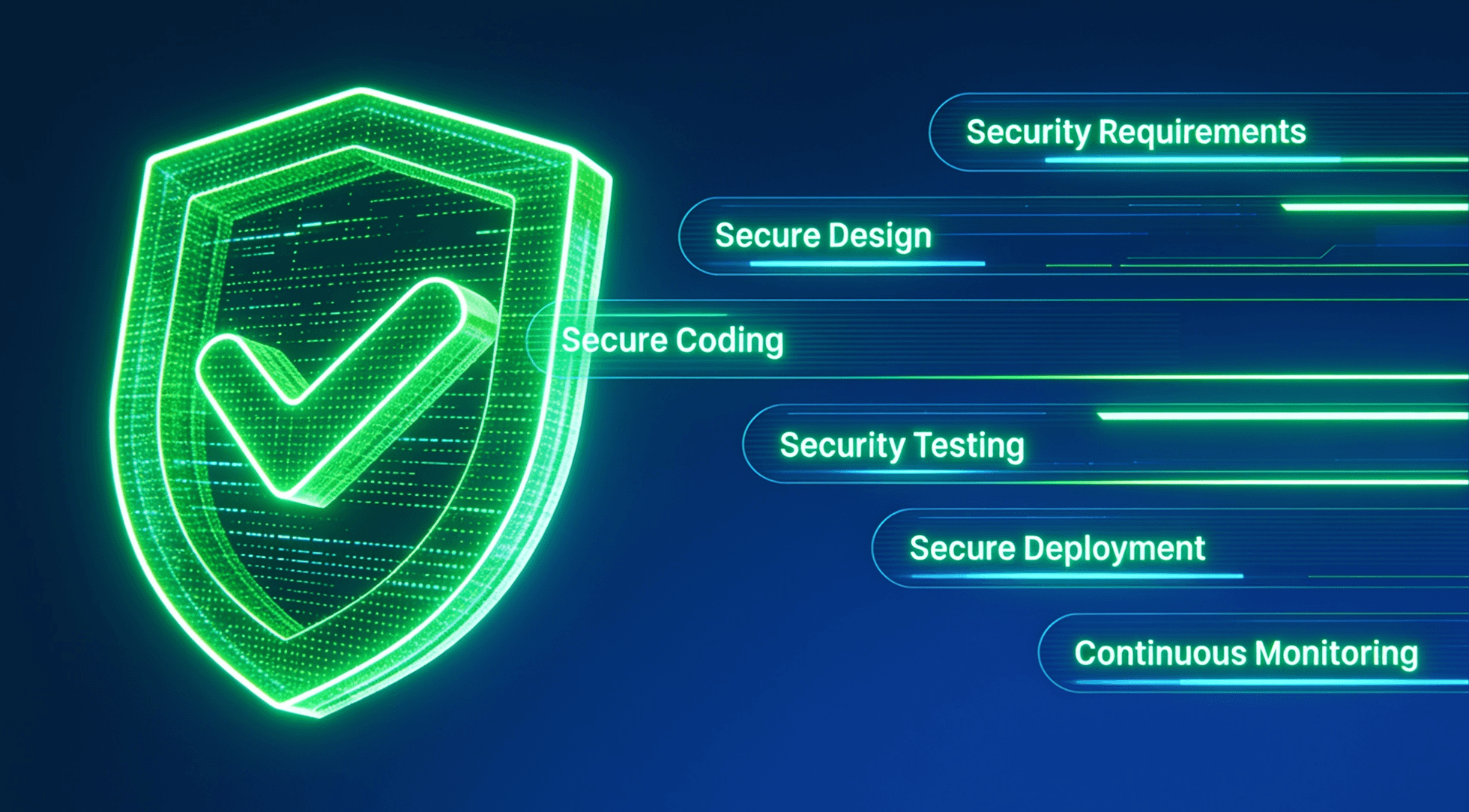
Security testing should span design, coding, build, and runtime phases of the software lifecycle - not just a single pre-release scan.
Static application security testing (SAST). SAST tools perform static analysis on source code and configuration files during development and CI builds. They detect patterns like SQL injection, cross site scripting, weak cryptography, and insecure deserialization early, when fixes are cheapest.
Dynamic application security testing (DAST). DAST probes a running application over HTTP/HTTPS, simulating real-world attacks against endpoints and APIs. It finds potential security vulnerabilities that only manifest at runtime, such as misconfigured headers or exposed admin panels.
Additional layers. Interactive application security testing (IAST) combines runtime instrumentation with vulnerability detection during functional tests. Periodic penetration testing adds a realistic attacker perspective, uncovering chained vulnerabilities and business logic flaws. Dependency scanning tools round out the picture by catching known CVEs in third party libraries.
Remediation workflow. All findings from SAST, DAST, SCA, and pen tests should flow into an issue tracker - for example, as tasks in a BridgeApp project board - with severity ratings, SLAs, and assignees. This closes the loop between detection and resolution and ensures nothing is silently ignored.
Code Reviews, Peer Collaboration, and Security Training
Structured code reviews remain one of the most effective security mechanisms for catching subtle flaws that automated tools miss.
Review checklists. Use checklists covering authentication, access control, input validation, cryptographic practices, error handling, and configuration. At least one additional reviewer should examine security-critical code, especially authorization logic.
Automated checks in pull requests. Integrate linters, SAST scanners, and dependency checks into your PR workflow so that insecure code is flagged before merge. This combination of human judgment and automated tools produces the most reliable results.
Ongoing security training. Regular workshops, OWASP-aligned courses, and short hands-on labs focused on current vulnerability trends keep developers sharp. Security training works best when it is continuous and embedded in daily work - short just-in-time sessions at sprint start, not rare all-day seminars.
BridgeApp can centralize secure coding guidelines, training materials, and review workflows so that developers and security teams share one workspace. When your coding standards, threat models, and review templates live alongside your tasks and chats, integrating security into everyday development becomes the default rather than an extra step.
Building a Secure Development Pipeline with BridgeApp and Magic Coder
Secure coding best practices are most effective when embedded into a repeatable, automated development pipeline - not left to individual discipline. In practice, that's the part most stacks get wrong: the policy lives in a wiki, the finding lives in a ticketing tool, the review happens in Slack, and the fix happens in a terminal - four hops between "this is our rule" and "this diff follows it," each one a place enforcement quietly drops. BridgeApp closes that distance by keeping the rule, the task, the review, and the code change inside the same system.
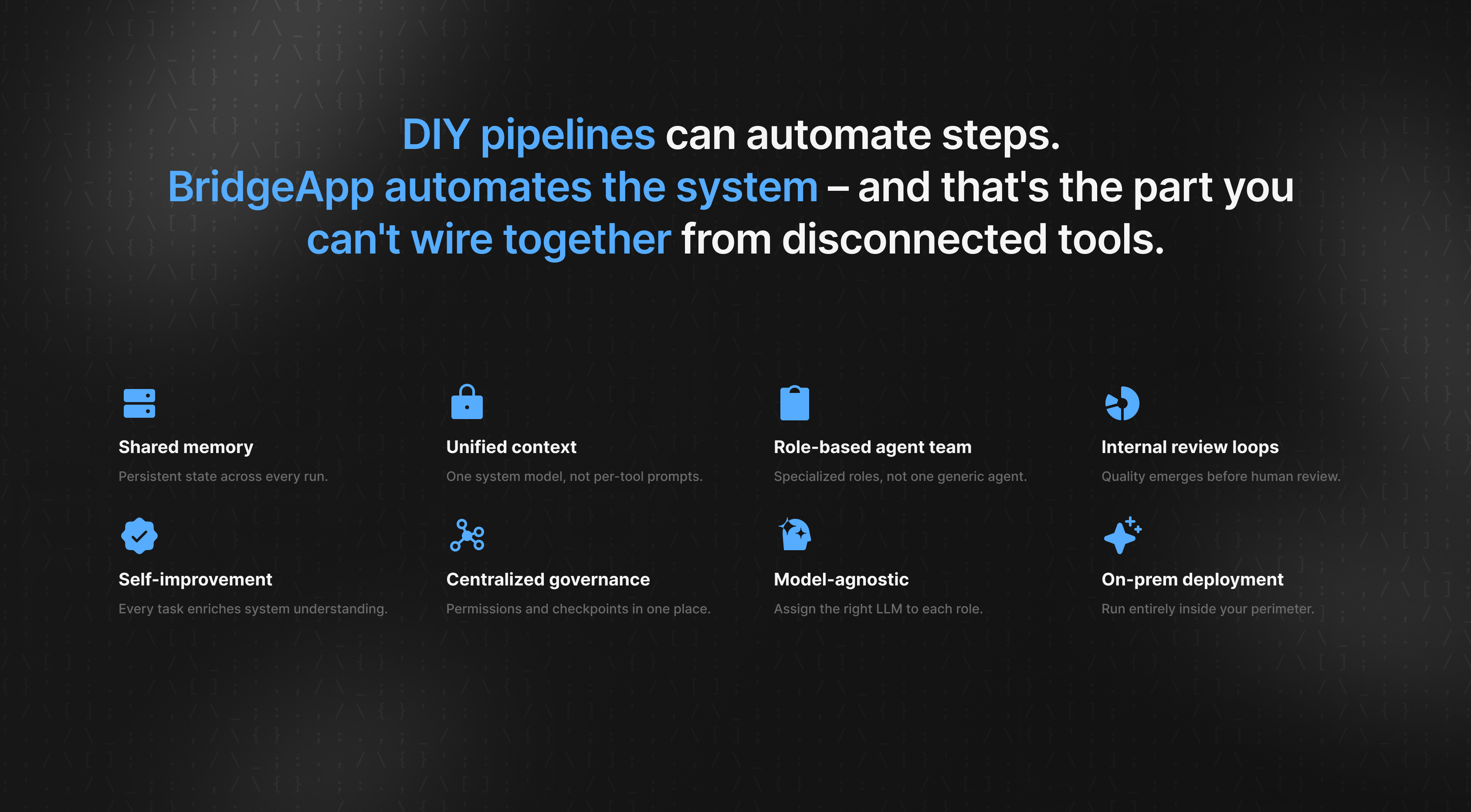
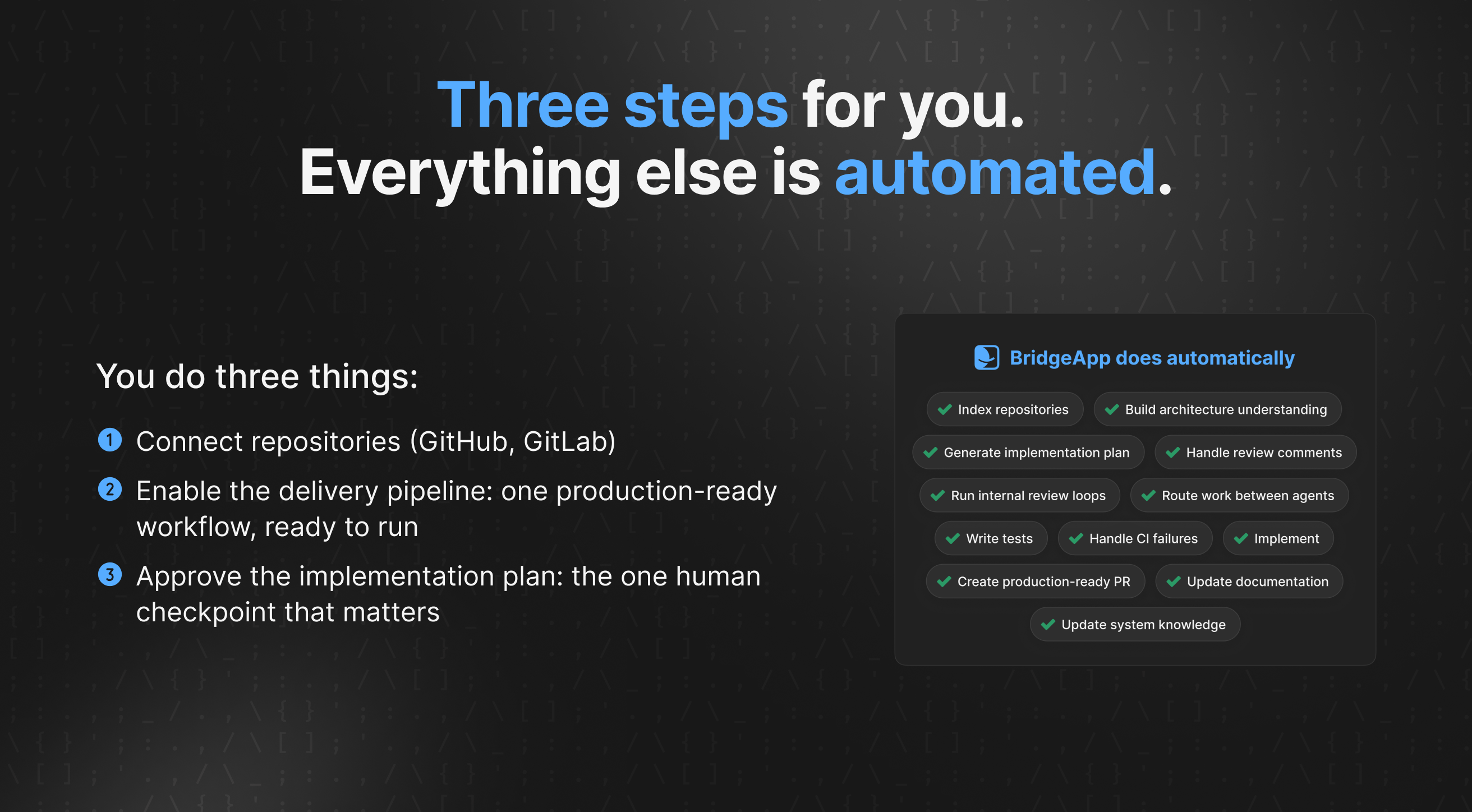
Track security alongside features. Use BridgeApp projects and tasks to manage security requirements, threat models, and remediation work on the same board as feature development. Every security risk gets an owner, a priority, and a due date, just like any other task.
Centralize standards and automate reminders. Store your secure coding standards in BridgeApp documents and databases. Use BridgeApp flows to map coding guidelines to repositories, trigger review reminders, and ensure that security checklists are completed before code is merged.
AI-assisted secure coding. Magic Coder by BridgeApp is an AI coding agent that runs in the terminal, reads your codebase, and executes tasks - refactors, bug fixes, feature scaffolding - by following shared team standards. It can help developers write secure code by applying centralized rules across repositories, such as rewriting unsafe queries into parameterized ones or flagging hardcoded secrets for removal.
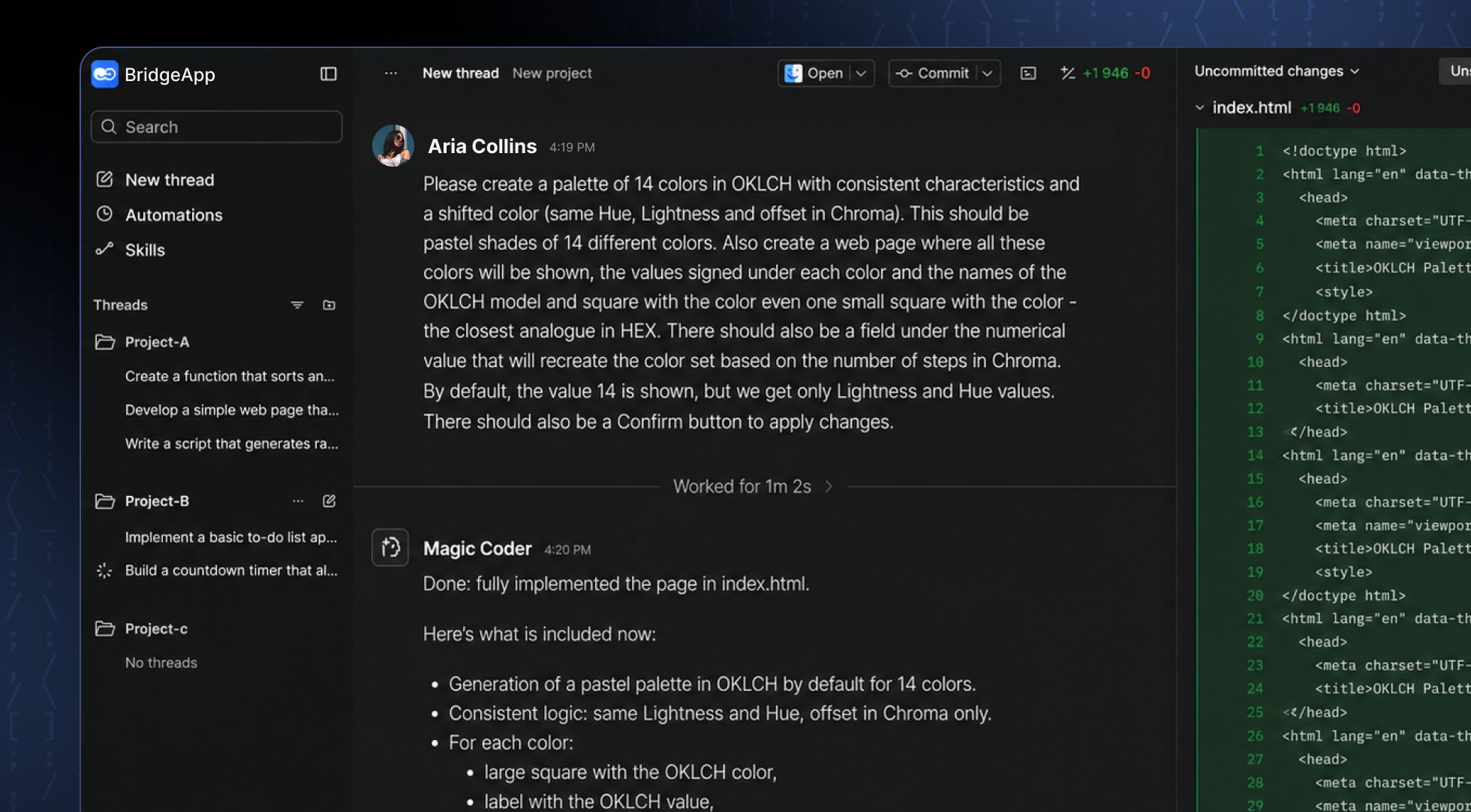
Practical examples of how this pipeline operates daily:
- SAST findings automatically create tasks in a BridgeApp project board with severity labels.
- A BridgeApp agent reviews new pull requests against the team's secure coding guidelines and posts warnings in the relevant channel.
- Magic Coder rewrites legacy string-concatenated SQL into parameterized queries across an entire repository in a single session.
That's the actual shift: not one more tool bolted onto the stack, but one less hop between a rule existing and a rule being followed - which is what turns application security from a bottleneck into a built-in part of how your team ships software.
FAQ
What are the most common security vulnerabilities secure coding aims to prevent?
Secure coding targets recurring issues including SQL and NoSQL injection, cross site scripting (XSS), broken authentication, broken access control, insecure direct object references, insecure deserialization, cryptographic failures, and security misconfigurations. The OWASP Top 10 is the most widely used reference list for these high-impact vulnerability classes and is updated periodically to reflect shifts in the threat landscape. Addressing these common security vulnerabilities through secure coding techniques is far more effective than relying on perimeter security measures alone.
How do OWASP secure coding practices fit into an agile or DevSecOps workflow?
OWASP secure coding practices translate naturally into user stories, acceptance criteria, and automated pipeline gates. Teams can embed OWASP-based checklists into code review templates and sprint planning so that every iteration includes explicit security tasks. This approach ensures that security threats are addressed incrementally rather than deferred to a pre-release phase, keeping delivery speed high while reducing security risks.
What is the difference between SAST, DAST, and penetration testing?
SAST inspects source code or binaries for insecure patterns before runtime, catching issues like injection or weak cryptography during development. DAST probes a running application over HTTP/HTTPS to find exploitable behavior in real-world conditions. Penetration testing is a focused, often manual exercise where specialists attempt to chain vulnerabilities and misconfigurations to demonstrate real-world impact. Each layer catches different classes of security breaches, which is why mature teams run all three.
How can we improve developers' ability to write secure code without slowing delivery?
Invest in lightweight, continuous security training embedded in everyday tools - short lessons, annotated code examples, and just-in-time guidance during reviews. Supplement this with automation and AI assistance. BridgeApp agents and Magic Coder can enforce secure defaults, suggest templates, and perform refactors faster than insecure shortcuts, removing the friction that makes developers skip best practices under deadline pressure.
Is secure coding still necessary if we deploy on a managed cloud platform?
Cloud providers secure the underlying infrastructure, but application-level vulnerabilities - input validation gaps, access control errors, business logic flaws - remain the development team's responsibility. Deploying on managed infrastructure does not preven security vulnerabilities in your own code. Secure coding practices are essential regardless of whether workloads run on public cloud, private cloud, or on-premise environments, because the application layer is where most data breaches originate.