BlogIndustry Insights
Secure SDLC Phases: How to Integrate Security Into Every Step of the Development Lifecycle

BridgeApp Team
15 min read
Every major data breach in recent memory shares a common root cause: security was treated as a late-stage checkpoint instead of a design constraint. If your team is still bolting security onto the end of the software development process, the cost of that approach is growing fast. A secure SDLC changes the equation by embedding security into every phase, from the first requirement to post-production monitoring. This guide breaks down each secure SDLC phase with concrete activities, frameworks, and tooling your team can adopt now.
Dive Deep
- A secure SDLC overlays classic software development lifecycle sdlc phases (requirements, design, implementation, testing, deployment, maintenance) with concrete security activities, controls, and evidence at every step.
- Shifting security left-into requirements, design, and coding-dramatically reduces the cost and impact of potential vulnerabilities compared to fixing them in production, with organizations reporting 30–50% lower defect-related costs.
- Established frameworks like the NIST Secure Software Development Framework (SSDF) and OWASP SAMM provide structured, outcome-oriented guidance for producing secure software in 2025–2026.
- Automated tooling (SAST, SCA, DAST, secrets scanning) and secure coding standards are non-negotiable foundations of modern secure development.
- Platforms like BridgeApp can operationalize a secure SDLC by running it as a governed dev pipeline: security requirements, threat models, and tickets live in the same tracker where custom AI agents plan, implement, and review code, with a human approving the plan and the final merge at team and enterprise scale.
What Is a Secure SDLC?
A secure software development lifecycle is the standard software development life cycle augmented with explicit security requirements, security controls, and documented evidence integrated into every phase—not just a final testing gate. Where traditional SDLC treats security as something to verify before release, a secure SDLC treats security as a design constraint that shapes requirements, architecture, code, and operations from the start.
This distinction matters practically. In a traditional model, security teams run a scan weeks before launch, find critical issues, and force costly rework. In a secure SDLC, those same issues are caught (or prevented entirely) during design reviews and implementation, when fixing them is orders of magnitude cheaper.
Secure SDLC applies broadly: web apps, APIs, backend services, internal tools, mobile clients, and AI-powered systems all benefit. It works across cloud and on-premise environments. And it is methodology-agnostic—Agile, Scrum, Kanban, or hybrid all work, as long as security work is planned, resourced, and tracked alongside functional software delivery.
The secure SDLC concept also connects directly to DevSecOps (the culture and automation of embedding security into DevOps pipelines) and application security posture management, which provides unified visibility and prioritization across security tools and services. Together, these practices form the backbone of how modern development teams ship software that is both fast and defensible.
Overview of Secure SDLC Phases
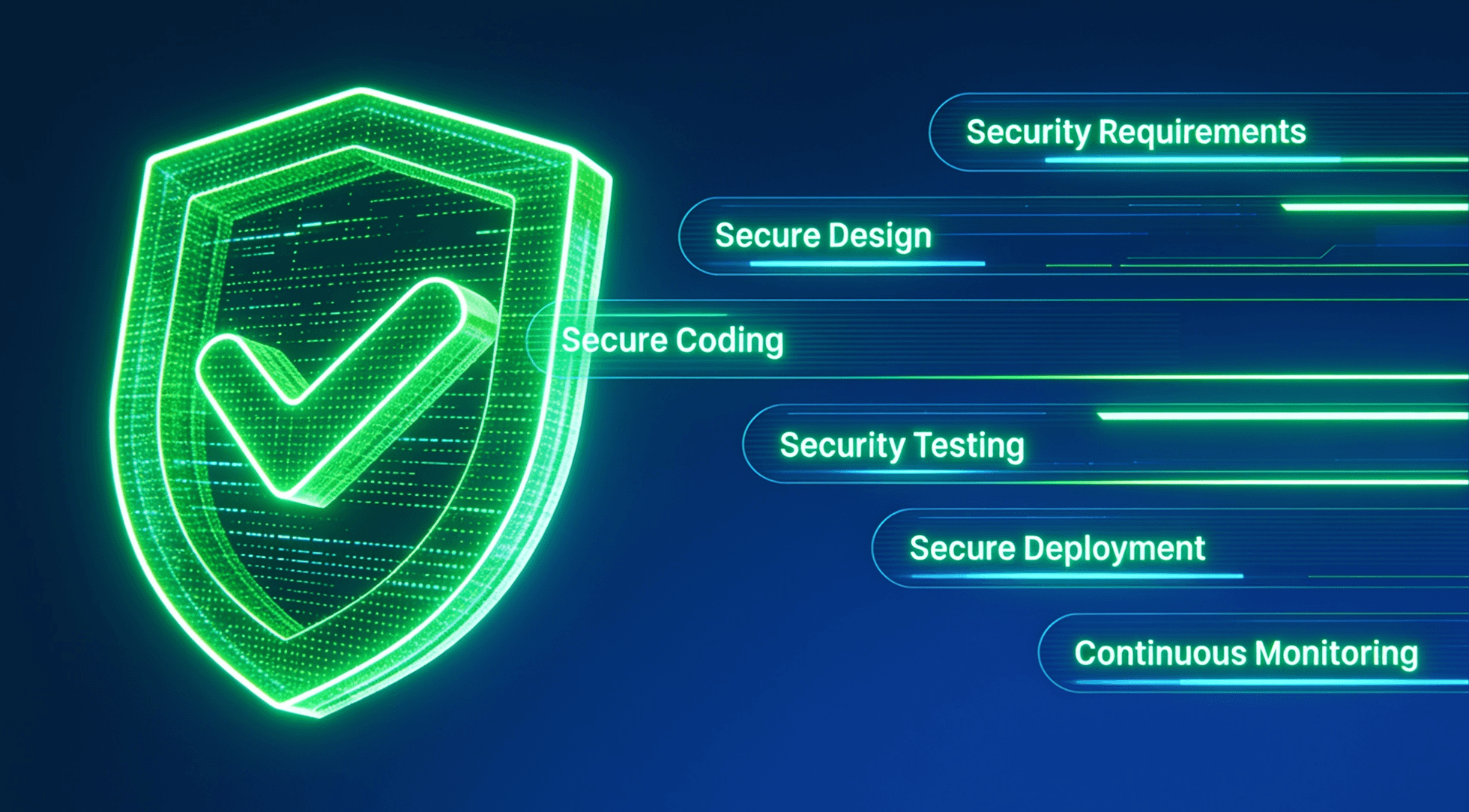
The secure software development life cycle divides into six phases, each with explicit security objectives, deliverables, and owners.
Requirements & Planning focuses on defining security objectives, risk appetite, compliance obligations, and abuse cases. Product managers, architects, and AppSec own this phase. Secure Design establishes the system architecture, threat models, trust boundaries, and data-flow maps. Architects and security leads drive these decisions. Secure Implementation translates design into code under secure coding standards, with SAST, SCA, and secrets scanning integrated into developer workflows. Developers and AppSec collaborate here. Security Testing & Verification validates that implementation meets both functional and security requirements through layered testing-SAST, DAST, SCA, fuzzing, and requirement-driven tests. QA, security testers, and developers share responsibility. Secure Deployment & Release hardens CI/CD pipelines, signs artifacts, scans infrastructure as code, and enforces least-privilege access. DevOps, release engineers, and AppSec own delivery. Operations, Monitoring & Maintenance covers continuous monitoring, patch management, incident response, and periodic pen testing, feeding findings back into earlier phases.
The critical principle here is flow. Security decisions and artifacts must move forward with the work. Abuse cases from requirements feed test plans. Threat models guide code review checklists. Skipping or weakening earlier phases—say, shipping without a threat model—forces later phases to compensate with expensive redesigns, emergency security patches, and production security incidents. This is the same flow a governed AI dev pipeline enforces mechanically: a task can't skip from Planning straight to Waiting for Merge without passing through an approved plan and a completed code review.
The sections below break down each phase with concrete activities and examples for modern web and cloud applications.
Phase 1: Requirements & Planning
This phase combines classic requirements gathering with security objectives, risk appetite, and governance planning. It is where treating security as a first-class concern pays off most.
The core practice is defining security requirements like functional stories, with clear, testable acceptance criteria. Instead of vague goals like "the app should be secure," write requirements such as: "All PII at rest is encrypted with AES-256 and keys rotated every 90 days" or "Logging must detect and alert on unauthorized access attempts within 60 seconds."
Capture compliance and regulatory obligations alongside business requirements. In 2025–2026 projects, this means mapping GDPR, HIPAA, PCI DSS, and newer mandates like the EU Cyber-Resilience Act, which requires SBOMs and evidence of secure development practices. These constraints should be visible to the entire team, not buried in legal documents.
Write security user stories and abuse/misuse cases. For example: "As an attacker, I attempt to enumerate other users' records via the membership renewal API" or "As an attacker, I exploit a forgotten admin endpoint to escalate privileges." These force the team to think adversarially before code exists.
Both NIST SSDF (SP 800-218) and OWASP SAMM provide checklists for planning-phase activities and documentation. NIST SSDF Practice PO.1, for instance, specifically requires identifying and documenting security requirements aligned with external standards.
Teams using BridgeApp workspaces can centralize security epics, user stories, SLAs, and risk registers linked directly to tasks and chats—keeping security considerations visible to product, engineering, and security teams rather than siloed in spreadsheets.
Phase 2: Secure Design
Design is where the system's security posture is largely determined, long before the first line of code. Getting security architecture wrong here means retrofitting later-an expensive, often incomplete process.
Threat modeling is the core activity. Using techniques like STRIDE (Spoofing, Tampering, Repudiation, Information Disclosure, Denial of Service, Elevation of Privilege) or PASTA, teams identify assets, entry points, trust boundaries, and likely attackers. This structured analysis catches misunderstandings of trust boundaries that automated security tools routinely miss.
Create data-flow diagrams that map how sensitive data-payment details, health records, authentication tokens-moves across microservices, message queues, databases, and external APIs. These diagrams make security risks visible and specific.
Secure architecture decisions made here include:
- Zero-trust assumptions (verify every request, regardless of network location)
- Least privilege for all service accounts and users
- Network segmentation and access controls between components
- Hardened identity and access management (OAuth 2.1, OpenID Connect)
- Encryption choices: TLS 1.3 in transit, AES-256 at rest, bcrypt or Argon2 for password storage
Secure design also means choosing vetted frameworks and third party libraries with active maintenance and known security track records. Rolling your own cryptography or authentication is almost always the wrong decision.
Version-controlled architecture docs and BridgeApp documents assigned as Knowledge keep threat models and design decisions aligned with evolving code, so they stay useful rather than becoming stale PDFs.
Phase 3: Secure Implementation (Secure Coding)
Implementation is where secure coding standards turn design intent into secure software-or introduce vulnerabilities if ignored. Every line of code is either reinforcing or undermining the security architecture decided in Phase 2.
Secure coding standards are language-specific rules covering input validation, output encoding, authentication, authorization, and cryptography. Standards like OWASP ASVS and SEI CERT provide comprehensive baselines. Concrete secure coding practices include:
- Parameterized queries and prepared statements to prevent SQL injection
- Output encoding and escaping to prevent XSS
- Strict type handling and validation at trust boundaries
- Safe file handling (path traversal prevention, size limits)
- Avoiding insecure functions (e.g., strcpy in C, MD5 for hashing)
Integrate static application security testing (SAST), secrets scanning, and linters into developers' daily workflows and CI pipelines. IDE plugins that flag insecure patterns at write-time are far more effective than scan reports delivered days later. Software composition analysis (SCA) tools check dependencies for known vulnerabilities-critical given that most modern applications depend heavily on open-source packages.
Handle secrets correctly using vaults or cloud KMS. Hardcoding API keys or passwords in repositories, Dockerfiles, or CI configs is one of the most common and preventable security gaps.
At HPE, switching to a more accurate SCA tool reduced false positives by 92%, improved mean time to remediation by 10×, and saved $1.4M. That kind of ROI demonstrates why tool selection during this phase matters.
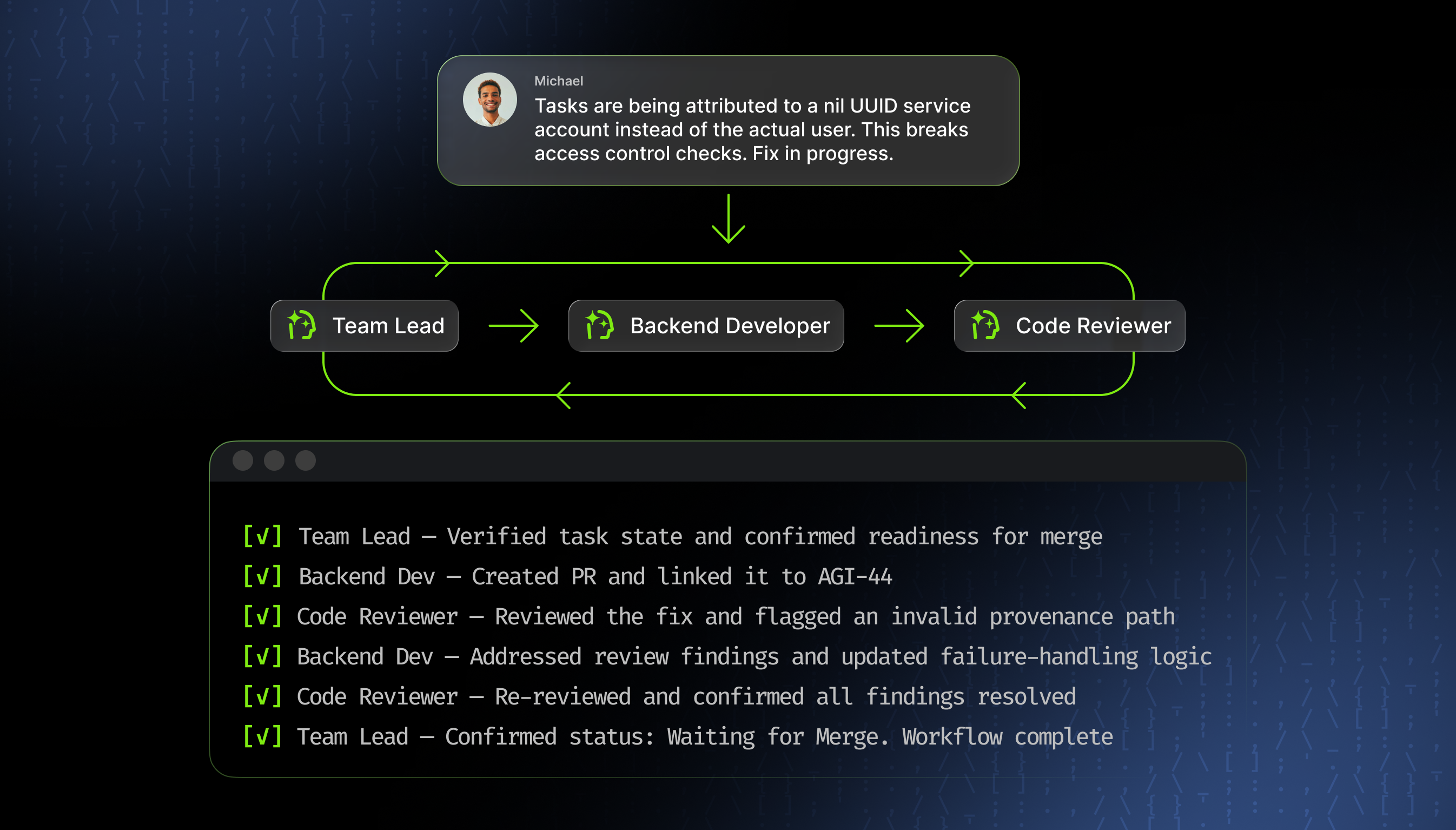
Teams using AI coding agents like BridgeApp's Magic Coder should align them with central secure coding rules and repository-level guardrails - and structure the work as a pipeline of roles rather than one agent going straight from prompt to pull request. A System Architect agent can draft the implementation plan against secure coding standards; a human reviews and approves that plan before any code is written; a Backend or UI Developer agent then implements it; and a Code Reviewer agent checks the result against both the approved plan and the secure coding rules before the task moves to Waiting for Merge, where a human still makes the final call. That plan-approval and code-review split is what keeps AI-generated code auditable rather than a black box.
Phase 4: Security Testing & Verification
This phase validates that implementation meets both functional and security requirements before promotion to production. It is where security testing catches what earlier phases missed-and where automated security testing provides the safety net.
Layered testing is essential:
- Unit and integration tests verify security behaviors (authentication flows, authorization checks, input validation)
- SAST scans source code for injection, buffer overflow, and other code-level issues
- SCA identifies vulnerable dependencies via SBOM analysis
- Dynamic application security testing (DAST) probes the running application for misconfigurations, injection, and runtime flaws
- Interactive application security testing (IAST) and fuzzing target complex execution paths in high-risk applications
Map tests back to security requirements and threat models to ensure coverage of high-risk flows. If your threat model identified an API endpoint as security sensitive components, there should be tests that specifically attempt to exploit it.
Use automated test gates-security gates in CI/CD-that block merges or releases when critical vulnerabilities or policy violations are detected. Calibrate these gates carefully: too aggressive and you slow delivery with false positives; too lax and you ship known risks.
Application security posture management (ASPM) tools or dashboards provide unified visibility into findings across multiple scanners and services. AuditBoard, for example, achieved a 98% reduction in false positives and saved $1M by consolidating tools into a unified platform, enabling rapid remediation of real issues.
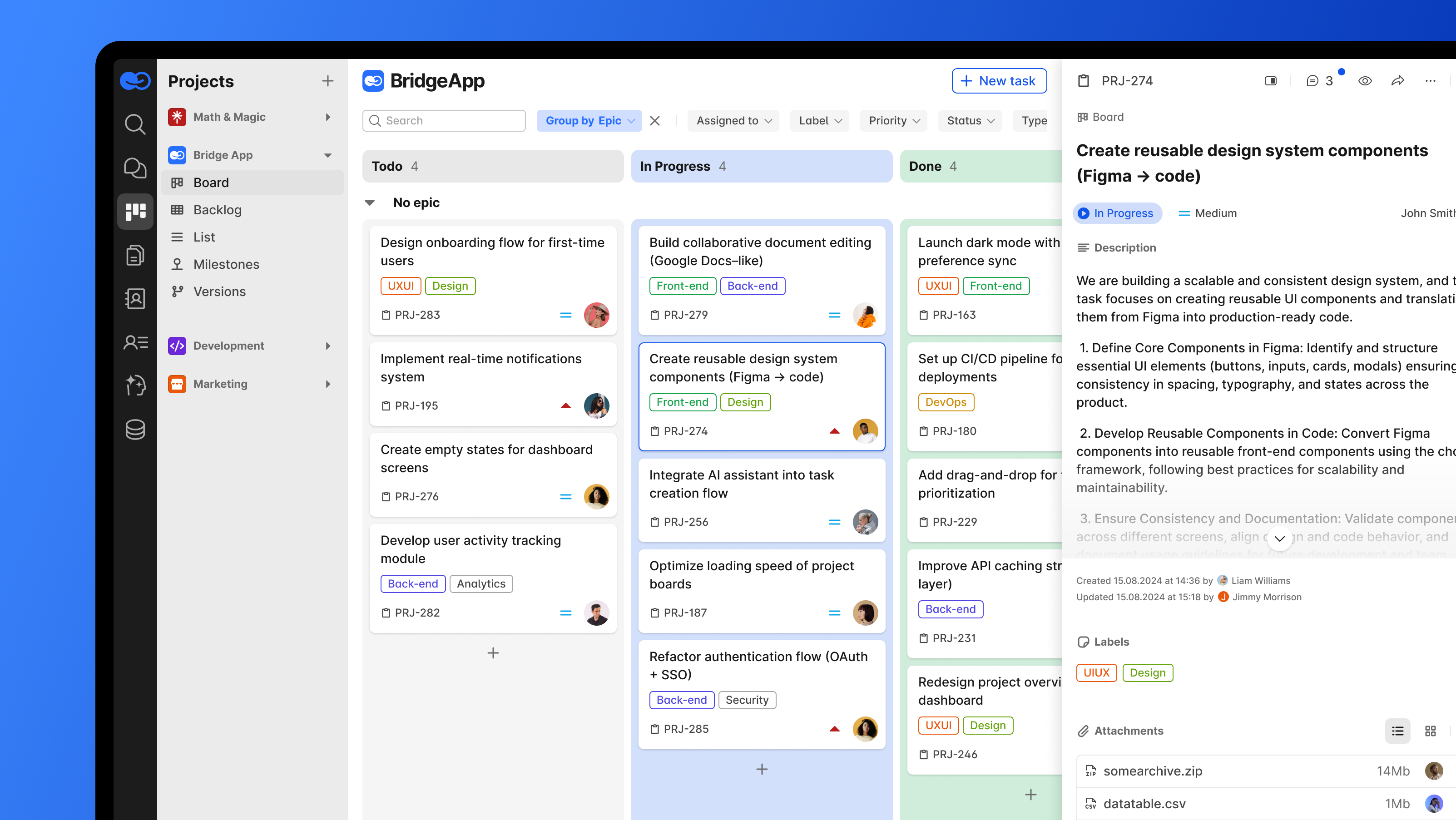
Results from scans, application security testing, and penetration tests should be tracked as tasks in BridgeApp projects with ownership, priorities, and due dates to ensure issues are actually fixed—not just logged.
Phase 5: Secure Deployment & Release
Deployment and infrastructure choices are now central to application security in cloud-native and containerized environments. A perfectly secure codebase deployed onto misconfigured infrastructure is still vulnerable.
Secure CI/CD practices include:
- Hardened build runners with minimal attack surface
- Signed software artifacts (container images, binaries) with provenance records
- Least-privilege access for pipeline components (no admin tokens shared across jobs)
- Audit logging on all pipeline actions
Scan Infrastructure as Code (Terraform, Kubernetes manifests, CloudFormation) to prevent misconfigurations like public S3 buckets, open security groups, or overly permissive IAM roles. These scans catch infrastructure-level security risks before they reach production.
Release strategies like blue-green and canary deployments, paired with security and observability checks, allow teams to validate security assumptions before full rollout and roll back quickly if anomalies appear.
Implement strong access controls, secrets management, and configuration baselines across staging and production environments. Use version control systems for all infrastructure and configuration code-just as you would for application code.
Document release notes and security assumptions in a shared BridgeApp document linked to the release task - the same task that sits in Waiting for Merge once code review has passed, so the human approving the merge sees the security context alongside the code. This ensures that security and development teams can trace exactly what shipped and under what security constraints.
Phase 6: Operations, Monitoring & Maintenance
Operations is the long tail of the secure SDLC. Patching, continuous monitoring, and incident response keep the application secure over its lifetime-which is typically far longer than the initial development cycle.
Set up centralized logging, metrics, traces, and alerts that cover authentication failures, permission changes, unusual data access patterns, and infrastructure anomalies. Runtime security monitoring integrates security measures into the operational fabric rather than relying solely on pre-deployment checks.
Patch management processes for application code, containers, OS packages, and third party libraries need clear SLAs. When Log4Shell hit in December 2021, organizations with mature software supply chain visibility (via SBOMs and dependency tracking) patched within days. Those without spent weeks scrambling to even identify affected systems.
Schedule periodic security reviews: penetration tests, red-team exercises, and bug bounty programs. These uncover security issues that automated tools and internal testing miss. Feed findings into the backlog as actionable tickets.
The most important practice in this phase is closing the feedback loop. Every security incident and near-miss should update earlier phases: revised requirements, updated threat models, new secure coding rules, additional test coverage. This is how a development lifecycle becomes genuinely self-improving.
BridgeApp can host post-incident retrospectives, capture learnings in documents, and update shared playbooks and runbooks—making security knowledge accessible for future events rather than locked in someone's memory.
Secure Coding Standards and Developer Enablement
Written secure coding standards only matter if developers can find, understand, and apply them quickly. A 200-page PDF nobody reads provides zero security value.
Create language-specific secure coding guides covering common vulnerability classes: injection, XSS, CSRF, insecure deserialization, and access control flaws. Map each standard to concrete examples in your organization's primary stacks-Java Spring Boot, Node.js/TypeScript, Python FastAPI, mobile clients.
Embed standards into daily work through:
- IDE extensions that flag violations at write-time
- Pre-commit hooks that catch secrets and common anti-patterns
- CI gates that enforce compliance before merge
- Peer code reviews with security-focused checklists
Ongoing security training matters more than one-off workshops. Use up-to-date case studies-recent software supply chain attacks, token theft campaigns from 2023–2025-to keep the material relevant and concrete.
BridgeApp documents can serve as the single source of truth for secure coding rules, accessible from any chat or task - and referenced directly inside the pipeline, since a System Architect agent's plan and a Code Reviewer agent's checklist can both point to the same living document. AI agents like Magic Coder can help refactor legacy code to comply with updated standards, with the same plan-review and code-review handoffs applied, accelerating the process of reducing security debt across older codebases.
Frameworks and Benchmarks for Secure Development
You do not need to invent a secure SDLC from scratch. Established frameworks provide structured, tested guidance.
NIST Secure Software Development Framework (SSDF, SP 800-218) is a US government standard organizing practices into four groups: Prepare the Organization (PO), Protect the Software (PS), Produce Well-Secured Software (PW), and Respond to Vulnerabilities (RV). It contains 19 practices and 42 tasks. The software development framework ssdf is outcome-oriented rather than prescriptive, making it adaptable across organizations. U.S. federal procurement now requires self-attestation against these practices via CISA's Secure Software Development Attestation.
OWASP SAMM is a maturity model for assessing and improving secure software practices across governance, design, implementation, verification, and operations. Its maturity levels (foundational, mature, advanced) let teams measure progress and prioritize improvements.
OWASP ASVS provides a detailed set of application security requirements that can be mapped to specific features and APIs-useful for both security requirements definition and verification.
Supply chain security frameworks like SLSA (Supply-chain Levels for Software Artifacts) protect build integrity and provenance. After high-profile supply chain incidents from 2021–2024, SBOM requirements have become regulatory expectations, not optional best practices.
Align internal policies with these frameworks inside a BridgeApp project - since BridgeApp doesn't ship fixed templates, teams build their own compliance tracker once, as tasks, documents, and database views, and reuse it to track maturity over time rather than starting fresh for each audit.
Tooling, Automation, and Application Security Posture Management
Modern secure SDLC depends on automation to keep pace with daily or hourly releases. Manual security reviews alone cannot scale to the velocity of modern software development.
Key tool categories include:
- SAST - static analysis of source code
- SCA - dependency and license vulnerability scanning
- DAST - runtime application scanning
- Container scanning - image vulnerability detection
- IaC scanning - infrastructure misconfiguration detection
- Secrets detection - hardcoded credentials and tokens
- Dependency monitoring - continuous tracking of third party libraries
Application security posture management unifies findings from these tools, correlates them with assets and ownership, and prioritizes remediation based on real risk-not just severity scores. This is critical for teams drowning in alert noise from multiple disconnected security solutions.
Integrate security tools into CI/CD and developer workflows rather than isolated security consoles. Developers should see findings in their pull requests, not in a separate portal they check weekly.
AI-powered assistants and agents—including BridgeApp's Magic Coder—can help fix vulnerabilities at scale while following the team's standards. Organizations that shifted security testing earlier saw 30–50% lower defect-related costs and 30–50% faster release cycles.
Visualize security status in dashboards or BridgeApp database views that track potential security vulnerabilities by severity, age, and affected service. This makes security posture visible to engineering leadership, not just the security team.
Building Security into Team Culture and Processes
Culture is the glue that makes secure SDLC practices sustainable instead of one-off initiatives. Without cultural buy-in, even the best security tools and processes decay.
Establish shared responsibility for security across product, development, operations, and security teams. The phrase "security is someone else's job" is the single biggest predictor of security gaps in an organization. When security and development teams collaborate from requirements through operations, the entire development process improves.
Practical culture-building tactics:
- Security Champion programs: Developers in each squad act as first-line security advocates, conducting initial risk assessments, reviewing PRs for security concerns, and liaising with the central AppSec team.
- Remediation SLAs: Define realistic fix timelines by severity (e.g., critical: 48 hours, high: 1 week) and track them as KPIs. This prevents security debt from silently accumulating.
- Knowledge-sharing rituals: Lunch-and-learns, internal capture-the-flag events, and blameless post-mortem reviews keep security top of mind and build skills across the organization.
BridgeApp's unified workspace—combining chat, tasks, documents, databases, and AI agents—can host champion programs, store playbooks, track SLAs, and make security knowledge easy to discover and reuse. When security knowledge lives alongside daily work rather than in a separate wiki, it actually gets used.
The goal is not to make every developer a security expert. It is to make security a natural part of how the team thinks, builds, and ships functional software.
FAQ
How is a secure SDLC different from a traditional SDLC in practice?
A secure SDLC adds explicit security tasks and controls to every phase-from threat modeling during design to continuous monitoring in operations-rather than treating security as a final testing step. In practice, this means security user stories, design reviews, secure coding standards, automated scanning, and incident response planning are all planned and tracked like any other work. Timelines may initially seem longer, but they usually shorten overall by reducing production security incidents and emergency fixes that derail sprints.
When should we start integrating security into our development lifecycle?
Security should start at the very first phase, when defining requirements and planning scope, so that constraints and controls influence system architecture and feature design. Waiting until implementation or testing forces expensive redesign and creates friction between development and security teams. A practical approach: start with one pilot product or service in the next quarter, apply the basics (security requirements, threat model, SAST/SCA in CI, logging), then expand the secure software development practices across more teams as you build muscle.
Which secure coding standards should our team follow?
Use OWASP ASVS for web and API security requirements, plus language-specific standards like SEI CERT C/C++ or community best practices for Java, .NET, JavaScript/TypeScript, and Python. Tailor these to your technology stack and document them in a central, searchable place—a BridgeApp Knowledge document works well for this. Standards should be living documents updated as frameworks, libraries, and threat landscapes evolve, not static artifacts from a compliance exercise years ago.
How can small teams adopt a secure SDLC without slowing down too much?
Start with a minimal, high-impact set of controls: basic threat modeling for critical features, secure coding checklists, SAST/SCA and secrets scanning in CI, and simple logging and alerting. Automate as much as possible and embed checks into existing tools instead of adding manual security gates. Use BridgeApp to keep security discussions, tasks, and documentation close to daily development work so overhead stays low. Small teams that integrate security early consistently report fewer production incidents and less time spent on emergency patching.
Does using AI coding assistants make secure development harder or easier?
AI coding assistants can improve security by suggesting safer patterns and automating repetitive fixes, but only if guided by clear secure coding standards and human review. Unguided AI can replicate insecure examples from training data or introduce subtle logic issues that integrates security practices poorly. Configure AI agents like BridgeApp's Magic Coder as a pipeline of roles instead of one agent going straight to a pull request: a plan gets human approval before implementation starts, and a Code Reviewer agent checks the result against that plan and your documented standards before the task ever reaches Waiting for Merge. The tool accelerates producing secure software—but the team's standards and review process remain the ultimate safety net.