BlogProduct Updates
BridgeApp: How AI-Native Software Development Automation Cuts Time-to-Ship by 10x

BridgeApp Team
16 min read
Shipping software faster without sacrificing quality is no longer optional - it's a baseline expectation. Just as often, the real bottleneck isn't a missing tool but too many of them: a pipeline stitched together across six or seven disconnected systems, where nobody can trace a change from ticket to production without switching tabs five times. This guide walks through every layer of dev pipeline automation, from basic scripts to AI-driven orchestration.
Most teams that try to wire AI agents into their pipeline end up with exactly the kind of stack this guide is about replacing: a CLI tool here, a cron job there, a script that quietly stops working the day a provider has an outage or two people kick off the same job by accident. BridgeApp starts from a different premise — that putting agents into production isn't a prompting problem; it's an engineering problem, and it only works if a whole stack of unglamorous properties hold up at once.
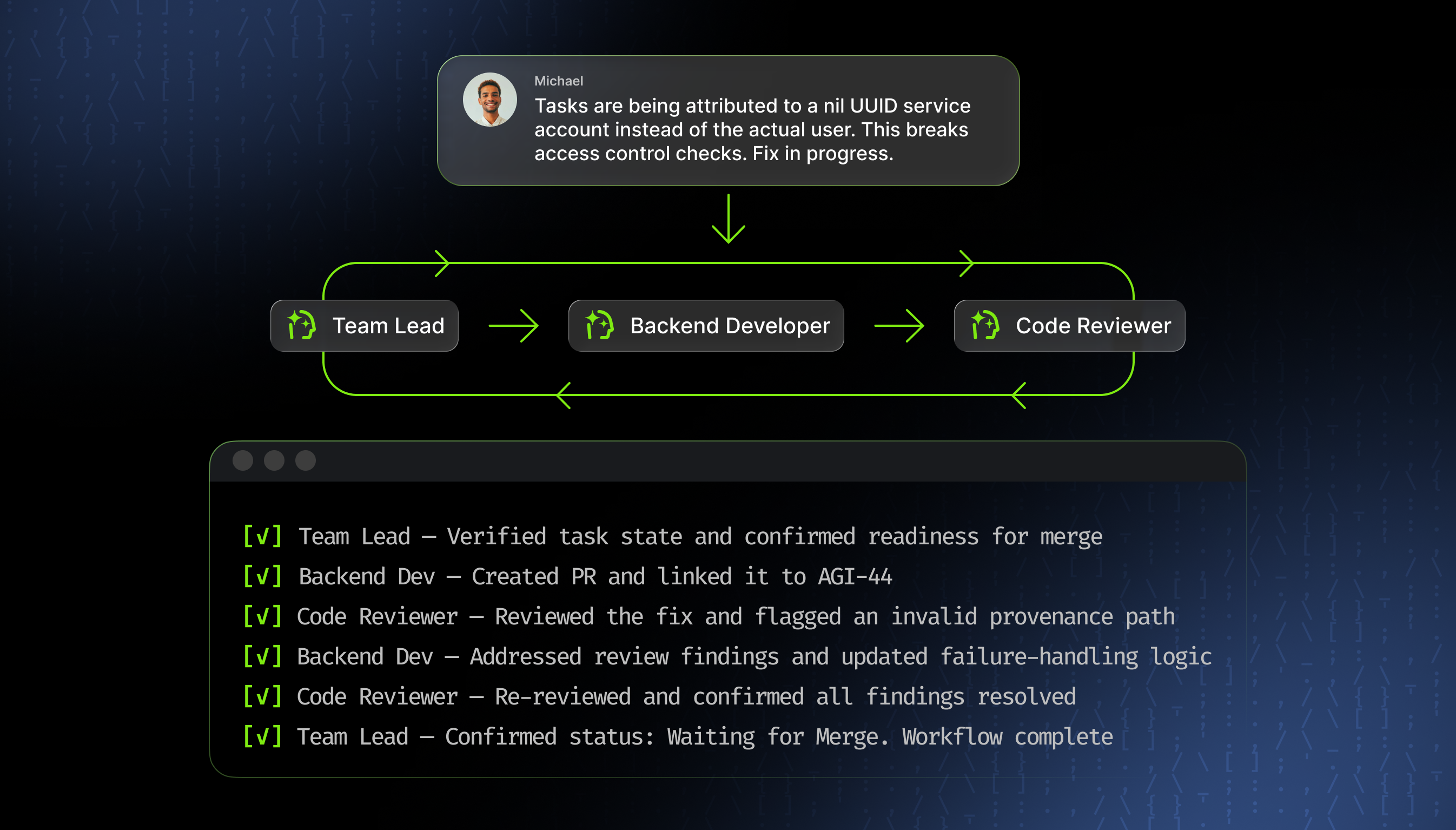
The board itself is the workflow: a directed graph where each task's work is serialized, deduplicated, and resumable from a crash rather than quietly failing and starting over. On top of that sit authored execution graphs — typed nodes, checkpointed state between steps — that fire from a domain event or a schedule, with every run queryable afterward instead of vanishing into a silent script failure. Subagents run server-side and in parallel, each with its own durable transcript and bounded depth, timeouts, and token limits, inheriting exactly the context a given step needs and no more. A background memory layer runs continuously underneath all of it, deduplicating facts, resolving conflicts, and retiring information that's gone stale, per agent, private or shared, fail-closed if anything goes wrong.
New repositories become a queryable code graph rather than a folder an agent guesses its way through — callers, call chains, cross-service traces, plus the architecture docs layered on top — so changes land in the files that actually need them. Knowledge retrieval works the same way: documents are versioned and re-chunked on publish, results are reranked, and what an agent can read is scoped exactly like what it can call, so nothing stays stale and nothing leaks past its boundary. Which tools an agent can reach is governed centrally and audited, skills unlock progressively rather than all at once, and every run executes inside an isolated, sandboxed environment with short-lived, scoped credentials and secrets encrypted at rest — so a compromised run has nothing valuable to find. A single model layer sits above OpenAI, Anthropic, DeepSeek, Moonshot, Groq, and others, with typed retries and automatic failover, so a provider outage is a blip, not a rebuild. And because none of this is free to run at scale, a byte-stable cache prefix and anchored compaction of long transcripts keep the whole system materially cheaper per token than a naive request loop.
None of these pieces is impressive alone — they're each months of unglamorous engineering. What they add up to is the difference between an agent that wrote something and a team of agents that ships reliably, safely, and cheaply. Everything below — the orchestration layer, the multi-agent execution, the knowledge and memory systems — runs on that same engine.
Diving Inside
- Software development automation covers every stage of the SDLC - coding, testing, deployment, and maintenance - not just one slice.
- Modern automation stacks combine CI/CD pipelines, infrastructure as code, and AI agents to shrink release cycles from quarterly to daily.
- Both open source and paid tools form the backbone of most setups, and blending them thoughtfully avoids vendor lock-in.
- BridgeApp is an AI-native workspace that replaces six or seven fragmented SaaS tools with one platform: chat, tasks, documents, and databases sit alongside custom AI agents, so a task's status can double as a dev pipeline's state machine - agents plan, implement, and review work as first-class assignees, with humans approving the plan and the final merge.
- Incremental adoption beats big-bang rollouts: start with one high-impact area, prove value, then expand.
What Is Dev Pipeline Automation?
At its core, this is the use of software, scripts, and AI to perform repetitive tasks across the SDLC with minimal human intervention. Software is the set of instructions that tell a computer what to do. It falls into a few categories: system software (the operating system, drivers, firmware) runs the computer itself; application software (browsers, Microsoft Word, and the rest) is what people use to get work done; programming software (compilers, IDEs) turns source code into something a machine can execute. Automation lives in that middle layer - software written to operate on other software, coordinating the tools a team already has rather than replacing them.
Automation entered the mainstream through Jenkins, then GitHub Actions, GitLab CI/CD, CircleCI, and Azure DevOps - platforms that let teams define pipelines triggered by a commit or pull request instead of manual commands. It's tightly coupled with DevOps, continuous delivery, and trunk-based development, but it complements rather than replaces human judgment: architecture decisions, product strategy, and complex debugging stay firmly in human hands.
The SDLC Behind the Automation
However automated a pipeline becomes, it still follows the SDLC: planning and analysis define what's needed, design maps out architecture, implementation is where developers write code, testing checks for bugs and usability problems, deployment launches the result, and maintenance keeps fixing and shipping after launch. Automation doesn't remove any of these phases - it removes the manual, repetitive work inside each one.
Why Automate in 2026?
Remote-first teams, multi-cloud deployments, and AI coding tools have made automation a practical necessity.
For the developers actually shipping through this, the pipeline changes less than it might seem. Reviewing an agent's implementation plan looks like reviewing any other design doc — it's a linked document in the same task, not a separate tool to check. Nothing merges without a human; nothing gets access it wasn't explicitly scoped for, and every agent run is bounded — depth, timeouts, token limits — so a stuck or looping agent stalls out and gets caught instead of quietly burning through a budget overnight. And because a new repository is indexed into a code graph automatically, a team doesn't spend the first weeks teaching agents where things live — the call chains and cross-service traces are there from day one, same as they would be for a new hire reading the codebase for the first time.
Key benefits:
- Faster releases. Teams with mature CI/CD deploy daily; the median still ships quarterly. Automating build and release pipelines alone can cut delivery timelines by up to 50%.
- Fewer regressions. Automated linters, static analysis, and test suites catch issues before they reach users - far cheaper to fix in a pull request than in production.
- Consistent quality checks. Every commit goes through the same gates, regardless of who wrote it or when.
- Security and compliance. Checks integrated into every deployment and audit logs that manual processes can't match.
- Cost control. Automating build verification and environment provisioning frees engineering time - teams consolidating their toolchain onto one platform commonly report payback within about three months.
Core Areas of Automation Across the Lifecycle
- Source control workflows - branching policies, merge checks, pull request automation.
- Build automation - compiling, packaging, producing artifacts.
- Test automation - unit, integration, E2E, and performance testing.
- Deployment automation (CI/CD) - continuous integration, delivery, and deployment.
- Infrastructure as code (IaC) - provisioning environments through code instead of manual configuration.
- Feedback and analytics - monitoring, coverage metrics, observability.
These apply across Java, Python, JavaScript/TypeScript, C#, Go, Rust, and both open source and proprietary stacks.
Automating Implementation and Review
Effective coding automation starts with version control - Git plus a branching strategy like trunk-based development gives you predictable trigger points where automation can kick in. Linters, formatters, and static analysis tools like SonarQube gate whether code can be merged, catching bugs before a human reviewer opens the file.
Modern AI coding agents go further than diff generation - the more reliable ones take on defined roles inside a governed pipeline instead of jumping straight from prompt to pull request, and they need to actually understand the codebase rather than pattern-match on file names. Magic Coder by BridgeApp is built this way: each new repository is indexed into a queryable code graph - callers, call chains, cross-service traces - so changes land in the files that actually need them instead of producing a plausible-looking diff in the wrong place. The work is split across custom AI agents configured through BridgeApp's visual no-code Agent Builder, each scoped to one responsibility, with subagents running server-side and in parallel.
A concrete workflow:
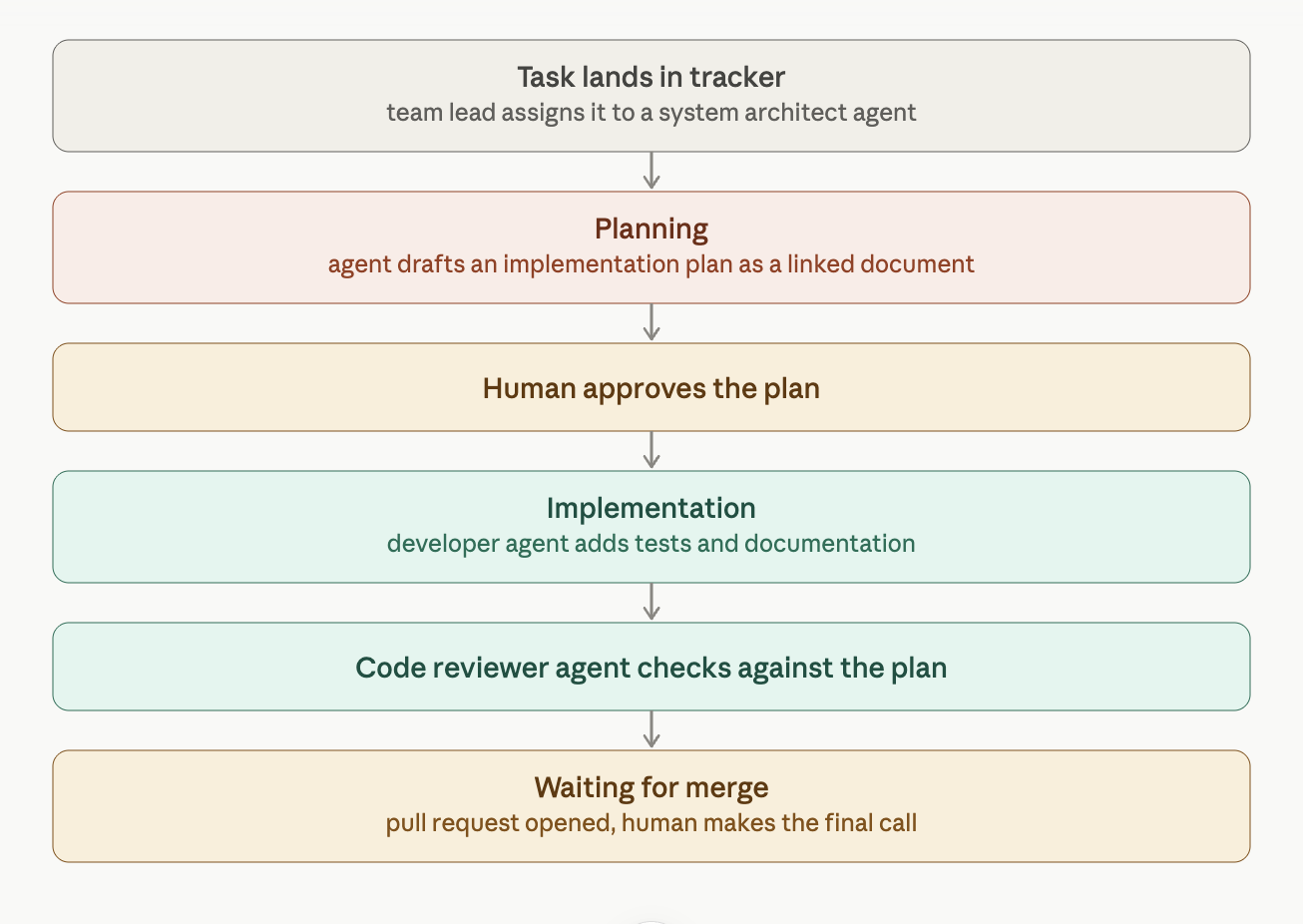
- A task lands in the tracker; a Team Lead role reviews it, assigns it to a System Architect agent, and moves it to Planning.
- The System Architect agent inspects the relevant repositories and drafts an implementation plan as a linked document.
- A human reviews and approves the plan before any implementation begins.
- Once approved, a Backend or UI Developer agent implements the plan, adds tests and documentation, and moves the task to Local Code Review.
- A Code Reviewer agent checks the implementation against the approved plan, approving it or sending it back until it passes.
- The developer agent opens a pull request and moves the task to Waiting for Merge, where the pipeline deliberately stops - merging stays a separate, human-owned step.
This supports, but doesn't replace, peer review and architectural decision-making: a human approves the plan, the agent system checks the implementation against it, and every handoff is logged in the task's comment thread - no separate audit tool to maintain, no context lost jumping between a chat app, a ticket, and a repo. Every step runs inside an isolated execution environment with short-lived, scoped credentials, and which tools an agent can call is governed centrally and audited.
Test Automation Across the SDLC
Test automation means running repeatable test suites instead of manual clicking - the single most impactful area for improving quality without adding headcount.
Unit tests validate individual functions (JUnit, pytest) and catch regressions at the smallest, cheapest scope. Integration/API tests verify services communicate correctly. E2E/UI tests simulate real user flows (Selenium, Cypress, Playwright). Performance tests measure throughput and latency under load.
Tests trigger on every push, on pull requests, in nightly builds, and before deployment. Average test coverage across teams sits around 68%; best-in-class teams push above 92%. Shift-left testing - moving these checks to the earliest possible stage - is what keeps a bug cheap to fix instead of expensive.
CI/CD: Automating Builds, Integration, and Deployment
Continuous integration means merging small changes frequently, with automated builds and tests that catch issues early. Continuous delivery keeps software in a deployable state at all times; continuous deployment pushes every passing change to production automatically.
Build automation compiles source code and produces artifacts (Docker images, .jar files, .apk bundles) using tools like Maven, Gradle, npm, and Docker. Average build time is roughly 12 minutes; best-practice teams target under 5. Integration automation enforces status checks on shared branches - all tests pass, linters are clean, reviews are approved - before anything merges into main.
Deployment automation uses blue-green deployments, canary releases, and rolling updates, especially on Kubernetes. GitHub Actions leads CI/CD adoption at roughly 33-42% market share, with Jenkins around 28% and GitLab CI around 18-19%.
Infrastructure as Code and Environment Automation
Infrastructure as code (IaC) manages servers, networks, and cloud resources through machine-readable definitions instead of manual console clicks. Popular tools: Terraform, AWS CloudFormation, Pulumi, Ansible, Chef, Puppet. Teams spin up ephemeral environments per pull request, run tests, then tear them down automatically. GitOps tools like Argo CD and Flux continuously reconcile declared state with actual state, catching drift before it causes failures.
Because BridgeApp doesn't ship pre-built automation templates, teams wire this kind of automation themselves from the same building blocks used everywhere else in the platform: a custom agent can trigger a Terraform apply, post results to a chat channel, create a review task, and notify approvers - assembled once, inside the same workspace where the rest of the project's context already lives.
AI, Agents, and Orchestration in Development Automation
Roughly 64% of companies now generate a majority of their code with AI assistance, and autonomous agents that open pull requests are growing rapidly - though many setups lock a team into a single model provider, with no easy path to switch if pricing or quality shifts.
Most "AI agent" setups are a stack of CLI tools and glue scripts wired together by hand - they work until a process crashes mid-run, a provider has an outage, or two engineers unknowingly kick off the same job. A dev pipeline is arguably the cleanest case for an orchestration layer built the right way, because every piece it needs already exists as a native BridgeApp primitive: a task's status field doubles as the pipeline state, a linked document holds the plan, the comment thread holds the review history, and a chat channel carries the handoff.
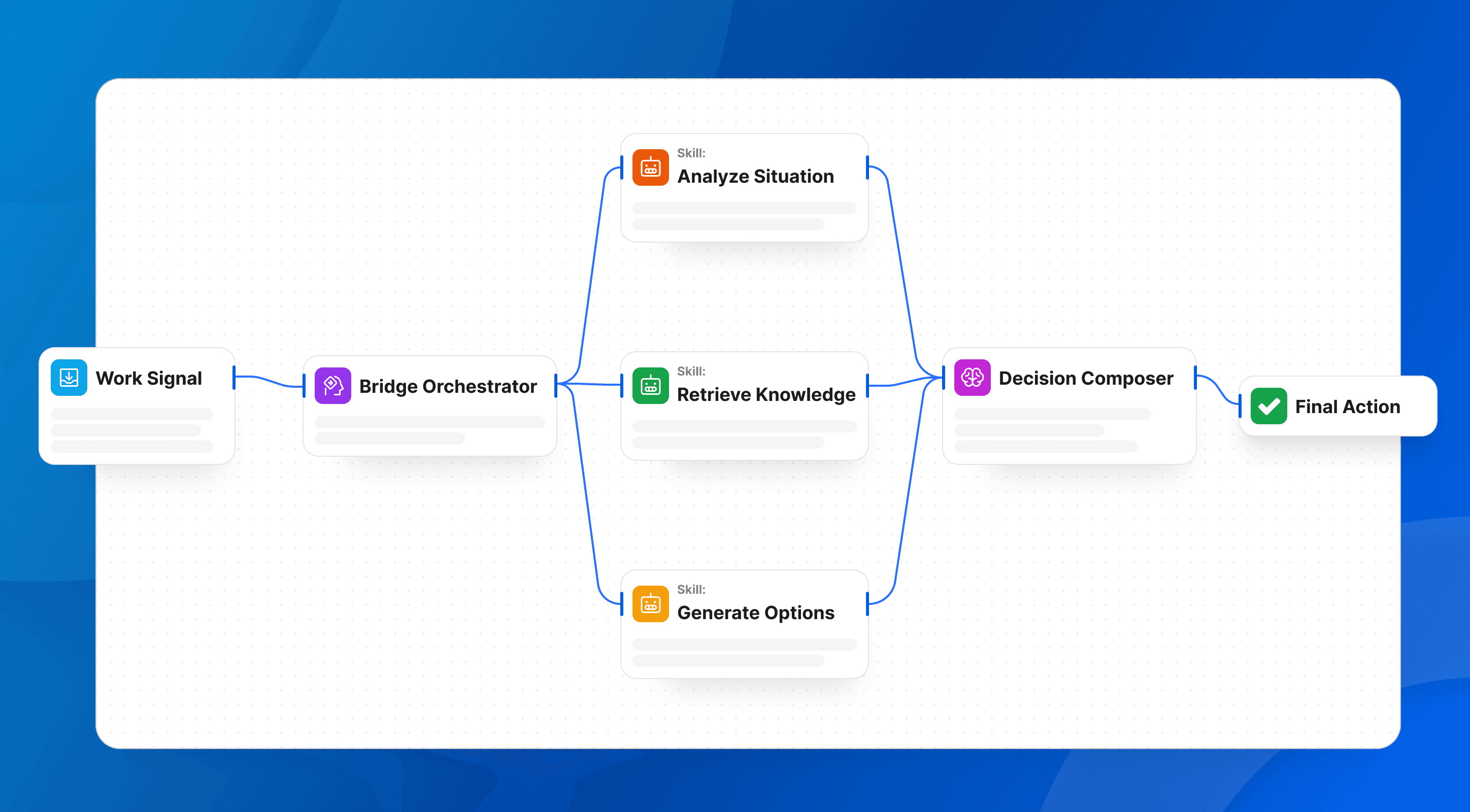
Underneath the board sits an authored execution graph rather than a hidden one: teams define typed nodes and the state checkpoints between them, and a run starts from a domain event inside BridgeApp or from a schedule, not from someone remembering to trigger a script. Every run stays queryable after the fact — what fired, what each node returned, where it stalled — so a pipeline that misbehaves at 3am leaves a trail instead of a silent gap in the log.
BridgeApp is built as a production engine rather than a demo: the board itself is the workflow, modeled as a directed graph where each task's work is serialized, deduplicated, and - critically - resumable from a crash instead of quietly failing and restarting from zero. Subagents run server-side and in parallel, each with its own durable transcript and bounded depth, timeouts, and token limits. A background memory layer deduplicates facts, resolves conflicts, and retires outdated information across agents automatically.
Retrieval works the same way underneath: documents are versioned and re-chunked automatically on publish, so an agent querying company knowledge isn't working off a stale snapshot from three releases ago, and results are reranked and scoped per agent — the same access boundary that governs tool calls applies to what an agent is allowed to read. Knowledge stays current without anyone scheduling a manual reindex.
Agents are configured through a visual no-code builder - prompt, variables, knowledge sources, skills - with access to all major AI models on the market, not just one provider, with typed retries and automatic failover if a provider has an outage. A caching and compaction layer keeps long agent conversations materially cheaper per token than a naive request loop. Which tools an agent can call is controlled by a centrally audited policy, and execution happens inside isolated, sandboxed environments with short-lived credentials - and none of this ships as a fixed template: teams design the workflow that fits how they work, and can run it entirely on-premise if the codebase can't leave company infrastructure.
Magic Coder by BridgeApp is the autonomous coding agent built on these foundations. New repositories are indexed into a queryable code graph so the agent edits the files that actually matter instead of producing a plausible-looking diff in the wrong place.
The work in BridgeApp split across roles - planning, implementation, and code review - so a plan is approved by a human before implementation starts, and the implementation is checked against that plan before it ever reaches a pull request. An important example: CI detects a failing test → a task is created and assigned to the relevant agent role → the agent investigates and proposes a plan → once approved, it implements the fix and opens a pull request → the reviewer agent checks the implementation against the plan → the task moves to Waiting for Merge, where a human makes the final call. Teams running this in production report throughput moving from roughly 3 to 50 pull requests per engineer per week, at close to a tenth of the cost of the equivalent human time.
Сost and throughput are really the same lever pulling on time-to-ship from two directions: A tenth of the cost means a team can afford to run the plan-implement-review cycle on far more tasks in parallel instead of queuing them behind whichever engineer has bandwidth this sprint; sixteen times the pull requests per engineer means the queue itself gets shorter. The net effect shows up less in any single commit and more in what a backlog looks like a month in: a task that used to sit for two sprints waiting for someone to pick it up can move from Planning to Waiting for Merge inside a day once an agent role is assigned to it — not because any individual step got instant, but because the bottleneck was never the code itself, it was waiting.
Organizations with mature DevOps practices tend to succeed more with AI agent adoption; low maturity leads to more risk and lower ROI.
Tooling Landscape: Free, Open Source, and Paid Software
Most automation stacks blend tools that come in various forms - free, open source, freemium, and commercial - the same way most teams run Microsoft Office instead of writing their own word processor.
Free and open source: Git, Jenkins, GitLab CE, Argo CD, Kubernetes, Terraform, Ansible - freedom to run and modify without licensing fees. Paid and enterprise: GitHub Enterprise, GitLab Premium, Datadog, New Relic - support SLAs and reduced ops overhead in exchange for a subscription. Free software grants full access to the underlying implementation; freemium tools may lock features behind a paywall - which is exactly why most stacks blend both instead of picking one camp.
A practical pattern: standardize on open source pipelines for the core, then layer in a unified orchestration platform like BridgeApp so engineering, QA, and product share a single workspace instead of the usual six or seven disconnected tools. BridgeApp coordinates around the CI/CD engines, compilers, and repositories teams already rely on rather than replacing them, and its model-agnostic agent layer means switching AI providers later doesn't mean rebuilding the pipeline. The DevOps tooling market is estimated at roughly $14.8 billion in 2026, growing at 18.4% CAGR.
Best Practices for Implementing Development Automation
- Start incrementally - automating every SDLC stage at once produces brittle workflows.
- Assess current workflows and identify where teams repeat the same manual steps every sprint.
- Prioritize high-friction tasks - automated builds, linting, and unit testing deliver fast ROI with low risk.
- Match tools to your stack and verify your CI/CD platform supports your languages natively.
- Pilot with one team, get early wins, then scale.
- Enforce governance - embed coding standards, branching policies, and audit trails directly into pipelines.
- Centralize visibility. Use an orchestration platform like BridgeApp so tasks, plans, and agent handoffs stay visible in one tracker instead of scattered across separate tools.
- Upskill continuously on CI/CD, IaC, and AI agent supervision.
Common Pitfalls and Limitations of Automation
- Automating unstable processes. Flaky tests and inconsistent build environments make pipelines unreliable.
- Neglecting test quality. Slow or flaky tests erode trust in CI gates faster than no tests at all.
- Ignoring pipeline security. Deployment without dependency scanning or secrets management opens the door to vulnerabilities.
- Lack of ownership. When no team owns automation scripts, broken pipelines get ignored until failures cascade.
- Tool sprawl. Different teams pulling in different CI, monitoring, and ticketing tools without coordination creates duplication - teams that consolidate onto a single workspace report cutting context switching by as much as 60%.
- Tasks requiring complex product judgment or nuanced risk tradeoffs still need human oversight. Automation handles the repeatable; humans handle the novel.
- Mitigation: standardize conventions, document flows, and use platforms like BridgeApp to keep agent roles, handoff rules, and task history in one place so existing tools, bots, and agents stay coordinated rather than siloed.
Key Takeaways and Other Resources
- Automation accelerates delivery and reduces repetitive work, but it must be guided by sound engineering principles, not a substitute for understanding how the underlying system behaves.
- The automation stack spans IDEs and compilers, collaboration tools, CI/CD, IaC, and AI orchestration platforms like BridgeApp.
- Start with one or two high-impact areas - automated testing and CI - before layering in AI-driven flows.
- The teams that ship fastest aren't the ones that automate the most; they're the ones that automate the right things first.
For other resources, explore documentation for GitHub Actions, Terraform, Kubernetes, and BridgeApp's product pages for details on AI agents, flows, and Magic Coder.
FAQ
Is this kind of automation only for large enterprises?
Not anymore. Cloud-based CI/CD platforms and AI agents have made automation accessible to teams of any size. Even a two-person startup can benefit from automated tests, simple pipelines, and an orchestration layer like BridgeApp to coordinate work. Most tools in this space offer free tiers or open source editions.
Does automation work with all programming languages?
Most CI/CD and testing platforms are language-agnostic, supporting multiple languages through plugins, container images, or custom scripts. Polyglot microservice architectures are routinely automated using shared pipelines with language-specific job steps.
How does automation affect developer jobs?
It reduces manual, repetitive work - builds, basic testing, boilerplate - so developers spend more time on design, complex debugging, and problem-solving. Skills like system architecture, observability, and AI-agent supervision (reviewing and approving a plan before Magic Coder's agents implement it) grow in importance; the role evolves rather than disappears.
Can I automate legacy applications that weren't designed for DevOps?
Yes - wrap them with scripts, containerize when feasible, and gradually integrate into CI/CD pipelines. You don't need to rewrite everything at once. A workspace like BridgeApp can manage runbooks, approvals, and documentation around legacy release processes while modernization progresses incrementally.
Where does BridgeApp fit into an existing toolchain?
BridgeApp is an AI-native workspace that sits above your existing tools rather than replacing them. It connects chats, task boards, documents, databases, and AI agents so that planning, implementation, and review happen inside the same tracker your team already uses, with agents like Magic Coder by BridgeApp assigned to tasks the same way a developer would be. None of this ships as a fixed workflow - teams configure the same agent, task, and document building blocks to match their own review process, choosing whichever AI model fits each role and deploying on-premise if the codebase needs to stay inside company infrastructure.
Underneath, the engine is built for production rather than demos: crash-resumable orchestration, isolated and audited execution, and centrally governed tool access mean a failed run doesn't silently disappear and a misconfigured agent can't quietly gain access it shouldn't have. Organizations keep their current editors, compilers, repositories, and CI/CD engines; BridgeApp coordinates the handoffs between them and keeps a readable audit trail of what each agent did and why. Think of it as the orchestration hub, not a replacement for your runtime or build system.