BlogIndustry Insights
Best Claude Tag Alternatives for Team Collaboration in 2026

BridgeApp Team
10 min read
Claude Tag landed in late June 2026 as Anthropic's answer to a question every team has been asking: can AI actually work alongside us, not just for us? Built on the Opus 4.8 model, Claude Tag operates as a shared AI teammate inside a Slack channel, breaking tasks into stages, surfacing context from a conversation, and even taking initiative when a thread goes quiet - an ambient mode that makes it feel less like a chatbot and more like a coworker.
But not every team wants to be locked into Anthropic's cloud, pay enterprise-tier pricing, or limit their agent to Slack alone. Whether you need to deploy on your own machine, access different models, or connect AI across different channels beyond Slack, there are strong alternatives worth evaluating in mid-2026.
Here's a breakdown of the six best options available right now.
How We Chose the Best Claude Tag Alternatives
Every tool on this list was evaluated against the criteria that matter most when replacing or supplementing Claude Tag:
- Deployment flexibility - cloud, on-premise, hybrid, or self-hosted options
- AI model access - whether you're locked to a single provider or can choose your own
- Integration capabilities - tool access across chat, email, CRM, project management, and more
- Team collaboration features - shared memory, context persistence, and multi-user workflows
- Pricing structure - per user, per agent, credits, or flat subscription
- Security and compliance - data isolation, audit trails, credential control, and the ability to verify permissions at a granular level
The focus was on solutions that deliver genuine team-based AI collaboration, not just a reactive Q&A bot you tag in a channel.
Top 6 Claude Tag Alternatives for Team Collaboration
1. BridgeApp
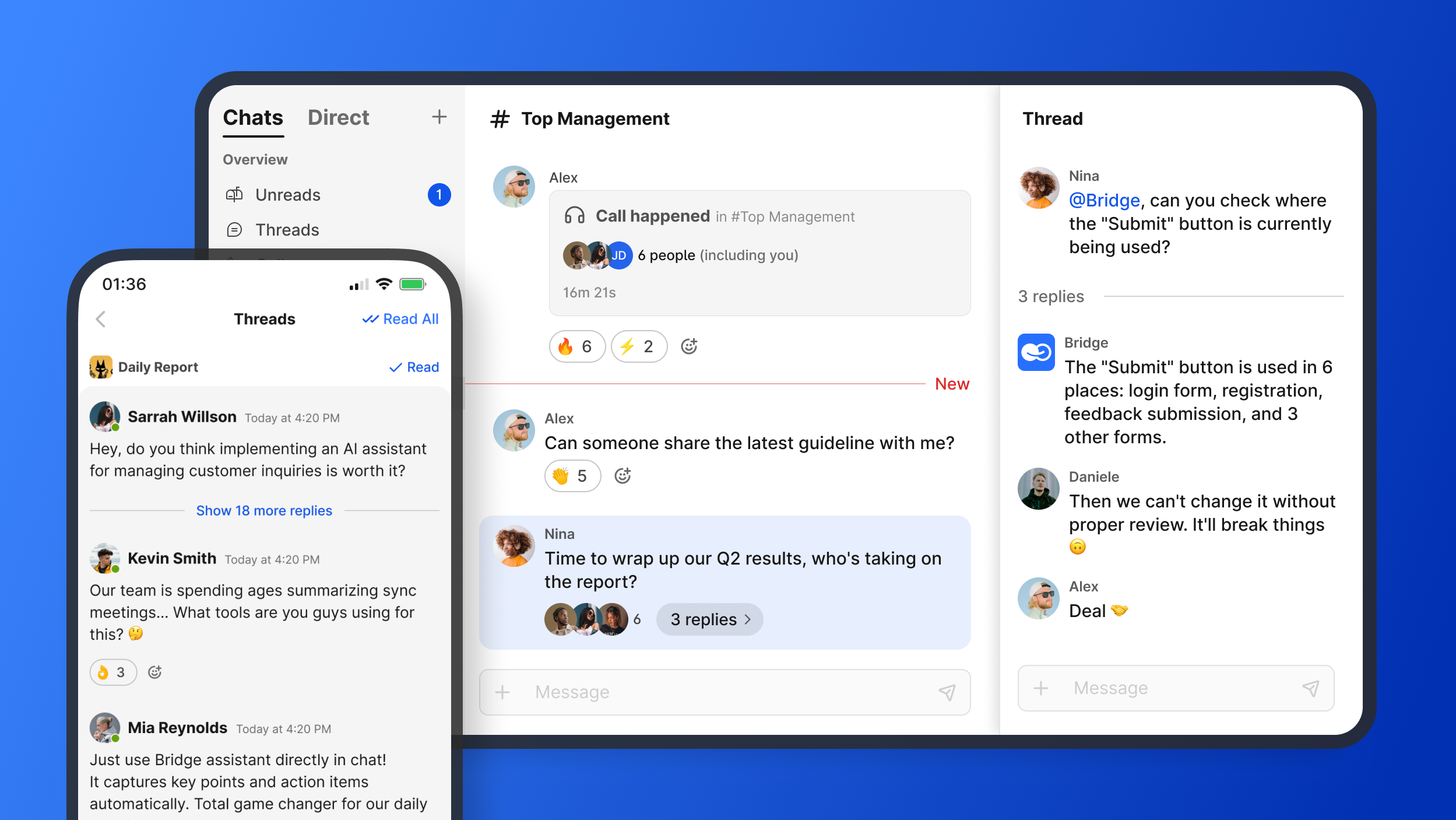
BridgeApp is an AI-native unified workspace that combines team chat, task management, documents, databases, and custom AI agents with a no-code flow builder - all in a single platform.
Why It Stands Out
Unlike Claude Tag, which adds an AI layer on top of Slack, BridgeApp replaces the fragmented tool stack entirely. You get sync and async chat, a full project tracker with board and backlog views, a rich document editor, structured databases, and AI agents that plug directly into all of it. The agent builder uses a visual flow editor where you describe skills through reusable blocks - no code required.
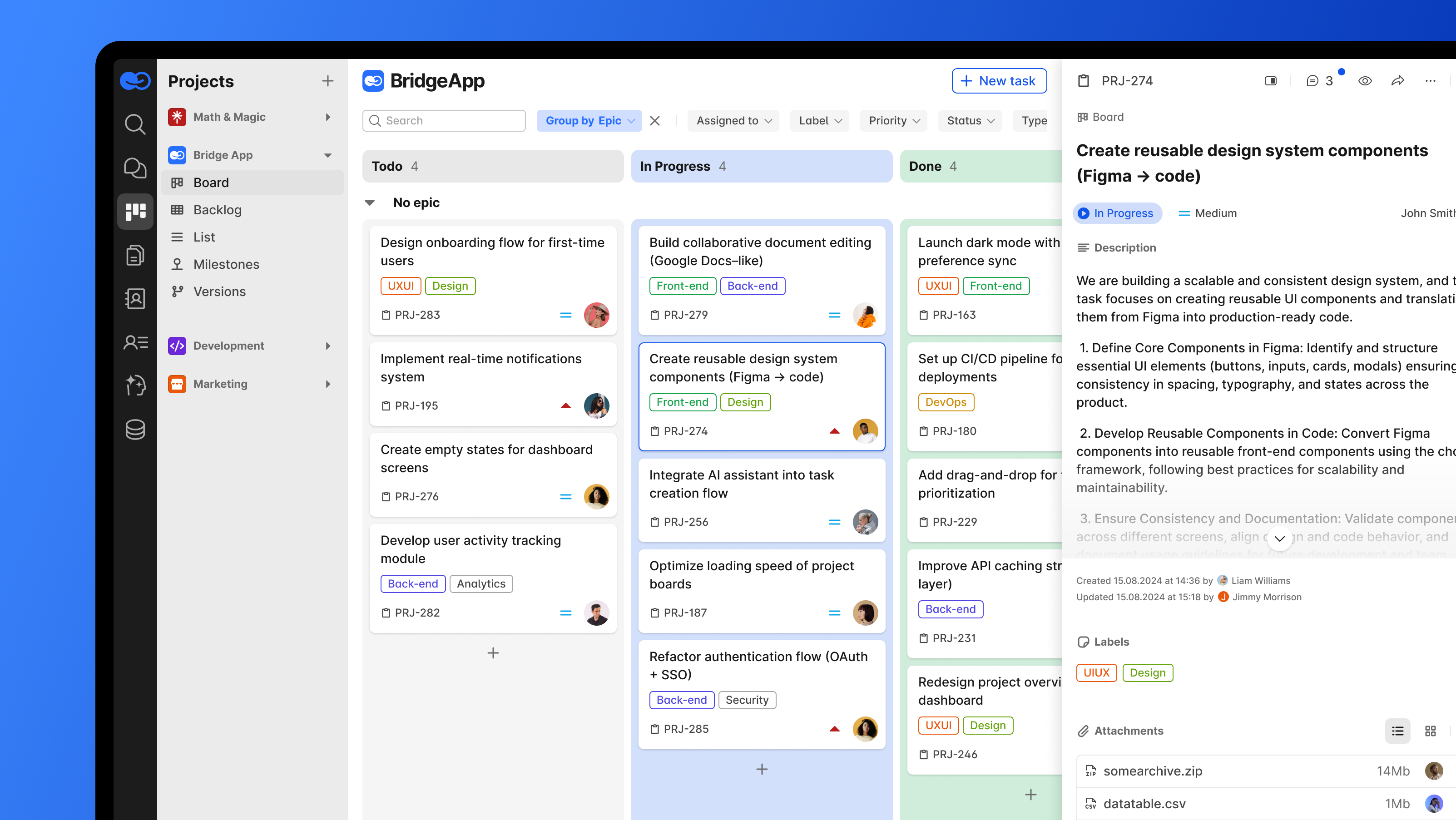
BridgeApp provides access to all major AI models on the market -the platform is model-agnostic, allowing each agent to run a different underlying AI model depending on the task. Review checkpoints are placed between each stage, and the company says human team members can intervene at defined approval points. Errors, it says, are intended to be caught at the next checkpoint rather than after code reaches production. Pick a ready-made template - a virtual team with a best-practice task lifecycle - or customize everything to fit your workflow. Users can add workflow stages, AI roles, or human checkpoints, and assign LLMs per role - start with best practices, adapt later.
Best For
- Teams wanting a complete workspace replacement with built-in AI agents
- Organizations that need on-premise, private cloud, or hybrid deployment for data sovereignty
Key Strengths
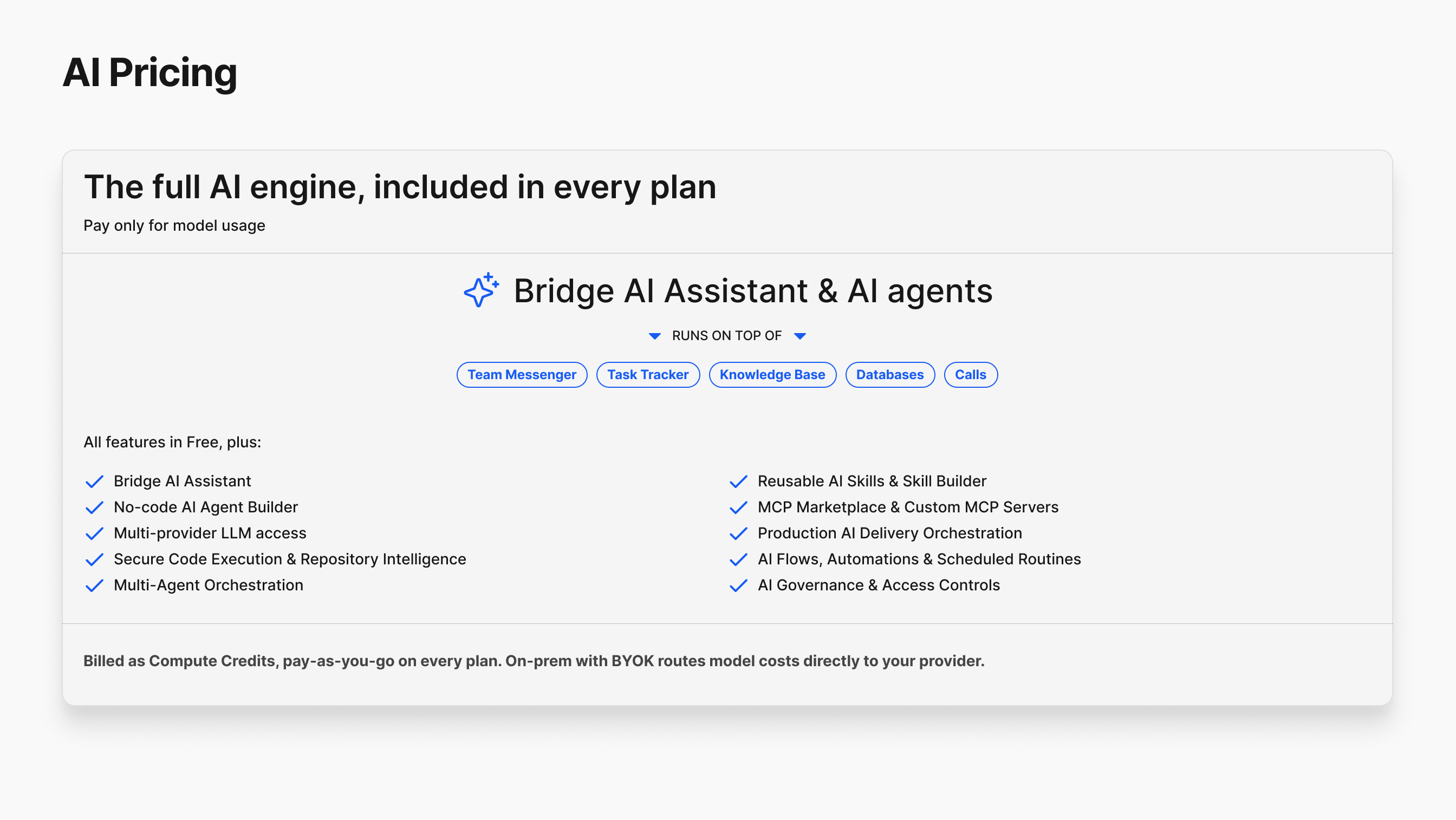
- No-code AI agent builder with visual flow editor, version control, and knowledge integration
- Cloud, on-premise, and hybrid deployment options
- Integrated chat, tasks, documents, and databases - one platform instead of five
- Agents built from Prompt + Variables + Knowledge + Flows; each agent reads assigned documents and data to stay contextual
- Supports Telegram integration via bot token, with more connections on the roadmap
2. Junior
Junior positions itself as an approval-gated AI coworker for Slack and Microsoft Teams, designed to keep a human in the loop at every step.
Why It Stands Out
Where Claude Tag can take initiative automatically, Junior requires explicit approval before executing any task. Every action the agent proposes - drafting an email, updating a CRM record, scheduling a meeting - goes through a one-click approval gate. This makes it a strong fit for teams in regulated environments or those that aren't ready for fully autonomous agents.
Best For
- Teams requiring direct human oversight before any AI action is taken
- Sales, marketing, and operations workflows where errors carry real cost
Key Strengths
- One-click approval system for all AI-generated tasks
- Native integration with Slack and Microsoft Teams
- Connects to CRM, advertising platforms, and operations tools
Possible Limitations
- Approval gates add friction and may slow down workflow automation
- Limited to specific operational use cases rather than general-purpose AI assistance
3. Open Claude Tag
Open Claude Tag is an open source alternative that replicates core Claude Tag functionality while giving you full control over the code, deployment, and data.
Why It Stands Out
The entire source code is available under an MIT license, which means your team can fork the repo, customize agent behavior, swap in local models via Ollama or connect to mcp servers, and deploy on your own infrastructure. It supports channel-native shared memory and can work with markdown files for knowledge base configuration.
Best For
- Development teams comfortable managing their own infrastructure
- Organizations that need complete data control and cannot send data to third-party clouds
Key Strengths
- MIT license allowing full customization - branch, modify, and ship your own version
- LLM-agnostic: supports Anthropic, OpenAI, and local models from different providers
- Shared context and memory across channels, similar to Claude Tag's default behavior
- Works as a Slack app or can be adapted as a code extension for other platforms, alongside tools like cursor for development workflows
Possible Limitations
- Requires significant technical setup and ongoing maintenance
- No enterprise support or SLA - you're relying on community contributions
- UX polish lags behind managed cloud solutions
4. Lindy
Lindy is an AI agent builder platform that lets you assemble custom automations from a library of pre-built integrations and agent behaviors.
Why It Stands Out
Rather than offering a single shared agent like Claude Tag, Lindy lets you build specialized agents with distinct skills and assign each one to specific workflows. You can create an agent that handles support tickets, another that monitors ad spend, and a third that drafts weekly reports - each with its own configuration and tool connections.
Best For
- Technical teams wanting granular control over AI workflow automation
- Power users who prefer building and tuning agent behaviors themselves
Key Strengths
- Large library of pre-built integrations across CRM, email, project management, and more
- Custom agent workflow assembly with detailed control over each step
- Can connect to multiple data sources and write outputs to various destinations
Possible Limitations
- Credit-based pricing can get expensive on complex, multi-step workflows
- Requires manual agent configuration - there's no ambient "just works" setup
- Less focused on real-time team chat collaboration compared to Claude Tag
5. Slackbot by Salesforce
Salesforce overhauled Slackbot in early 2026 with over 30 new features, transforming it from a basic assistant into an agentic AI deeply integrated with the Salesforce ecosystem.
Why It Stands Out
For teams already invested in Salesforce and Slack, Slackbot requires zero additional setup. It pulls CRM records into a conversation when a customer name comes up, surfaces relevant data proactively, and understands the full context of messages, files, and thread history across your workspace.
Best For
- Salesforce customers already using Slack who want seamless CRM integration
- Sales and customer success teams that need real-time company and contact data in chat
Key Strengths
- Native Slack integration - no extra app to install or manage
- Direct connection to Salesforce CRM, pulling records and insights into any thread
- Available on Business+ and Enterprise+ plans, with limited access rolling out to Free and Pro tiers
Possible Limitations
- Heavily limited to the Salesforce ecosystem - less useful if your stack is elsewhere
- Fewer customization options than standalone agent platforms
- You don't get to decide which model powers it or how data flows through the system
6. ChatGPT in Slack
OpenAI's ChatGPT integration for Slack provides a reactive AI assistant that responds when mentioned in channels and direct messages.
Why It Stands Out
ChatGPT in Slack keeps things simple. There's no autonomous behavior, no proactive surfacing - it responds when a person tags it. This makes it predictable and easy for a whole team to adopt without training or onboarding.
Best For
- Teams wanting basic AI assistance without autonomous features
- Organizations that prefer reactive over proactive AI and want to drop in an assistant quickly
Key Strengths
- Familiar ChatGPT experience inside Slack - low friction for any user
- Requires @mentions, giving the team full control over when the agent activates
- Good for drafting, summarization, Q&A, and brainstorming in any slack channel
Possible Limitations
- No autonomous actions, team-level memory, or persistent context across posts
- Limited integration with business tools beyond basic Slack functionality
- Not built for multi-step workflows or task management
Quick Comparison of the Best Claude Tag Alternatives
| Alternative | Best For | Deployment | Model Flexibility |
|---|---|---|---|
| BridgeApp | Complete workspace replacement with AI agents | Cloud, on-premise, hybrid | All major models |
| Junior | Approval-controlled team automation | Cloud (SaaS) | Provider-selected |
| Open Claude Tag | Self-hosted, customizable solutions | Self-hosted | Any model (BYOK) |
| Lindy | Custom agent building for power users | Cloud (SaaS) | Multiple providers |
| Slackbot | Salesforce-integrated workflows | Cloud (Salesforce) | Locked |
| ChatGPT in Slack | Simple, reactive AI assistance | Cloud (OpenAI) | GPT models only |
How to Choose the Right Claude Tag Alternative
Choose Based on Deployment Requirements
If your organization handles sensitive data or operates in a regulated industry (finance, healthcare, government), deployment flexibility matters more than anything. BridgeApp and Open Claude Tag both offer in-house deployment - on-premise or private cloud - so data never leaves your infrastructure. For teams comfortable with SaaS, Junior, Lindy, and ChatGPT in Slack all work without you managing any infrastructure.
Choose Based on Integration Needs
Look at your existing tool stack. If Salesforce is the center of your workflow, Slackbot is the obvious pick. If you need an agent that connects across chat, tasks, documents, and databases in one place, BridgeApp eliminates the need to wire together separate tools. For teams that want to connect a specific set of external tools, Lindy's integration catalog gives the most granular control.
Choose Based on Team Technical Expertise
Not every team has engineers who can maintain a self-hosted agent or build custom flows. If your team needs something that works by default with minimal configuration, ChatGPT in Slack or Slackbot are the fastest to deploy. If you have developers who want to run tests, customize behavior, and manage their own provider keys, Open Claude Tag gives maximum flexibility.
Which Option Is Best for You?
To get a clearer picture of which alternative fits, match your situation to these scenarios:
- Choose BridgeApp if you want a comprehensive workspace that replaces fragmented tooling and need flexible deployment with access to all major AI models
- Choose Junior if you need approval-controlled automation in your existing chat tool and want every AI action to go through a human gate
- Choose Open Claude Tag if you require complete customization, self-hosting, and want to use local models or your own API keys
- Choose Lindy if you need powerful agent building capabilities and want to assign specialized skills to different agents
- Choose Slackbot if you're deeply invested in the Salesforce ecosystem and want zero-setup CRM integration
- Choose ChatGPT in Slack if you want simple, reactive AI assistance that any person on your team can use immediately
The Best Option for Your Team
Claude Tag set a new standard for what AI collaboration looks like inside Slack, but the best alternative for your team depends on how you work, where your data lives, and how much control you need.
The biggest differentiators across these tools come down to deployment flexibility, model access, and whether you want a single-purpose agent or a unified platform. The trend in mid-2026 is clear: teams are moving toward specialized, customizable AI collaboration tools rather than one-size-fits-all assistants.
Start by evaluating your deployment and integration requirements, then match them against the options above. If you want to explore more posts on AI team collaboration and workspace tools, keep an eye on how this space evolves - it's moving fast, and the tools that win will be the ones that adapt to how your team actually works.