BlogIndustry Insights
Developer Velocity: How to Accelerate Software Delivery Without Burning Out Your Team

BridgeApp Team
7 min read

Developer velocity is the sustainable speed at which a team ships high-quality software to production, week after week. In a world where every company races to complete features faster, understanding what actually drives velocity-and what quietly kills it-separates high-performing teams from those stuck in endless sprints.
Dive Deep
- Developer velocity measures system performance (processes, tools, culture), not how many hours a person spends online or lines of code they write.
- Tracking only story points or ticket counts is insufficient in 2026; combine flow metrics like cycle time and lead time with quality indicators such as defect rate and change failure rate.
- AI-native platforms that combine custom AI agents with a governed dev pipeline can meaningfully compress delivery time—but only when execution stays observable and auditable, not just fast.
- Sustainable velocity protects developers from burnout by reducing friction-context switching, tool chaos, unclear requirements-rather than demanding more work.
What Is Developer Velocity (and What It Is Not)?
Let's define it clearly: developer velocity is the rate at which a team reliably turns ideas into running, high-quality software in production. It is a local, team-level metric shaped by codebase, domain, and infrastructure-never a universal speedometer you compare across teams.
- It focuses on outcomes (shipped features, incident-free releases), not activity (commits, hours logged).
- It is sustainable-burst speed that creates technical debt is not velocity.
- In 2026, teams ship weekly app updates, deploy microservices daily, and leverage AI-powered automation as background parts of their pipeline.
Why Modern Teams Track Developer Velocity in 2026
Daily backend deployments and weekly mobile releases are now standard. Leadership needs predictable delivery to forecast launch windows, allocate resources, and measure ROI. Organizations that improve developer velocity consistently out-iterate competitors, respond to security events faster, and build new technologies before the market catches up.
Tracking velocity also surfaces developer experience data: fewer blockers, clearer requirements, and faster code review correlate with higher satisfaction. In AI-heavy projects, velocity determines how quickly teams experiment with new models and architectures.
How to Measure Developer Velocity Without Misusing It
No single metric captures the full picture. Teams should combine:
- Lead time (idea → production)
- Cycle time (work started → done)
- Deployment frequency
- Change failure rate (DORA metrics)
Story points are inherently subjective; time-based flow metrics give a more reliable sign of actual throughput. Pair quantitative dashboards (Git, CI/CD, project trackers) with qualitative signals like developer NPS and post-incident reviews. For example, one analysis of a GitHub Copilot rollout using Harness SEI found a 10.6% increase in pull requests and a 3.5-hour reduction in average cycle time during the month Copilot was active—a reminder that flow metrics, not story points, are what actually move.
Common Pitfalls: When Developer Velocity Becomes a Vanity Metric
Many organizations misused velocity as a performance scorecard between 2020 and 2024, and the community on platforms like reddit still debates the damage. Classic anti-patterns include:
- Comparing velocity across different scrum teams with different contents and contexts.
- Rewarding higher points regardless of quality or error rates.
- Treating velocity drops as individual failure rather than a systemic sign.
- Ignoring bug counts, rollback frequency, and customer outcomes.
The "Sugar Rush" study showed that AI-boosted code output jumped 281% initially, but complexity rose 41% and static warnings increased 30%-future velocity dropped sharply.
What Slows Developer Velocity in Real Teams
Most velocity problems are systemic. Unclear requirements, shifting priorities, and missing acceptance criteria waste days. Fragmented tools force developers to jump between separate chat apps, task boards, and documentation platforms-each switch draining cognitive capacity.
Technical debt from years of quick fixes makes every change riskier. Flaky CI tests and unreliable staging environments turn simple changes into multi-day efforts. Constant context switching, excessive meetings, and lack of deep work time catch teams off guard and slow delivery across every layer.
Practical Ways to Improve Developer Velocity
Velocity improves when you remove friction, not when you push developers to hustle harder:
- Invest in clearer product discovery-lightweight specs, decision logs, early stakeholder alignment.
- Standardize CI/CD pipelines so most changes follow one automated path from pull request to rollout.
- Allocate 15–25% of sprint capacity to refactoring and debt repayment.
- Build reusable components, enforce coding standards, and maintain strong documentation.
- Measure each improvement over 3–6 months using cycle time, deployment frequency, and defect leakage.
How BridgeApp's Unified Workspace and Governed Dev Pipeline Take Teams from 3 to 50 PRs a Week
BridgeApp is an AI-native unified workspace that combines team chat, tasks, documents, databases, and custom AI agents-available as cloud or on-premise deployment. By consolidating everything a developer touches in a single day into one platform, BridgeApp eliminates the context-switching that silently destroys flow.
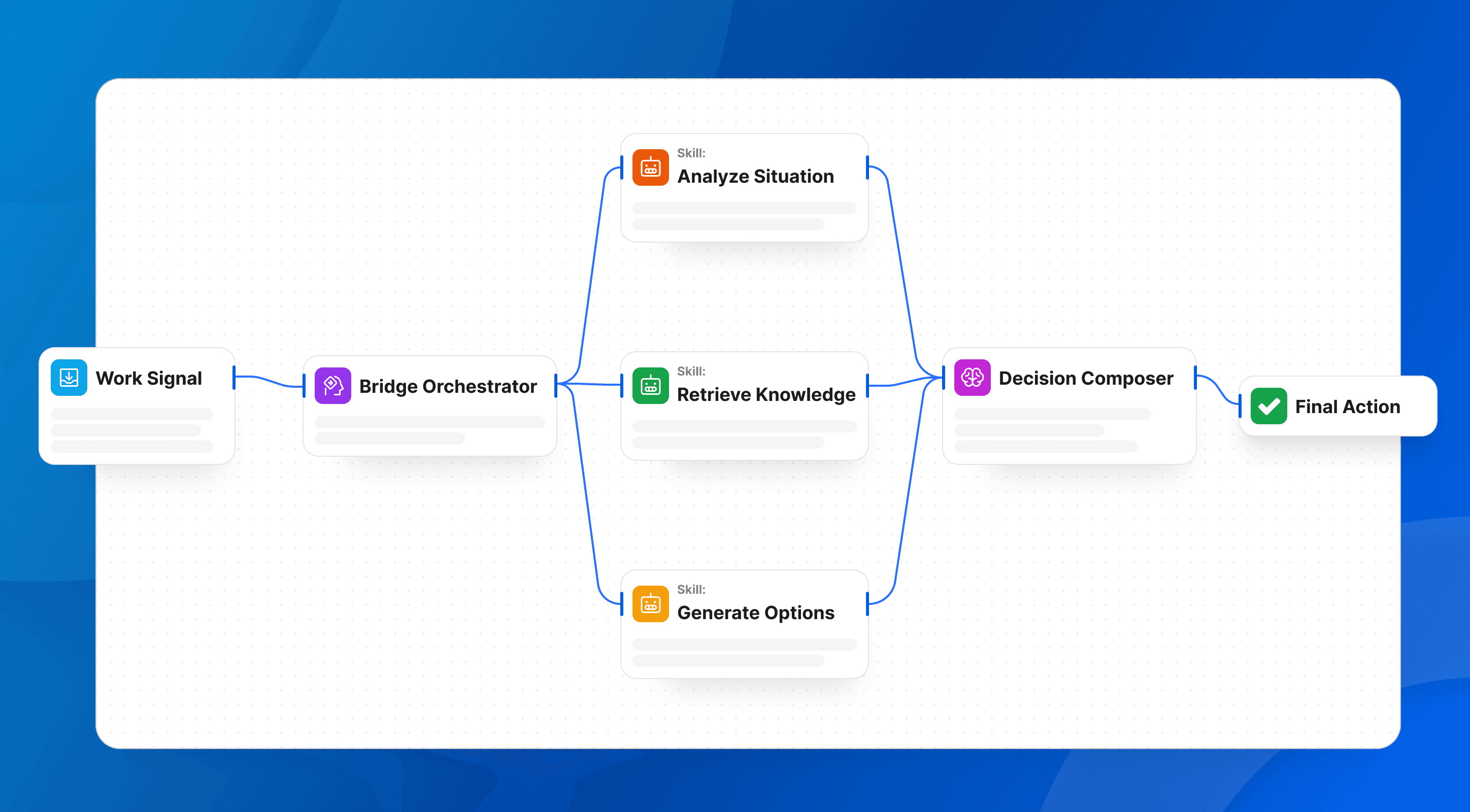
The dev execution pipeline works like this: tasks (bugs, features, epics) in BridgeApp carry specs, design docs, and discussions that feed directly into AI agents. Custom flows automate repetitive work-generating test data, summarizing requirements, posting deployment notifications. BridgeApp provides access to all major AI models through a no-code flow editor, so engineering leaders can build tailored automations without writing glue code.
Combining BridgeApp's unified workspace, custom AI agents, and dev pipeline cuts manual coordination and hand-offs at scale: on the underlying Magic Coder engine, execution runs roughly 10x cheaper than equivalent human time, and teams that adopt the full pipeline move from around 3 to 50 pull requests per engineer per week.
AI Agents and Autonomous Coding: Rethinking Developer Tools in 2026
The developer toolchain has evolved from IDE plugins to fully agentic systems that read entire codebases and take actions via terminals. Typical use cases include triaging error logs, scaffolding new services, refactoring legacy modules, and generating integration tests.
The difference between chat-style assistance and agentic execution is critical: agents call tools, interact with repos, and follow multi-step plans. Magic Coder by BridgeApp exemplifies this-it reads repos, proposes plans, edits files via diffs, and runs commands while staying aligned with team standards stored in the workspace. Safety remains paramount: every change moves through an explicit Plan Review and a Local Code Review before a pull request is even opened, and the pipeline deliberately stops at "Waiting for Merge"—a human always owns the merge decision, and agent tool access is granted centrally, not self-expanded.
Teams that fold agents into a governed dev pipeline now are the ones setting the pace the rest of the industry will be measured against over the next few release cycles.
Building a Culture That Sustains High Developer Velocity
No amount of tools can compensate for a culture that punishes experimentation. Psychological safety matters: every person on the team must be able to surface risks or admit uncertainty without blame. Regular blameless post-incident reviews, weekly technical share sessions, and quarterly retrospectives focused on system improvements-not individual performance-build this foundation.
Leadership should model healthy practices: limiting after-hours deployments, protecting focus time, and celebrating improvements to developer experience. When decisions and standards live in a shared workspace like BridgeApp, onboarding is smoother and learning happens faster across the company.
Getting Started: A 90-Day Plan to Improve Developer Velocity
A simple three-phase roadmap for engineering leaders who want tangible success by end of quarter:
Days 1–30 (Discovery): Map your current workflow from idea to production. Collect baseline metrics-cycle time, deployment frequency, incident count. Survey developers about top friction points. Pull the last 2-3 retros for recurring blockers-these become your priority list for the pilot phase.
Days 31–60 (Execution): Pilot BridgeApp for one product team. Streamline their CI/CD path. Introduce one or two AI agents to remove repetitive tasks. Start tracking improvements against your baseline.
Days 61–90 (Scaling): Iterate based on data and feedback. Standardize successful practices across projects. Extend the improved dev execution pipeline to additional teams and agree on shared velocity goals. By this point, most teams see measurable gains that justify broader rollout.
FAQ
These questions cover practical concerns not fully addressed above.
How often should we measure and review developer velocity?
Most agile teams review velocity every sprint (1–2 weeks) and run deeper trend analysis monthly or quarterly. Track a small set of stable metrics-cycle time, deployment frequency, change failure rate-and discuss them in retrospectives. Avoid adjusting processes after every minor fluctuation; wait for clear patterns across several sprints before changing your pipeline.
Can small teams of 5–10 developers benefit from tracking velocity?
Small teams often see the biggest returns. A few targeted improvements-automating tests, centralizing communication in one platform like BridgeApp-can dramatically reduce coordination overhead. Keep metrics lightweight: simple charts of lead time, weekly deployments, and bug counts. The goal is fast learning cycles and clear visibility, not formal compliance dashboards.
How do we prevent developer velocity from being misused as an individual performance metric?
Velocity should be owned at the team or system level. Codify this in engineering guidelines and reinforce it during performance review cycles. Frame discussions around "what is slowing our system down?" rather than "who is not fast enough?" Use qualitative feedback and peer reviews for individual growth conversations while leaving quantitative velocity metrics for planning.
Where do AI coding agents fit into our development process without compromising safety?
AI coding agents like Magic Coder by BridgeApp should be integrated as controlled tools inside your existing dev execution pipeline-not as autonomous deployers to production. A safe workflow: the agent analyzes a repo, proposes a plan, prepares diffs, and runs tests. Human developers retain final review and merge authority. Scope agent access to specific repositories and log all actions for auditing.
Which tools should we consolidate first to see a quick boost in developer velocity?
Start by unifying chat, tasks, and documentation into a single workspace so developers stop searching across separate apps. Integrate CI/CD notifications and decision logs into that same space. Once communication and planning are centralized, incrementally add AI agents and automations to remove manual steps like status updates or release notes. This staged approach typically yields visible improvements within one or two release cycles.