BlogHow-To Guides
What Is Vibecoding?

Maria ZhuHead of content
11 min read

Vibecoding is changing how development teams build software. Instead of writing every function by hand, developers describe what they want in plain language and let AI do the heavy lifting. Here is everything you need to know about this approach, how it works, and whether it belongs in your workflow.
Diving into Intent-Driven Software Development with AI Agents
- Vibe coding refers to a software development paradigm where developers describe intent using natural language prompts and AI coding tools generate, refine, and iterate the code. The human steers; the AI implements.
- Vibe coding was coined by Andrej Karpathy in February 2025, but it builds on years of AI-assisted development, from autocomplete to full code generation with large language models.
- Platforms like BridgeApp combine team chat, tasks, documents, and AI agents in one workspace, making it practical to facilitate vibe coding in real team environments rather than solo experiments.
- The benefits are significant: rapid prototyping, lower cognitive load, broader participation in software creation. But the risks are equally real: security vulnerabilities, technical debt, and potential loss of codebase understanding.
- Vibecoding works best when paired with disciplined code review, automated testing, and clear governance, treating AI output as a draft that always needs human validation.
What Is Vibecoding?
Vibecoding is an AI-assisted development approach where humans specify the desired behavior of software and AI tools handle most of the technical implementation. Instead of composing logic line by line in a code editor, developers describe what the application should do, how it should feel, and what constraints it must satisfy. The AI then generates working code based on those instructions.
This paradigm relies heavily on large language models trained on vast code repositories, AI coding assistants integrated into development environments, and increasingly autonomous AI agent systems that can plan, edit files, and run tests. Vibe coding replaces traditional manual coding with a focus on communication of intent. Prompt-driven development is a key principle of vibe coding.
Think of it this way: you tell an AI coding platform "build a React dashboard that shows sales metrics in charts, supports user login, export to CSV, and includes a dark mode toggle," and the AI scaffolds the entire application. You review, adjust, provide feedback, and iterate. The human role shifts from typing syntax to making design decisions, enforcing quality, and guiding the AI toward the right outcome. Vibe coding emphasizes outcome over technical implementation.
Origins and Evolution of Vibecoding
The term vibe coding appeared in developer communities in early 2025. Andrej Karpathy, former Tesla AI leader and OpenAI co-founder, coined the phrase in a February 2025 post on X (formerly Twitter), describing a workflow where you "see stuff, say stuff, run stuff, and copy paste stuff, and it mostly works." He suggested developers embrace exponentials and forget about manually typing every line and instead let AI handle the bulk of implementation.
But vibecoding didn't emerge from nothing. Its evolution tracks the broader arc of AI capability growth in software development:
| Period | Development |
|---|---|
| Pre-2015 | Classic IDE tooling, autocompletion, static analysis |
| 2019–2020 | First LLM-based coding assistants, ML-powered suggestions |
| 2021–2023 | GitHub Copilot, ChatGPT, Replit Agent, Cursor launch; multi-line code generation becomes mainstream |
| 2024–2025 | Agentic AI and multi-file reasoning mature; Karpathy coins "vibe coding" |
| 2025–2026 | Vibecoding moves from throwaway weekend projects toward production workflows |
Collins Dictionary named "vibe coding" its Word of the Year in November 2025, reflecting how deeply the concept had entered mainstream vocabulary. Community experiments and startup prototypes in 2024–2025 demonstrated that AI generated code could build full applications rather than just code snippets, inspiring serious tooling investment around vibecoding.
How Vibecoding Works in Practice
The typical vibecoding loop follows a predictable pattern: clarify intent, describe it in natural language, let AI tools generate or modify code, review and refine, then repeat. Feedback loops for vibe coding are very short, allowing immediate iteration. AI-native editors support vibe coding development by embedding generative AI directly into the coding surface.
How does vibe coding differ from using a standard autocomplete? The difference is scope. Where autocomplete suggests a line, vibecoding delegates entire features. Agentic AI systems can plan multi-step tasks, read files across a repository, edit through diffs, run stuff like tests and linters, and adjust code until the output matches the developer's intent.
Real-world vibecoding still requires human oversight. Developers verify logic, run tests, enforce security practices, and make final design decisions. The AI handles boilerplate and repetitive tasks; the human handles judgment.
Core Building Blocks: Prompts, Context, and Agents
Three ingredients make vibecoding work:
- High-quality prompts that specify frameworks, data models, performance constraints, and edge cases rather than vague goals. "Make a dashboard" produces generic output. "Build a Next.js dashboard with Tailwind CSS, PostgreSQL backend, role-based access, and SSO via Auth0" produces something usable.
- Rich context supplied via repository indexing, linked documents, workspace knowledge bases, or tech stack definitions. The more an AI model knows about your project, the more architecture-aware its output becomes. This is where a unified workspace pays off: when your tasks, documentation, and databases live alongside the coding agent — as they do in BridgeApp, where Magic Coder by BridgeApp reads architecture from the surrounding project context — the model isn't guessing from a bare prompt but working against the actual structure of your codebase and team knowledge.
- AI agents that can plan steps, call tools (file edits, test runners, linters), and adjust code until tests pass. An AI agent can, for example, receive "add SSO to this app," then edit backend routes, update configuration files, and propose integration tests, all without the developer touching the actual coding of each file.
The quality of your prompts directly determines the quality of your output. Treat prompt engineering like you would treat writing a good spec.
Typical Vibecoding Workflow Steps
A concrete vibe coding work session typically follows these steps:
- Choose an AI coding platform and connect it to your repository and project context.
- Define intent and requirements in natural language descriptions. Humans choose architecture; AI writes the implementation.
- Generate initial code. The AI produces scaffolding, components, and logic based on the prompt. This is where the AI can generate code from natural language prompts at scale.
- Iteratively refine. Run the output, identify gaps, paste stuff back as feedback, and let the AI adjust. Developers guide rather than rewrite.
- Validate and deploy. Enforce tests, security scans, and code review before merging.
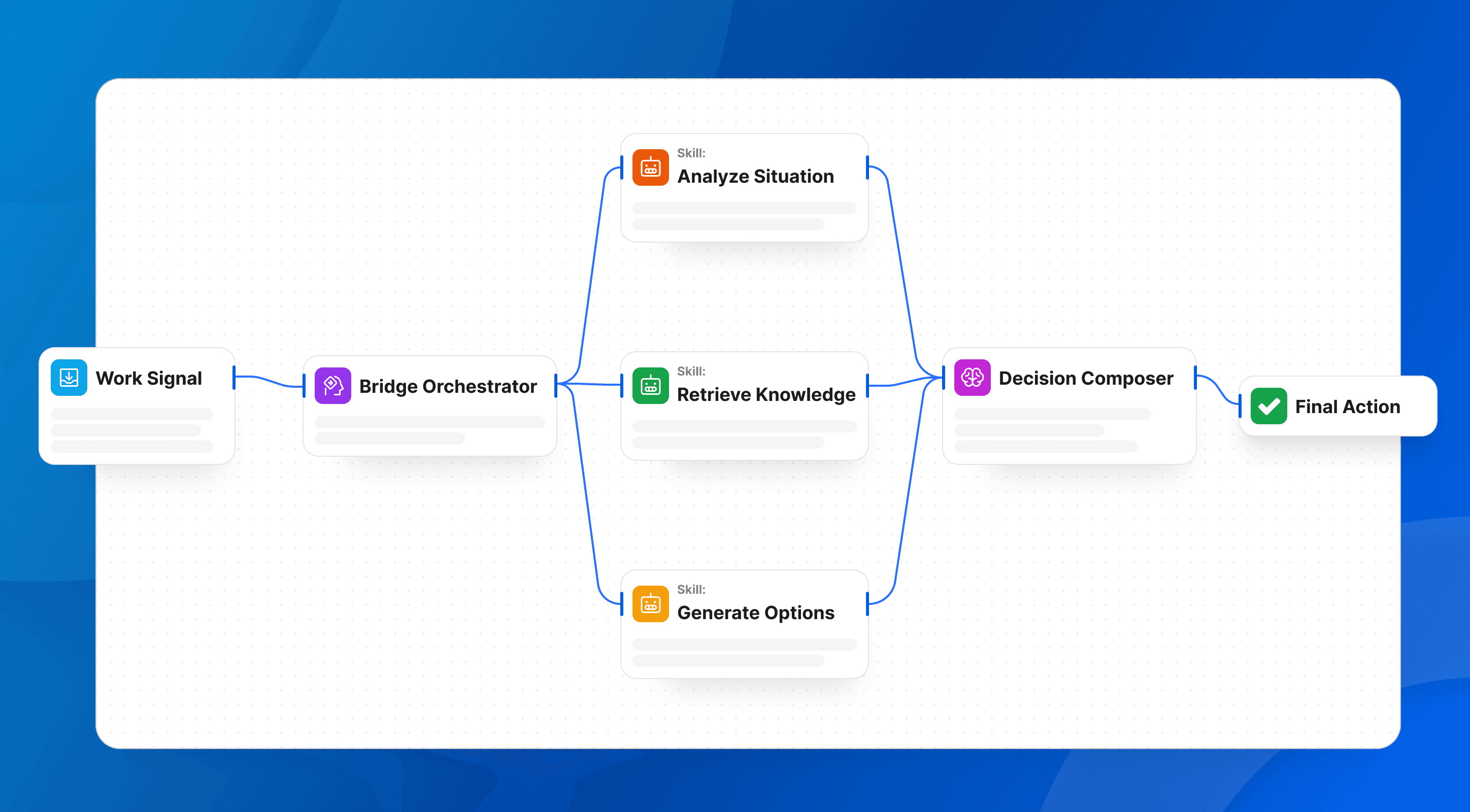
In 2026 workflows, multi-agent collaboration is increasingly common. One agent scaffolds, another writes tests, a third focuses on performance analysis. Platforms like BridgeApp can orchestrate this at the team level by tying prompts and decisions to tasks, chats, and project docs. As requirements change, developers update intent, and AI regenerates or refactors relevant parts of the codebase.
AI Tools and Platforms that Enable Vibecoding
Vibecoding is a pattern, not a single product. It is supported by a growing ecosystem of AI coding tools and platforms. The categories break down as follows:
- IDE-integrated AI coding assistants (inline suggestions, function generation)
- Conversational AI tools (chat-based code generation and explanation)
- Autonomous coding agents (terminal-first agents that execute multi-step tasks)
- Full-stack AI coding platforms with deployment, collaboration, and governance built in
For development teams, the real power comes when coding tools are integrated with planning, documentation, and communication rather than existing in isolation.
AI Coding Assistants and Code Generation
Popular vibe coding tools include GitHub Copilot and Replit, which live inside editors and suggest functions, generate boilerplate, and perform AI assisted code generation based on file context. Cursor and CodeWhisperer are also popular vibe coding platforms that have gained traction for multi-file reasoning. AI tools like ChatGPT can generate code from natural language prompts as well, though typically through a conversational interface.
Code generated by these assistants is a starting point. Developers shape it for style, performance, and security. In 2025–2026, project-wide refactors and multi-file reasoning became key advances that make vibecoding viable for larger codebases. Vibe coding tools automate boilerplate code generation and help reduce barriers for non-engineers to code, but they are most effective when combined with clear team coding standards to control code quality.
Agentic AI Coding: Terminal Agents and Workflow Orchestrators
An AI agent that runs as a terminal or CLI tool represents the most advanced form of vibecoding. These agents read the repository, edit files through diffs, and execute tests and shell commands to complete entire tickets. They embody the "vibe" of a project by following high-level instructions like "fix failing tests" or "add a settings page" and autonomously working toward the goal.
Magic Coder by BridgeApp is one example of an AI coding agent integrated with a team workspace. It inherits project context from BridgeApp tasks and docs, operates in plan mode (proposes changes before executing) or automagic mode (hands-off auto-confirmation), and supports session resume for long-running tasks. These agents are what push vibecoding beyond individual code snippets toward full feature development and large-scale refactors, with minimal human input during execution.
BridgeApp: Unified Workspace for Vibecoding Teams
BridgeApp is an AI-native unified workspace that brings together chats, tasks, documents, databases, and a no-code AI agent builder. This makes it well-suited to facilitate vibe coding for B2B teams who need more than a standalone code editor.
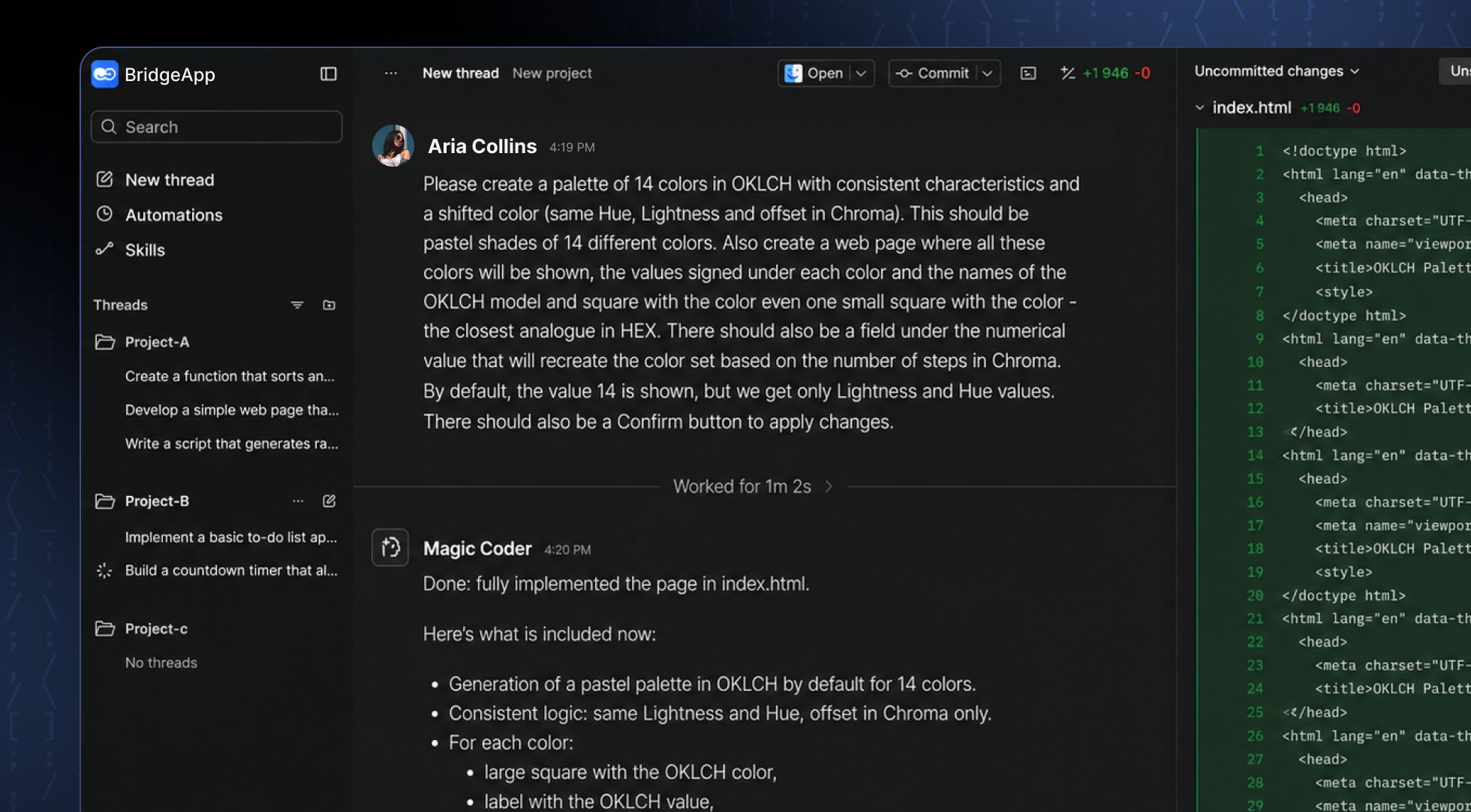
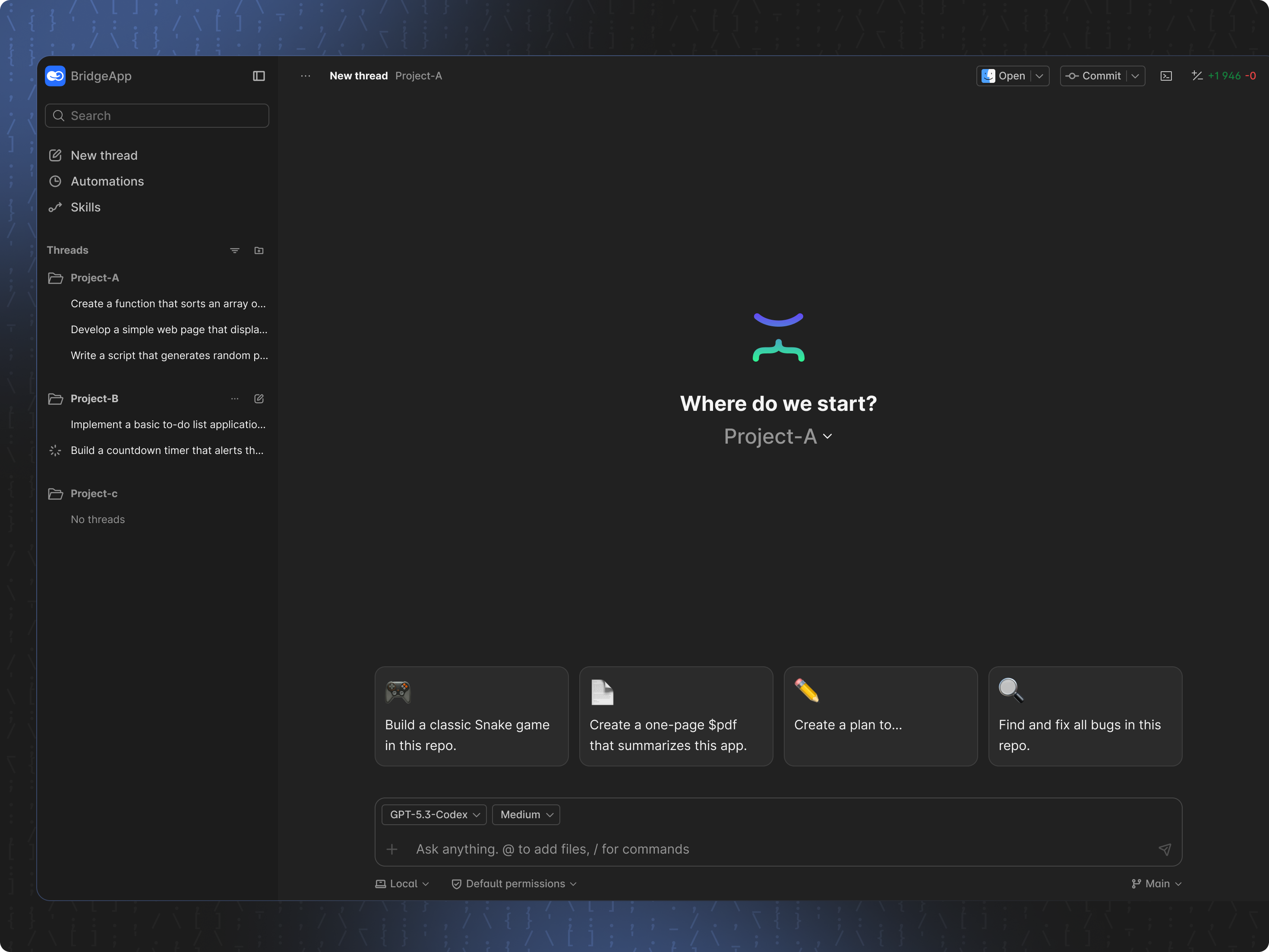
Here's how it fits the vibe coding workflow:
- Discuss requirements in chat, then turn messages into tasks with a click.
- Link tasks to docs and databases that store coding standards, API catalogs, and service inventories.
- Let custom AI agents or Magic Coder act on connected repositories, pulling context from the workspace.
- Configure agents with flows (read a database, update a task, send a message) and knowledge to enable end-to-end automation around coding tasks.
BridgeApp supports access to all major AI models and can run in cloud, private cloud, or on-premise deployments-critical for enterprises evaluating AI coding workflows with strict data governance. Teams can capture feature ideas in channels, let an AI coding agent implement changes, and coordinate code review and deployment within the same platform.
Benefits of Vibecoding for Modern Software Teams
Vibe coding matters because it fundamentally changes how teams allocate their time. The core advantages are speed, lower cognitive load, better exploration, and broader participation in software creation.
From Intent to Prototype in Hours, Not Weeks
Vibe coding allows rapid software prototyping. Teams can go from a written problem statement to a functional prototype in the same day using AI-generated code and iterative prompts. Vibe coding enables near-instant prototyping of applications and allows for quick validation of application concepts.
Consider an internal dashboard for tracking support ticket metrics, or a simple workflow automation tool for the ops team. Previously, these would sit in a backlog for weeks. With vibecoding, a product manager describes the need, an engineer feeds it to an AI agent, and a working version exists by end of day. Vibe coding accelerates development and launch times significantly.
BridgeApp's combination of task boards, chats, and agents lets teams keep each experiment documented, tracked, and reviewable. Shorter cycles also improve stakeholder communication because non-technical participants can see changes in near real time.
Focus on Higher-Order Design and Architecture
As code generation becomes cheaper, the scarce resource shifts to good problem framing, domain modeling, and architecture decisions. Vibe coding allows developers to focus on design and architecture rather than syntax. AI tools can automate boilerplate code, freeing developers for complex tasks like defining resilience patterns, service boundaries, and performance characteristics.
Vibe coding encourages a focus on higher-level design rather than syntax. Organizations that document architectural decisions in shared docs-and use them as AI agent knowledge-keep generated code aligned with standards over time.
Collaboration Across Roles and Time Zones
Vibe coding democratizes the software creation process. Product managers, designers, and data analysts can express desired behavior in natural language directly to tools, giving developers more concrete intent to refine. AI tools in vibe coding help create software without requiring syntax knowledge, which means non-engineers can participate meaningfully under engineer supervision.
Digital artists can use vibe coding for generative art. Operations teams can script their own automations. Vibe coding facilitates the scripting and automation of tasks across roles. Multi-time-zone teams benefit when AI agents can continue refining or testing code during off-hours based on queued tasks. BridgeApp's channels, threads, and agent chats serve as the conversational backbone where decisions and code changes are tied to specific conversations.
Risks, Limitations, and Responsible Use of Vibecoding
Vibecoding, like any powerful tool, introduces real risks. Vibe coding can introduce security vulnerabilities into applications. It can lead to compliance issues if data processing is unmonitored. And developers may lose familiarity with codebases due to rapid vibe coding if guardrails aren't in place.
Treat AI output like code from an untrusted contractor: useful, but always requiring validation.
Combining vibe coding with good DevSecOps practices, automated testing, and code review can dramatically reduce these risks.
Security and Compliance Concerns
Vibe coding can introduce security vulnerabilities in generated code when reviews are skipped. AI-generated code may contain hardcoded credentials and insecure endpoints. Large language models may reproduce insecure patterns from training data and seldom add full security hardening unless explicitly instructed. AI may replicate existing vulnerabilities in codebases during vibe coding as well.
For regulated industries (finance, healthcare, public sector), this means mandatory reviews, on-premise deployment options, and audit trails of code changes. Developers must review AI-generated code for security and quality before anything reaches production. Platforms like BridgeApp, which can run on-premise or in private clouds, appeal to organizations that must keep code and prompts inside their own infrastructure. A workflow where AI generated code always passes through security review, static analysis, and vulnerability scanning is non-negotiable.
Maintainability, Technical Debt, and "Vibe Sprawl"
AI-generated code in vibe coding can lack long-term maintainability. Rapid, unconstrained code generation leads to inconsistent naming, duplicated logic, and modules that no one fully understands. This "vibe sprawl" makes onboarding harder and debugging slower over time. Vibe coding reduces manual effort by automating boilerplate code, but that speed comes with a cost if governance is absent.
Recommended guardrails include:
- Style guides and automated formatters applied equally to human- and AI-authored code
- Test coverage thresholds enforced in CI/CD
- Code review policies that don't exempt AI commits
- Regular "cleanup sprints" to refactor heavily generated areas
BridgeApp's task tracking and change history features help maintain a clear record of when AI agents modified the codebase and why.
Skill Development and Over-Reliance on AI
Vibe coding shifts developers' roles from writing code to guiding AI. This is powerful, but it introduces a risk: vibe coding can lead to loss of understanding of codebases, especially for junior developers who may skip learning fundamentals if they rely too heavily on AI.
Developers using vibe coding need to maintain codebase understanding. Vibecoding can be a strong learning tool when used intentionally. Ask the AI for explanations, alternative implementations, and walkthroughs of complex code. Teams should pair AI usage with code reading exercises, design reviews, and post-mortems to deepen understanding rather than replace it.
Strong programming, debugging, and architectural reasoning remain essential even in a heavily AI assisted coding environment. Coding knowledge doesn't become less valuable; it becomes differently valuable.
Implementing Vibecoding in Your Organization
Adopting vibecoding is less about installing one tool and more about reshaping processes, roles, and guardrails around AI assisted development. B2B teams, from startups to enterprises, can start small with internal tools and prototypes and gradually expand as confidence and governance mature.
Choosing the Right AI Coding Platform and Governance Model
When selecting an AI coding platform, consider these criteria:
| Criterion | What to Evaluate |
|---|---|
| Language/framework support | Does it handle your specific programming languages and tech stack? |
| Multi-file reasoning | Can it refactor across modules, not just single files? |
| Security posture | What data residency, logging, and access controls exist? |
| Deployment model | Cloud, on-premise, hybrid? |
| Cost model | Pay-as-you-go credits, per-seat, or flat rate? |
| Integration depth | Does it connect to your task management, docs, and CI/CD? |
Some organizations prefer unified tools-workspace plus AI agents plus task management-instead of a patchwork of disconnected plugins and chatbots. BridgeApp's pay-as-you-go Compute Credits, per-user billing, and deployment flexibility align with enterprise procurement and compliance needs.
Designing a Vibecoding-Friendly Development Workflow
A recommended end-to-end process looks like this:
- Capture user stories in channels or chats.
- Turn them into detailed intent documents with constraints and acceptance criteria.
- Feed that context to AI agents connected to the repository.
- Review generated code in normal pull request workflows.
- Track changes against tasks for traceability.
BridgeApp can host this entire workflow: product discussions in channels, requirements in documents, tickets in task boards, and AI agents that act on tasks and repositories. Use databases inside BridgeApp to store structured information (service inventory, coding standards, API catalogs) that AI agents reference when they create code.
Define clear roles: who is allowed to run stuff with fully autonomous AI agents in automagic modes versus who must operate in plan-and-approve modes.
Use Cases: Where Vibecoding Shines vs. Where to Be Cautious
Vibe coding is best suited for rapid iteration and trial-and-error processes. High-leverage scenarios include:
- Prototypes and internal dashboards
- Data exploration scripts
- Integrations between existing systems
- Ad-hoc automation for operations teams
- Building a web app for internal use
Vibe coding is best suited for prototypes and early-stage projects. Vibe coding emphasizes rapid prototyping and creative exploration. However, for safety-critical systems, core banking logic, or healthcare decision support, vibecoding should play a more assistive, code review-heavy role where deep technical expertise remains the primary driver.
Start with lower-risk, high-feedback projects. Track metrics like time-to-prototype, bug density in AI-generated components, and review coverage to measure vibecoding impact over time.
FAQ
Is vibecoding just another name for using AI autocomplete in my IDE?
No. While autocomplete is part of the ecosystem, vibe coding differ from simple suggestions in a fundamental way. Vibecoding centers on intent-driven development where AI handles multi-step coding tasks, not just single-line completions. It involves conversational clarification, executable code generation, refactoring, and testing driven by natural language. Autonomous AI agents and unified workspaces like BridgeApp extend vibecoding from "helper suggestions" to "delegating whole tickets under human supervision." Think of Cursor Composer or terminal-based agents rather than tab-completion.
Do I still need to learn programming if I want to use vibecoding effectively?
Yes. Basic coding knowledge remains extremely valuable for understanding logic, debugging, and architecture, even when AI writes the underlying code. Non-technical users can build simple tools via vibecoding, but teams building maintainable, secure systems benefit from experienced engineers guiding and reviewing the AI's work. Treat vibecoding as a way to accelerate learning-asking AI to explain code, patterns, and tradeoffs-rather than a complete substitute for understanding programming languages.
How does vibecoding affect code ownership and accountability?
Regardless of who generated the code-human or AI-the organization and its engineering leaders remain accountable for behavior, security, and compliance. Vibe coding shifts the developer's role from writing to guiding AI, but not from responsibility. Commits from AI agents should always be reviewed by human maintainers and mapped to specific tasks. BridgeApp helps by tying AI actions and discussions to tasks, creating an auditable trail. This enables developers to ship vibe coded features with confidence that decisions are traceable.
Can vibecoding be used safely in regulated industries?
It can, but with stricter guardrails. Organizations in finance, healthcare, and government need on-premise or private-cloud deployments, careful data governance, and mandatory reviews for all AI generated code. Understanding how prompts and code are stored matters. BridgeApp's flexible deployment-including on-premise-and workspace governance features are designed with regulated environments in mind. Vibe coding can lead to compliance issues if data processing is unmonitored, so logging, access controls, and developer talent with domain expertise remain essential.
How do I know if vibecoding is actually improving my team's productivity?
Track concrete metrics: cycle time from idea to merged feature, number of bugs found in AI-generated code vs. human-written code, and time previously spent on repetitive tasks like boilerplate. Run small experiments: some projects with heavy AI involvement, others with traditional coding. Compare outcomes and developer satisfaction. BridgeApp's project and task reporting can correlate AI usage with delivery timelines and incident rates over a few quarters. Vibe coding offers speed, but measuring that speed against code quality and maintenance cost tells the full story.